

Art of Tea vs Premium Competitors: 2026 Guide
Table of Contents
- How Premium Tea Brands Compare: Key Quality Markers
- Best Organic Loose Leaf Tea Brands: What Sets Them Apart
- How to Identify High-Quality Tea Leaves
- Fair Trade Tea Certification Standards Explained
- Brewing Parameters and Flavor Optimization
- Storage, Freshness, and Longevity Across Brands
- Pricing and Value: What You're Actually Paying For
Last Updated: August 26, 2026
How Premium Tea Brands Compare: Key Quality Markers
The difference between commodity tea and excellent tea comes down to specifics: origin, harvest method, leaf integrity, and freshness. Beverly Blend's approach to sourcing and preparation demonstrates what sets premium tea apart.

Whole leaf teas retain more flavor compounds and essential oils than broken pieces or dust. When you open a package of premium loose leaf tea, you should see recognizable leaf structure, not powder. Whole leaves steep evenly and can be re-steeped multiple times, extracting different flavor notes with each infusion.
Origin transparency is critical. Premium brands specify exactly where their tea comes from, down to region or estate. A tea labeled "Ceylon OP from the Nuwara Eliya district" tells you the elevation, harvest season, and processing style. Single-origin teas command higher prices because they're traceable and consistent.
Freshness is non-negotiable. Tea loses flavor and aroma over time once dried and packaged. The best premium brands roast or prepare to order, minimizing the time between production and delivery. Beverly Blend's made-to-order approach ensures you receive tea that hasn't been sitting in warehouse inventory for months.
Fair trade and ethical sourcing practices add another layer of quality assurance. When a brand commits to fair trade certification, it signals that farmers are paid fairly and working conditions meet established benchmarks, which typically correlates with better agricultural practices and superior tea.
| Quality Marker | What It Means | Why It Matters |
|---|---|---|
| Whole leaf | Unbroken, intact tea leaves | Better flavor, multiple steepings, premium appearance |
| Single-origin | Tea from one specific region or estate | Consistent flavor profile, traceability, terroir expression |
| Fair trade certified | Ethical sourcing with verified farmer payments | Better farming practices, sustainable production |
| Made to order | Prepared after purchase, not pre-packaged | Maximum freshness, better aroma and flavor |
| Organic certification | Grown without synthetic pesticides or fertilizers | Cleaner product, environmental responsibility |
Best Organic Loose Leaf Tea Brands: What Sets Them Apart
The organic loose leaf tea market has expanded significantly, but not all organic certifications are equal. Some brands pursue certification as marketing advantage; others build their entire sourcing philosophy around it.
Beverly Blend's organic selections demonstrate how a premium brand approaches the category. Their teas like Jasmine and Masala Chai are sourced from suppliers meeting organic standards, no synthetic pesticides, herbicides, or chemical fertilizers during cultivation. But organic certification alone doesn't explain premium pricing.

The real difference lies in what happens after certification. Premium organic brands invest in hand-picking and selection, small-batch processing, minimal handling to preserve aromatics, and direct relationships with farmers to ensure consistent quality year over year. Many organic brands compete primarily on certification, sourcing certified organic tea from commodity suppliers and repackaging it. These teas are genuinely organic but often broken leaf, aged inventory, or blended from multiple sources for cost efficiency.
Premium organic brands like Beverly Blend compete on quality metrics beyond certification. Their Jasmine tea combines hand-picked green tea with fresh jasmine blossoms paired at the optimal time during production. This specificity, knowing exactly when blossoms are ready and timing the pairing accordingly, separates artisanal production from commodity organic.
Organic certification is now table stakes for premium brands. The actual competition happens on flavor profile consistency, freshness, origin transparency, and production methods.
How to Identify High-Quality Tea Leaves
Before you buy, know what you're looking for. High-quality loose leaf tea has specific visual and sensory characteristics that separate it from lower grades.
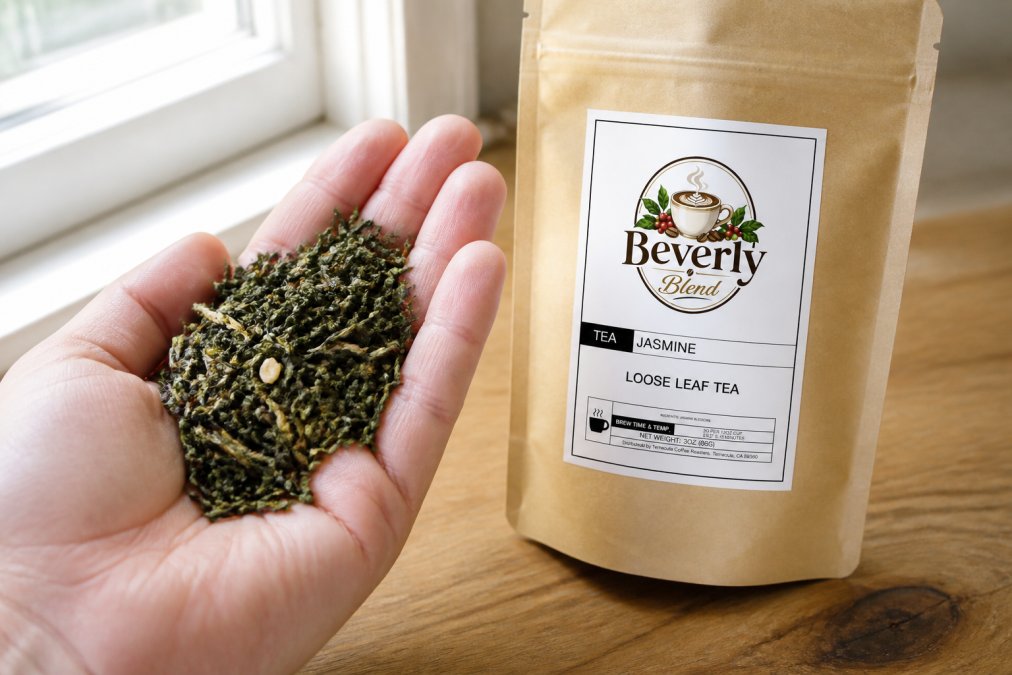
Appearance and structure: Premium loose leaf tea shows recognizable leaf fragments, not dust or powder. For green teas, you should see intact leaves with visible veining. For black teas, the leaves should appear twisted or rolled with a dark, glossy appearance. Broken pieces and fine particles indicate lower grade or older inventory.
Color consistency: High-quality tea has uniform color throughout the batch. Discoloration, browning, or pale patches suggest oxidation, age, or inconsistent processing. A premium green tea should be vibrant green; a premium black tea should be dark and lustrous.
Aroma: Open a package of premium loose leaf tea and you should detect a strong, complex aroma. The smell should be fresh and inviting, not musty, stale, or chemical.
Leaf size and uniformity: Premium brands sort their tea to remove fannings and dust. When you pour loose leaf tea into your infuser, the pieces should be relatively uniform in size, ensuring even steeping and consistent flavor extraction.
Visible botanicals: If the tea includes added botanicals like jasmine blossoms or cornflowers, these should be visible and intact. Beverly Blend's Earl Grey includes blue cornflowers visible in the blend. If you can't see added ingredients, they're either in negligible quantities or pre-ground into powder form.
Feel: Run your fingers through loose leaf tea. Premium tea should feel dry and crisp, not oily or damp. The leaves should break cleanly when bent, not crumble into powder.
When comparing premium competitors, examine samples side by side. The visual difference between premium whole-leaf tea and commodity broken-leaf tea is stark.
Fair Trade Tea Certification Standards Explained
Fair trade certification in the tea industry ensures farmers and workers are paid fairly and work under safe conditions. Understanding what the certification guarantees helps you evaluate whether a brand's fair trade claims are meaningful.
Fair trade certification standards are governed by organizations like Fair Trade USA and Fair Trade International. These organizations set baseline requirements: minimum price guarantees above commodity market rates, direct relationships between buyers and farmer organizations, worker protections covering wages and working hours, environmental sustainability benchmarks, and community investment from fair trade premiums.
The certification is verified through independent audits. A brand claiming fair trade certification should provide documentation of their supply chain.
Fair trade certification doesn't guarantee superior flavor or quality. A tea can be fair trade certified and still be broken leaf or aged inventory. However, the relationship between fair trade practices and tea quality is indirect but real. Farmers paid fairly can invest in better agricultural practices, long-term relationships incentivize consistent quality, and fair trade premiums allow farmers to experiment with specialty processing methods that produce higher-grade teas.
When comparing premium competitors, fair trade certification signals ethical sourcing and commitment to quality. It's not a guarantee of taste, but it's correlated with production practices that tend to yield better results.
Brewing Parameters and Flavor Optimization
The quality of the tea you buy means nothing if you brew it wrong. Premium loose leaf tea requires specific brewing parameters to extract its best flavors.
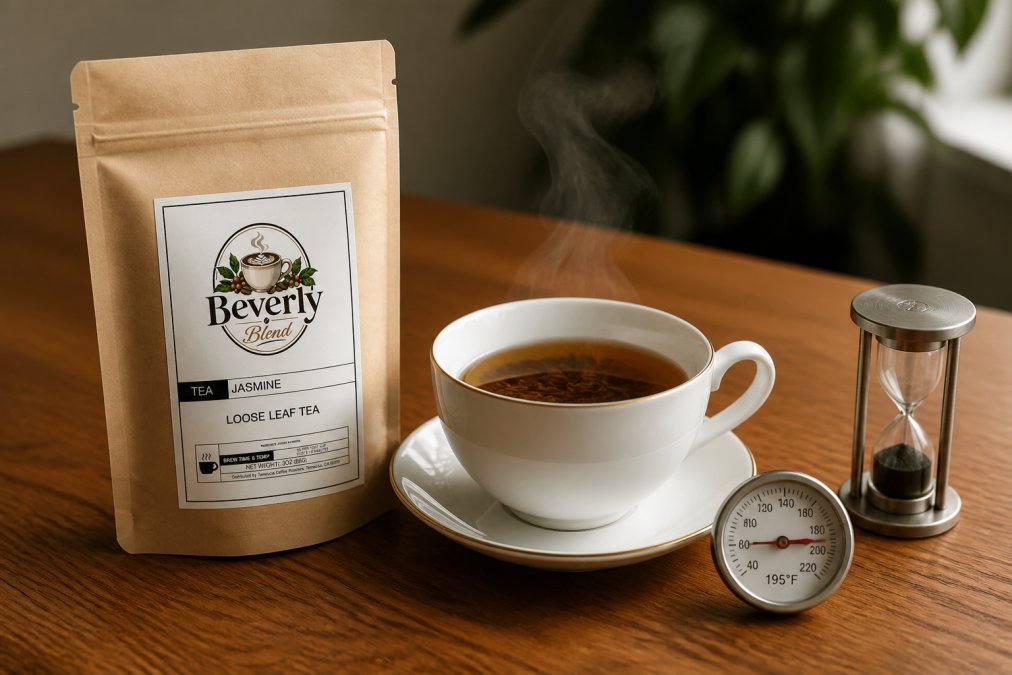
Water temperature: Different tea types require different temperatures. Black teas like Beverly Blend's English Breakfast and Masala Chai steep best at 195-205°F (peer-reviewed research). Green teas and delicate whites need cooler water, around 160-180°F, because hotter water extracts bitter compounds from young leaves (peer-reviewed research). Using the wrong temperature is the single biggest reason premium teas taste disappointing.

Steeping time: Premium loose leaf teas are designed to be steeped longer than broken-leaf teas because whole leaves release flavor more slowly. A typical steeping time for premium black tea is 5-10 minutes; green teas typically steep 3-5 minutes. The beauty of whole leaf tea is that it can be re-steeped multiple times, with each infusion revealing different flavor notes.
Leaf-to-water ratio: A common guideline is one teaspoon per 8 ounces of water, but premium loose leaf tea is denser than broken leaf, so you may need slightly less. Start with this ratio and adjust based on your taste preference.
Water quality: The mineral content in your water affects extraction. Hard water can mute delicate flavors. Soft or filtered water typically produces better results with premium teas.
Vessel choice: Glass and ceramic are neutral. Metal infusers can impart subtle metallic notes. Mesh infusers should be fine enough to contain broken particles but loose enough to allow full leaf expansion.
Storage, Freshness, and Longevity Across Brands
Once you've invested in premium loose leaf tea, how you store it determines whether it stays excellent or degrades into something flat and stale.
Tea degrades through oxidation and moisture absorption. Exposure to air, light, heat, and humidity all accelerate this process. Tea should be kept in an airtight container, away from light, heat, and strong odors. Opaque glass jars with airtight seals work well. Store in a cool, dark place, not above the stove or near a window.
Premium loose leaf tea, when stored properly, stays fresh for 6-12 months (peer-reviewed research). Some teas, like aged pu-erh, actually improve with age, but most teas are best consumed within a year of production.
Brands like Beverly Blend that prepare tea to order have a significant freshness advantage over brands that pre-package inventory. A tea prepared last week is fresher than one prepared months ago, regardless of storage conditions. Ask how long a brand's tea has been in inventory before shipping. A brand that can tell you "our teas ship within 48 hours of roasting" is making a specific, verifiable claim.
Some teas are harvest-specific. Premium brands often specify harvest season. If you're buying a tea that's out of season, you're likely buying aged inventory or a blend designed to approximate that season's flavor.
A premium tea that stays fresh for 12 months is better value than commodity tea that tastes stale after 3 months. When you factor in cost per cup over the tea's usable lifespan, premium loose leaf tea often costs less per serving than it appears upfront.
Pricing and Value: What You're Actually Paying For
Premium loose leaf tea costs more than grocery store tea. Understanding what drives that price difference helps you evaluate whether a brand's pricing is justified.
A typical premium loose leaf tea from Beverly Blend costs around $20.99 per package, with specialty options like Matcha at $22.99. The price gap becomes justified when you understand what goes into premium tea: direct sourcing ensuring consistency and quality control, whole leaf processing requiring labor and equipment, made-to-order freshness with flexible inventory management, traceability and certification adding cost, smaller batch sizes with higher per-unit costs, and direct-to-consumer delivery.
A $20.99 package of premium loose leaf tea typically yields 20-30 cups, depending on leaf amount and re-steeping. That's roughly $0.70-$1.00 per cup. When you factor in the ability to re-steep premium loose leaf tea multiple times, the cost per infusion drops to $0.25-$0.40. At that point, premium loose leaf tea is competitive with or cheaper than commodity tea bags.
Compare Beverly Blend's pricing against competitors by checking: Are they transparent about inventory age? Do they offer re-steeping guidance? Can they trace tea to specific regions or estates? Do they offer variety?
Premium pricing is justified when it reflects actual quality differences: whole leaf vs. broken leaf, fresh vs. aged, direct sourcing vs. commodity blending, and transparent vs. vague sourcing practices.
Choosing between premium tea brands comes down to evaluating quality markers you can verify: leaf integrity, origin transparency, freshness, and ethical sourcing. Beverly Blend demonstrates these commitments across its lineup, from hand-picked green tea paired with jasmine blossoms in their Jasmine blend to the bold character of their Masala Chai. When comparing premium competitors, look beyond marketing claims and examine the specifics: Where does the tea come from? How fresh is it when it arrives? Can you see whole leaves, or is it broken pieces? Start with Beverly Blend's curated selection and experience the difference that direct sourcing, made-to-order freshness, and transparent quality standards actually make in your cup.
Frequently Asked Questions
What makes a premium tea brand different from mass-market options?
Premium tea brands prioritize whole leaf and loose leaf formats over dust or fannings, source from specific origins with transparency, use ethical and fair trade practices, and control their own blending and roasting. They invest in hand-picked harvests, smaller batch processing, and often provide detailed flavor profiles and brewing guidance. Quality brands like Beverly Blend blend to order, ensuring maximum freshness and aroma compared to shelf-aged alternatives.
How do I know if a tea brand has legitimate fair trade tea certification standards?
Look for third-party certifications from Fair Trade USA or similar organizations displayed on packaging or websites. Legitimate fair trade tea certification standards ensure farmers receive fair wages, work in safe conditions, and maintain sustainable practices. Premium brands publish their sourcing information and certification details transparently. Ask brands directly about their certification, reputable companies readily share documentation and supply chain transparency.
Why does premium tea cost more than grocery store tea?
Premium tea costs reflect whole leaf quality, single-origin sourcing, ethical labor practices, and freshness guarantees. Loose leaf tea requires more careful harvesting and processing than mass-produced tea bags. Blended-to-order models like Beverly Blend eliminate inventory aging, preserving flavor and aroma. You're paying for superior tasting notes, multiple steepings per serving, and the assurance of origin transparency and fair trade practices.
What's the difference between loose leaf and pyramid sachets in terms of quality?
Loose leaf tea typically offers better quality because whole leaves unfurl fully during steeping, extracting more flavor and complexity. Pyramid sachets allow better water circulation than traditional tea bags, making them a middle-ground option. However, the tea grade matters most, premium loose leaf whole leaf tea outperforms lower-grade tea in sachets. Beverly Blend's loose leaf offerings maximize infusion and flavor profile depth compared to conventional tea bag alternatives.
This article was written using GrandRanker