

Best Alternatives to Mass Produced Tea Bags
Table of Contents
- What Are Plastic-Free Tea Bags and Why They Matter
- The Benefits of Loose Leaf Tea Over Mass Produced Bags
- Materials Used in Eco-Friendly Tea Bags and Reusable Options
- How to Brew Loose Leaf Tea Without an Infuser
- Reusable Stainless Steel Tea Infusers and Other Tools
- Cost-Per-Cup Analysis: Loose Leaf vs. Mass Produced Bags
- Taste Profile Comparison: Why Loose Leaf Wins
- Conclusion
- Frequently Asked Questions
Last Updated: September 16, 2026
What Are Plastic-Free Tea Bags and Why They Matter
Plastic-free tea bags are sachets made entirely from plant-based or inert materials, with no polypropylene seal or synthetic mesh woven into the paper. That distinction matters because the conveniences of a conventional bag, its shape, its seal, its ability to hold fine dust, are often built on plastic. Many businesses find that switching to loose leaf or a plastic-free option is less about virtue signaling and more about what ends up in the cup.
At Beverly Blend, we sell loose leaf tea, so we have an obvious bias here. We will flag it and move on.
Here is the part most guides get wrong: they frame this as a waste problem. It is also a materials problem. A growing body of reporting on microplastics in food and drink has pushed consumers to look harder at what their brewing method contributes. The National Institutes of Health research on microplastics is a reasonable starting point for understanding how these particles enter the body.
So why does a steeped bag release anything at all? Heat and time. A bag sitting in near-boiling water for several minutes is under conditions that encourage chemical leaching from synthetic fibers. If your goal is a cleaner cup, the material of the bag is the first variable to control, not the last.
The Benefits of Loose Leaf Tea Over Mass Produced Bags
The benefits of loose leaf tea start with what is in the tin: whole leaves rather than fannings and dust swept up for industrial packing. Whole leaves steep differently. They expand, they release flavor in layers, and they hold up to a second or third pour.
There is a practical angle too. Mass-produced bags are engineered for consistency and shelf life, which usually means smaller particles and a sealed sachet. Loose leaf skips both compromises. You control the leaf-to-water ratio, the steeping time, and the temperature, so the same tin can produce a delicate first cup and a bolder second one.
A common mistake is treating loose leaf as fussy. In practice, it is one extra step: measure, steep, strain. The payoff is a brewing method you can tune instead of one you accept as-is.
Materials Used in Eco-Friendly Tea Bags and Reusable Options
Eco-friendly tea bags fall into a few material families, and the labels are not always honest. Here is what the common terms actually mean:
- Paper and wood pulp: The traditional base. Unbleached versions avoid chlorine processing. Watch for a plastic heat-sealed edge, which many "paper" bags still use.
- Abaca fiber: A plant fiber from the banana family, strong enough to form a bag without a synthetic binder.
- Soilon: A mesh made from polylactic acid (PLA), a bioplastic derived from plant starch. It is compostable under industrial conditions, not necessarily in a backyard bin.
- PLA and bioplastic blends: Plant-derived, but "biodegradable" on the box does not always mean it breaks down in your home compost.
This is the distinction most shoppers miss: compostable and industrially compostable are not the same claim. A bag certified for industrial composting needs the sustained heat of a commercial facility. Drop it in a backyard pile and it may sit there for years.
How to Brew Loose Leaf Tea Without an Infuser
You do not need special equipment to brew loose leaf tea. A mug, a fine-mesh kitchen strainer, and a spoon will do it. The method is the same whether you are using a dedicated tea strainer or the sieve already in your kitchen drawer.
Here is the sequence that works:
- Heat water to the temperature the tea calls for. Black tea wants water near boiling; green tea wants it cooler.
- Add roughly one teaspoon of leaves per cup, more for a large mug.
- Pour the water over the leaves and start timing.
- Steep for the recommended window, then pour through the strainer into a second mug.
- Compost or discard the spent leaves.
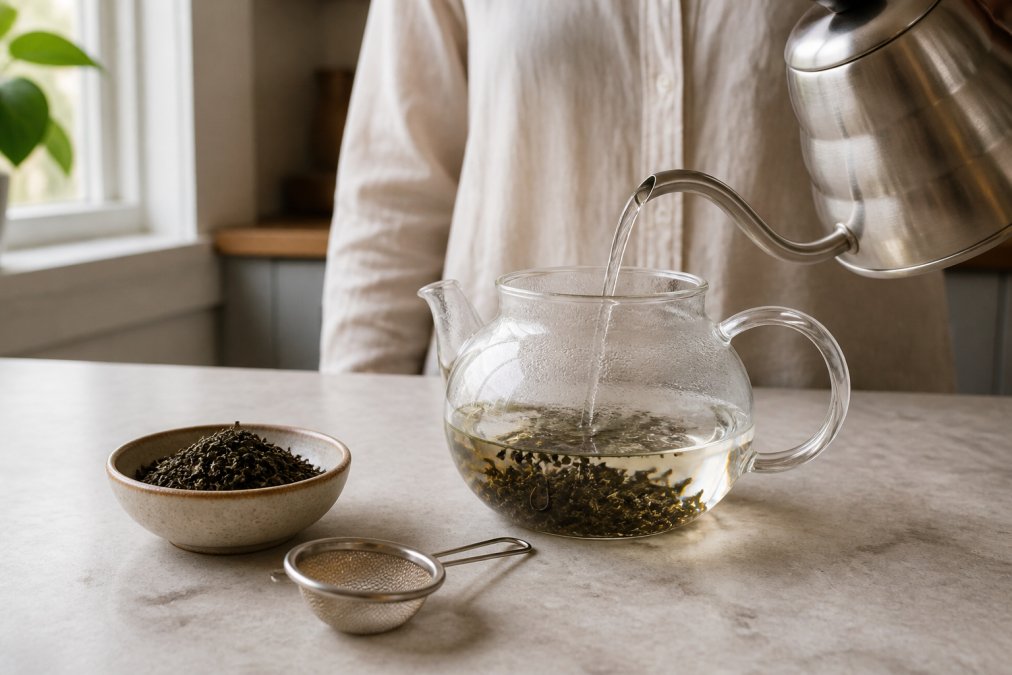
The trick is the second mug.
Reusable Stainless Steel Tea Infusers and Other Tools
Reusable stainless steel tea infusers solve the transfer problem by holding the leaves in the cup while you drink. They come in a few shapes, and the shape matters more than the brand.
- Basket infusers: Wide and deep, so leaves have room to expand. Best for whole-leaf teas that need space.
- Ball infusers: Compact and portable. The trade-off is less room, so leaves steep unevenly.
- Silicone and mesh strainers: Flexible and easy to rinse. Check that the mesh is fine enough for smaller leaf grades.
Cost-Per-Cup Analysis: Loose Leaf vs. Mass Produced Bags
Cost per cup is where loose leaf quietly wins, and the math is simple enough to do on a napkin. Measure the price of the tin, divide by the number of cups it makes, and compare that to the price of a box of bags divided by its count.
| Option | Format | Cost Basis | Reuse | Waste Per Cup |
|---|---|---|---|---|
| Mass-produced bags | Sealed sachet | Per box | Single use | Bag plus packaging |
| Plastic-free bags | Plant-based sachet | Per box | Single use | Bag plus packaging |
| Loose leaf plus strainer | Loose leaves | Per tin | Strainer reused | Spent leaves only |
| Reusable infuser | Loose leaves | Per tin plus tool | Infuser reused | Spent leaves only |
Taste Profile Comparison: Why Loose Leaf Wins
Whole leaves taste different from dust, and the reason is surface area. Smaller particles release their compounds faster, which is why a bag can turn bitter in under three minutes. Whole leaves release more slowly and more completely, so the cup has room to develop.
Conclusion
The switch away from mass-produced bags is really a switch toward controlling your own cup, and that control is the whole point. If you want loose leaf that rewards a second steep, Beverly Blend offers a range built for exactly that: a medium-bodied Jasmine that holds up across multiple pourings, a bold Masala Chai that stands up to milk, and a naturally caffeine-free Apple Cider Rooibos for evenings.

Frequently Asked Questions
Which tea companies don't use plastic in their bags?
Many artisan tea brands now offer plastic-free options, but you need to check the seal. Look for bags that are heat-sealed with plant-based materials like polylactic acid (PLA) or simply stitched, rather than glued with polypropylene. Beverly Blend avoids the issue entirely by offering loose leaf tea, which uses no bag at all. Their Jasmine, English Breakfast, and Earl Grey blends are all loose leaf and come in recyclable packaging.
What can I use instead of tea bags?
You have several alternatives. A reusable stainless steel tea infuser is the most common swap and works with any loose leaf tea. You can also use a teapot with a built-in strainer, a French press, or simply steep leaves directly in your cup and strain them out. For a zero-waste approach, try a gaiwan or a traditional tea strainer. Beverly Blend's loose leaf teas, like Masala Chai and Moroccan Mint, are ideal for these methods and give you full control over strength.
What are the healthiest tea bags to use?
The healthiest option is no bag at all: loose leaf tea. When you do use bags, choose ones made from unbleached paper, cotton, or silk, and avoid nylon or plastic mesh that can shed microplastics into hot water. Also look for bags that are not heat-sealed with polypropylene. Loose leaf tea from brands like Beverly Blend eliminates these concerns because the leaves steep freely and you strain them out, so you avoid synthetic fibers and chemical leaching entirely.
Are paper tea bags better than nylon or plastic mesh bags?
Yes, paper bags are generally better. Nylon and plastic mesh bags are made from synthetic fibers that can release microplastics when steeped in hot water. Paper bags, especially unbleached ones, are biodegradable and compostable. However, some paper bags are sealed with a thin plastic layer, so check for heat-sealed edges. For the cleanest cup, loose leaf tea in a reusable stainless steel infuser is the best choice.
How do I clean and maintain a reusable tea infuser?
Rinse your stainless steel infuser immediately after use with warm water to prevent tannin buildup. For a deeper clean, soak it in a mixture of baking soda and warm water for 10 minutes, then scrub gently with a soft brush. Avoid dishwashers if your infuser has a fine mesh, as high heat can warp it. Dry it completely before storing to prevent rust. With proper care, a quality infuser lasts for years, saving you money and reducing waste.