

Best Temperature for Loose Leaf Green Tea
Table of Contents
- Why Water Temperature Matters for Green Tea
- General Temperature Guidelines for Green Tea
- How Long to Steep Green Tea
- How to Measure Water Temperature for Tea
- What Causes Bitter Green Tea
- Temperature Ranges for Specific Green Tea Varieties
- Common Brewing Mistakes to Avoid
- The Role of Water Quality in Brewing
- Frequently Asked Questions
Last Updated: September 21, 2026
Why Water Temperature Matters for Green Tea
Understanding the best temperature for loose leaf green tea is critical for brewing. Heat it too much and you'll extract harsh tannins and astringency; too cool and the tea won't steep properly, leaving weak, grassy notes instead of smooth, complex flavor.
Most people boil water for everything, but with green tea, hotter water extracts harsh tannins before the best flavors, umami, sweetness, floral notes, emerge. Temperature control is the foundation of good brewing.
A few degrees matter: the difference between 160°F and 180°F can mean the difference between a tea you love and one you never order again.
General Temperature Guidelines for Green Tea
The best temperature for loose leaf green tea falls between 160°F and 180°F (70°C to 82°C) for most varieties. This range prevents thermal shock to the delicate leaves while allowing proper extraction of flavor compounds and beneficial catechins.
Start at 160-170°F if you're new to green tea, it's harder to over-steep and produces clean, bright flavors without bitterness.
For a stronger cup, move toward 170-180°F, but watch steeping time, stronger means hotter water, not longer brewing.
Japanese vs. Chinese Green Tea Brewing Differences
Japanese green teas like sencha and gyokuro are steamed, making the leaves more delicate and prone to bitterness if over-extracted.
Japanese green teas brew best at 160-170°F (70-76°C); steam-processing creates tender leaves that release flavor quickly, so excess heat causes astringency.
Chinese green teas like longjing are pan-fired, creating tougher leaves that can handle 170-180°F (76-82°C) without as much risk of bitterness.
How Long to Steep Green Tea
Steeping time ranges from 2 to 4 minutes depending on leaf size and temperature: smaller leaves steep faster, larger rolled leaves need more time.
At 160-170°F, aim for 3 to 4 minutes; lower temperature slows infusion, requiring extra time for proper extraction.
At 170-180°F, reduce steeping to 2 to 3 minutes; higher heat speeds extraction, so excess time develops bitterness quickly.
Start at 3 minutes, taste, then adjust: add 30 seconds if weak, or drop temperature/reduce steeping by 30 seconds if bitter.
Loose leaf tea can be re-steeped multiple times: leave leaves in the vessel and brew again after a few minutes, adding 30-45 seconds to each subsequent steep.
How to Measure Water Temperature for Tea
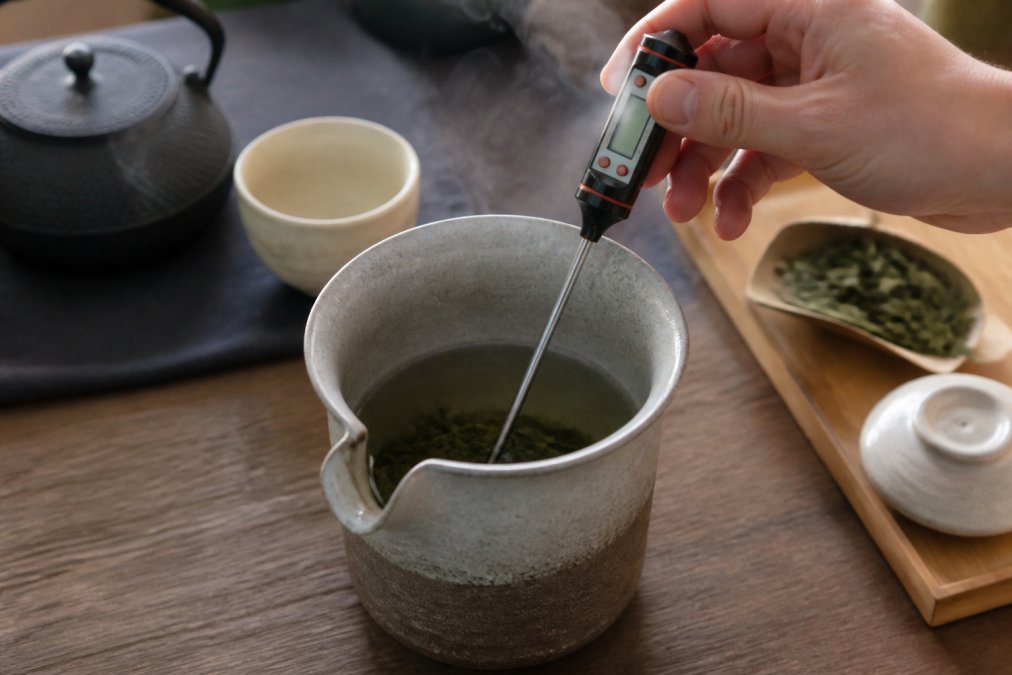
A digital thermometer is the most reliable tool for precision brewing. Kitchen thermometers cost $10-$25 and eliminate guesswork. Heat water to target temperature, pour into your brewing vessel, and check with the thermometer.
Visual Cues and Bubble Stages Without a Thermometer
Without a thermometer, observe bubble formation as water cools to estimate temperature.
Bubble stage guide (after boiling):
- Shrimp eyes (150-160°F): Tiny bubbles form at the bottom of the vessel and rise slowly to the surface, resembling shrimp eyes. This is the ideal range for premium Japanese teas like gyokuro.
- Crab eyes (160-170°F): Bubbles are slightly larger and rise more steadily, like crab eyes. This is the sweet spot for most Japanese green teas, including sencha.
- Fish eyes (170-180°F): Medium-sized bubbles rise continuously from the bottom. This range suits Chinese green teas and stronger Japanese varieties.
- String of pearls (180-190°F): Larger bubbles form a continuous stream. Suitable for some oolong and white teas, but too hot for most green teas.
- Rolling boil (212°F): Vigorous, continuous bubbling with heavy steam. Avoid this for green tea.
This method is accurate with practice; watch the bubble formation pattern, not just boiling speed.
Practical Cooling Techniques
Speed up cooling with these methods:
Pour-between-vessels: Pour boiled water back and forth between two ceramic or glass vessels 2-3 times. Each pour cools water by roughly 10-15°F, reaching 160-180°F in under a minute.
Lid-off method: Remove the lid immediately after boiling to allow steam to escape. Most water cools from boiling to 170°F in 2-3 minutes.
Pre-chilled vessel: Fill your brewing vessel with cool water while heating. Empty it just before pouring hot water in; the cooler ceramic absorbs heat, lowering final temperature by 5-10°F.
Ice-cube method: Add one small ice cube to lower temperature by a few degrees without significant dilution.
Sound and Steam as Temperature Cues
Water cooling from a boil makes progressively less noise. A gentle simmer indicates 180-190°F; nearly silent water with barely visible steam indicates 160-170°F. Many experienced brewers use sound as their primary cue.
Combine visual, auditory, and tactile observation: watch bubbles, listen to water, and hold your hand 6 inches above the vessel, gentle warmth indicates 160-180°F.
What Causes Bitter Green Tea
Bitterness comes from over-extraction: too-hot water or long steeping releases excessive tannins and astringency, creating a harsh, mouth-puckering sensation.
Temperature is usually the culprit: most people brew at 190°F or hotter, which is too hot and releases bitterness before best flavors emerge.
Steeping time matters too: leaving leaves in for 6 minutes or longer turns sweet tea sour, as extraction continues throughout contact.
Hard water with high mineral content can amplify bitterness. Use filtered or spring water instead of chalky, mineral-heavy tap water.
Broken or dusty leaves extract faster and taste bitter even at lower temperatures. Whole loose leaf tea steeps more evenly and releases flavor gradually.
Temperature Ranges for Specific Green Tea Varieties
Different green tea varieties have slightly different optimal temperatures based on processing, leaf structure, and delicacy. Leaf grade and altitude also influence ideal brewing temperature.
Sencha, Gyokuro, and Longjing Brewing
Sencha (Japanese green tea) brews best at 160-170°F (70-76°C) for 2-3 minutes. Steamed leaves are tender; too much heat brings out bitterness. First-flush sencha is more delicate and benefits from the lower end of this range.
Gyokuro (premium Japanese shade-grown tea) is the most delicate green tea. Brew at 150-160°F (65-70°C) for 2-3 minutes. Even a 5°F increase shifts the flavor profile noticeably.
Longjing (Chinese green tea, also called Dragon Well) can handle 170-180°F (76-82°C) for 2-4 minutes. Pan-fired leaves are more resilient to heat. Premium grades benefit from the lower end of this range to preserve delicate floral notes.
How Leaf Grade Affects Temperature Sensitivity
Leaf grade, the size and intactness of the leaves, significantly impacts how quickly tea extracts and how sensitive it is to temperature.
Whole-leaf grades (the largest, most intact leaves) extract slowly and evenly. They can tolerate the full recommended temperature range without risk of over-extraction. A whole-leaf sencha at 170°F will taste clean; a broken-leaf sencha at the same temperature may taste bitter.
Broken-leaf or fannings (smaller leaf fragments) extract much faster because they have more surface area exposed to water. These grades require 5-10°F lower temperatures than whole-leaf versions of the same tea. If a whole-leaf sencha brews at 165°F, a broken-leaf sencha of the same origin should brew at 155-160°F to avoid astringency.
Dust or powder (the finest particles, common in lower-grade tea bags) extracts almost instantly. These require the lowest temperatures in the green tea range (150-160°F) and the shortest steeping times (1-2 minutes). Brewing dust at standard temperatures will produce harsh, over-extracted tea.
When you switch from whole-leaf to broken-leaf tea, reduce your steeping time by 30-60 seconds or lower the water temperature by 5°F. This adjustment prevents bitterness and preserves the intended flavor profile.
Altitude and Boiling Point Adjustments
Water boils at lower temperatures at higher altitudes because atmospheric pressure is lower (Facts About Water). This is a critical factor most brewing guides ignore, yet it directly affects extraction.
At sea level: Water boils at 212°F. Your target 160-180°F range is straightforward to achieve.
At 3,000 feet elevation: Water boils at approximately 207°F. To reach 160°F, you need to cool water slightly less than at sea level, roughly 2-3 minutes instead of 3-5 minutes.
At 5,000 feet elevation: Water boils at approximately 202°F. The difference becomes noticeable. Your "boiling" water is already 10°F cooler than at sea level, which means you may need to use slightly hotter water (closer to the boil) to hit your target temperature range.
At 7,000 feet elevation or higher: Water boils at approximately 198°F or lower. At this altitude, the gap between boiling and your ideal brewing temperature (160-180°F) narrows significantly. You have less margin for error.
Variety-Grade-Altitude Summary
The best temperature for your specific tea depends on three factors:
- Variety and processing (steamed vs. pan-fired): Sets the baseline range (150-180°F).
- Leaf grade (whole vs. broken vs. dust): Adjusts temperature down 5-10°F for smaller particles.
- Your altitude: Affects how quickly water cools and how much precision you can achieve.
Common Brewing Mistakes to Avoid
Using boiling water. This is the #1 mistake. Boiling water (212°F) scalds green tea leaves. Your cup will taste bitter and harsh. Let water cool before brewing.
The Role of Water Quality in Brewing
Water makes up 99% of your cup. Its quality matters as much as the tea itself.
Frequently Asked Questions
What is the ideal temperature range for delicate green teas?
Delicate green teas like Gyokuro and high-grade Sencha brew best between 130-150°F (54-65°C). Water hotter than 160°F (71°C) can cause thermal shock to delicate leaves, damaging cell structure and releasing excessive tannins that create harsh, astringent flavors. Using cooler water preserves the tea's subtle umami notes and grassy character.
Can you steep loose leaf green tea too long?
Yes. Steeping green tea beyond 3-4 minutes typically causes over-extraction, which pulls too many tannins and catechins into the water, creating bitterness and astringency. Most green teas steep optimally for 1-3 minutes depending on leaf grade and water temperature. Finer leaves at lower temperatures need less time; coarser leaves at slightly warmer temperatures can handle a bit longer.
Why does green tea taste bitter if the water is too hot?
Hot water accelerates extraction, pulling tannins and catechins from the leaves too quickly. These compounds create astringency and bitterness when concentrated. Water above 170°F (77°C) can extract these compounds in under 30 seconds. Cooler water (140-160°F / 60-71°C) extracts flavor compounds more slowly, allowing the delicate, sweet, and umami notes to come through before bitterness develops.
How does water quality affect the taste of green tea?
Filtered or spring water produces cleaner, brighter flavor profiles because it contains fewer minerals and chlorine that can mask delicate notes. Hard water (high mineral content) can dull the tea's flavor and create a cloudy infusion. Tap water with chlorine often imparts off-flavors. For premium loose leaf green tea, filtered water at the correct temperature brings out the full range of flavor, from grassy notes to subtle sweetness and umami depth.