

French Press vs AeroPress: Which Brew Wins in 2026?
Table of Contents
- French Press vs AeroPress: Quick Comparison Table
- How They Work: Immersion Brewing vs Pressure-Based Extraction
- French Press vs AeroPress Taste Profile: Body, Clarity, and Sediment
- Best Coffee Grind Size for French Press (and Why AeroPress Differs)
- Brew Time, Capacity, and Daily Convenience
- How to Clean an AeroPress (and the French Press Cleanup Routine)
- Cost Per Cup, Environmental Impact, and Travel Use Cases
- Which Brewer Should You Buy? Decision Framework by Lifestyle
- Frequently Asked Questions
Last Updated: October 2, 2026
French Press vs AeroPress: Quick Comparison Table
The french press vs aeropress comparison comes down to one trade-off: the French press gives you full-bodied coffee with minimal effort, while the AeroPress delivers a cleaner, more concentrated cup in less time.
The French press steeps coarse grounds for about four minutes; the AeroPress pushes hot water through a paper filter using air pressure in roughly 90 seconds.
| Feature | French Press | AeroPress |
|---|---|---|
| Brew method | Immersion | Pressure-based extraction |
| Typical brew time | 4 minutes | 90 seconds |
| Filter | Metal mesh | Paper |
| Cup profile | Heavy body, some sediment | Clean, concentrated |
| Grind size | Coarse | Medium-fine |
| Capacity | 3-4 cups | 1-2 cups |
| Portability | Glass, fragile | Plastic, durable |
| Cleanup | Rinse and scoop | Rinse and pop the puck |
Want a rich, oily cup to sip slowly? Go French press. Want espresso-style concentration and speed? The AeroPress wins.
How They Work: Immersion Brewing vs Pressure-Based Extraction
Immersion brewing means the grounds sit in hot water for the full brew time. The French press uses this method: add coarse grounds, pour hot water, wait four minutes, then press.
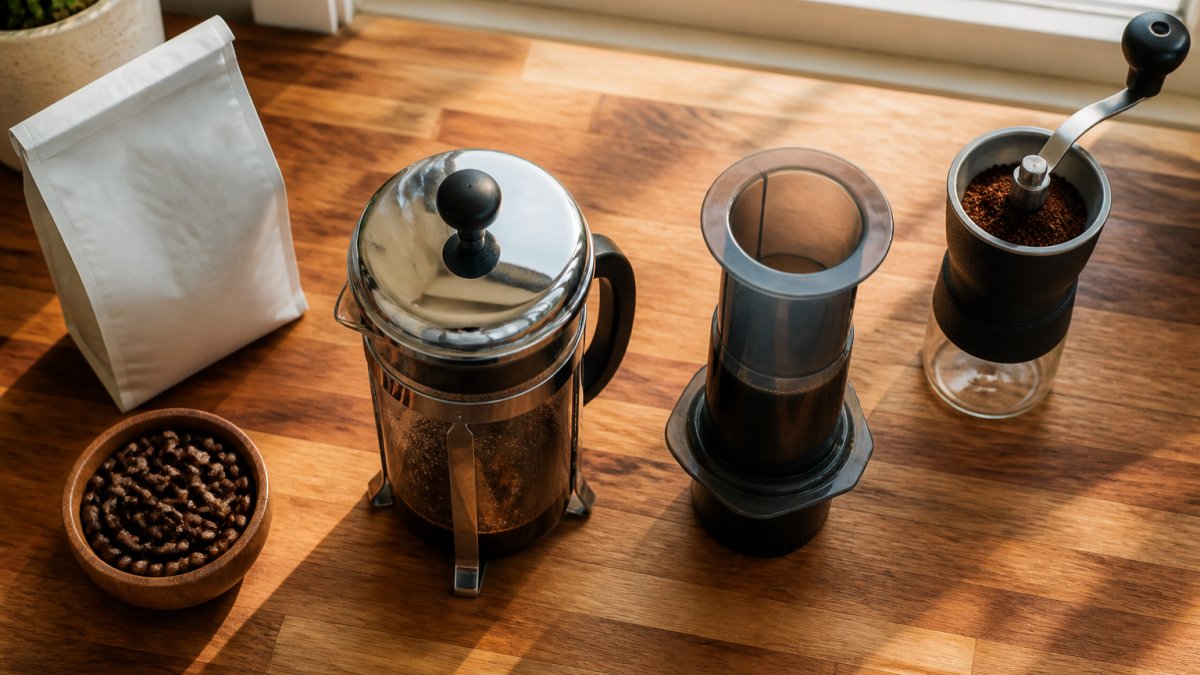
Pressure-based extraction works differently. The AeroPress builds air pressure by pushing a plunger through a narrow chamber, forcing water through the coffee and a paper filter in about 30 seconds of actual press time. Specialty Coffee Association brewing standards outlines how pressure and contact time affect extraction efficiency, and the AeroPress sits at the fast, high-pressure end of that spectrum.
The practical difference: the French press is forgiving because time does the work. The AeroPress is precise because you control pressure and timing by hand.
French Press vs AeroPress Taste Profile: Body, Clarity, and Sediment
The french press vs aeropress taste profile question has a clear answer. French press coffee has more body and mouthfeel because the metal mesh filter retains oils.
Immersion in a French press is a slow, even extraction: grounds sit in water for the full steep, so compounds and oils migrate gently into the liquid, landing on the round, sweet, low-acid side.
What the Paper Filter Does to Flavor and Oil Retention
A paper filter absorbs cafestol and other diterpene oils, so the body turns lighter and tea-like, the oils that carry heavy mouthfeel never reach the cup. A metal mesh filter lets those oils and some fine sediment through, so the cup tastes rounder and heavier.
A French press cup carries a fine layer of grounds at the bottom of the mug, which keeps extracting after you pour, that is why the last sip tastes stronger and sometimes bitter.
Recipe Versatility: The Angle Most Comparisons Skip
The French press is a single recipe with variables; the AeroPress is a platform with dozens of recipes. That difference matters if you like to experiment.
French press recipes worth knowing:
- Standard immersion: 1:15 coffee-to-water ratio by weight, coarse grind, 4-minute steep, then press slowly over 30 seconds.
- Cold brew concentrate: 1:8 ratio, coarse grind, steep 12 to 16 hours in the refrigerator, then press and dilute 1:1 with water or milk.
- James Hoffmann-style method: add grounds, pour all water, stir, wait 4 minutes, break the crust, skim the foam, wait 5 more minutes, then press. The extra wait lets fines settle for a cleaner cup.
AeroPress recipes worth knowing:
- Standard upright: medium-fine grind, 1:12 ratio, stir 10 seconds, press 30 seconds. Fast and clean.
- Inverted method: flip the AeroPress so the chamber sits on the plunger, add grounds and water, steep 1 to 2 minutes, cap, flip, and press. This gives full immersion control and is the base for most competition recipes.
- Cold brew: 1:5 concentrate, stir, steep 12 hours at room temperature or in the refrigerator, then press and dilute. The paper filter produces a cleaner cold brew than a French press.
- Espresso-style shot: fine grind, 1:5 ratio, 1-minute steep, slow press. Concentrated enough to drink as a shot or build a milk drink on top.
The takeaway: for one reliable cup, either brewer delivers. To chase a specific flavor, a syrupy cold brew, a bright single-origin shot, a clean iced coffee, the AeroPress gives you more levers to pull.
A medium roast like our Guatemala with its dark chocolate and butterscotch notes shines in a French press, where the oils carry those flavors forward. A darker, oilier bean like our French Roast can taste muddled in a French press but cleaner through an AeroPress. Match the bean to the brewer.

Best Coffee Grind Size for French Press (and Why AeroPress Differs)
The best coffee grind size for french press is coarse, roughly the texture of sea salt.
The AeroPress wants a medium-fine grind, closer to table salt. The paper filter catches fine particles, so a finer grind increases extraction without adding grit.
A burr grinder makes this easier because it produces consistent particle sizes. Blade grinders leave a mix of dust and boulders, meaning uneven extraction no matter which brewer you use.
Brew Time, Capacity, and Daily Convenience
Brew time is where the AeroPress pulls ahead for busy mornings: about 90 seconds from kettle to cup, versus four to five minutes for a French press.
Capacity flips the advantage. A standard French press makes three to four cups at once, enough for two people or a refill.
For a remote workday, the French press suits a slow morning with a full carafe on the desk; the AeroPress suits a quick afternoon pick-me-up with no leftover coffee going cold.
How to Clean an AeroPress (and the French Press Cleanup Routine)
Cleaning an AeroPress is faster than almost any other brewer. Pop the puck into the trash, rinse the plunger and chamber under warm water, and air dry.
The French press cleanup is messier: scoop the wet grounds out with a spoon, rinse the carafe, and disassemble the plunger to clean between the mesh layers.
Here is the routine that works for both:
- Dump or scoop grounds into the trash, not the drain
- Rinse all parts with warm water within an hour of brewing
- Disassemble the plunger and mesh or filter cap weekly
- Air dry upside down so water does not pool in the base
- Deep clean with a mild detergent once a month
Neither brewer needs special cleaning tablets, which keeps long-term ownership simple.
Cost Per Cup, Environmental Impact, and Travel Use Cases
Most comparisons stop at the sticker price. The real story is what each brewer costs over a year, what it leaves behind, and where it works.
Cost Per Cup: The Long-Term Math
Both brewers cost roughly the same upfront and are cheap to run because you buy ground or whole bean coffee rather than pods. The difference shows up in filters and replacement parts.
- French press: the metal mesh filter is reusable indefinitely, and a replacement screen is inexpensive. There is no per-brew consumable, so over a year of daily brewing, filter cost is effectively zero.
- AeroPress: paper filters are the consumable. A standard pack contains hundreds, so the per-cup cost is a fraction of a cent, small, but not zero. A reusable metal filter pays for itself within a few months of daily use, after which the AeroPress also runs consumable-free.
- Hidden costs: glass French press carafes break, and replacements often cost nearly as much as a new brewer. AeroPress parts, the rubber plunger seal, the filter cap, wear out over years but are inexpensive and replaceable individually.
The honest conclusion: neither brewer is expensive to own. The French press has no consumable; the AeroPress has a tiny one you can eliminate with a reusable filter.
Environmental Impact: Paper vs Metal
The filter difference is the environmental story, and it cuts both ways.
- Paper filters add up: a daily AeroPress user goes through hundreds a year. Even compostable paper carries a manufacturing and shipping footprint, and most filters end up in the trash. The upside: they are biodegradable, and the spent puck plus filter can go straight into a compost pile.
- Metal mesh filters generate no ongoing waste but require water to clean. A French press rinse uses more water than popping an AeroPress puck, and the grounds still need scooping into the trash. Over a year, that water is the trade-off against the paper you did not buy.
- The reusable-filter middle path: pairing an AeroPress with a reusable metal filter removes paper waste entirely while keeping its speed and portability, the lowest-waste option of the four configurations.
If waste reduction is your priority, the French press or an AeroPress with a reusable filter both beat a paper-filter-only setup. If water use is your priority, the AeroPress wins because cleanup takes less rinsing.
Travel Use Cases: Camping, Hotels, and the Office
Travel is where the AeroPress wins outright, but the details matter by scenario.
- Camping and backpacking: the AeroPress is plastic, lightweight, and needs no glass. It survives a pack, works with water heated over a camp stove, and the paper filter doubles as a tidy way to pack out the puck. A glass French press is a non-starter on the trail.
- Hotel rooms: the AeroPress fits in a carry-on, needs only a kettle or microwave, and brews a clean single cup without leaving grounds in the sink. A French press is bulky and fragile in a suitcase.
- Office and coworking desks: the AeroPress brews one cup at a time, suits a personal desk setup, and cleans up in under a minute. A French press makes more coffee at once, suiting a small team but leaving a carafe to wash and grounds to manage.
- Car camping and RV: a French press shines here because you have space, a stable surface, and often more than one coffee drinker. The volume advantage matters for a group.
The pattern: the AeroPress is the better traveler for one person on the move; the French press only wins when you have room, a stable surface, and more than one cup to make.
Which Brewer Should You Buy? Decision Framework by Lifestyle
The right brewer depends on how you drink coffee, not on which is objectively better. Use this framework.
Buy the French press if:
- You brew for two or more people at once
- You prefer a heavy, full-bodied cup with oil retention
- You want zero ongoing filter purchases
- You enjoy a slower morning ritual
Buy the AeroPress if:
- You brew for one person most days
- You want a clean, concentrated, espresso-style cup
- You value a 90-second brew and a 60-second cleanup
- You travel, camp, or brew at a desk
Buy both if: you want volume on weekends and speed on weekdays. Plenty of home brewers keep a French press for slow mornings and an AeroPress for quick single cups.
Whichever you choose, the brewer matters less than the beans. Freshly roasted coffee makes a bigger difference than any equipment. Beverly Blend roasts to order so the coffee reaches you at its peak, and a bean like our Bali Blue with its dark chocolate and molasses notes holds up beautifully in either brewer. Order once with no subscription required, and see which cup suits your routine.
Most home brewers spend months guessing which brewer fits their mornings, then buy the wrong one and let it collect dust. Beverly Blend makes the coffee side simple: beans roasted to order, shipped fast, delivered to your door with no commitment required. Start with a single bag of our African Espresso or the 6 Bean Blend, brew it in whichever press you choose, and taste the difference fresh roasting makes. Get started with Beverly Blend and give your daily cup the beans it deserves.


Frequently Asked Questions
Does an AeroPress make better coffee than a French press?
Neither is objectively better; they produce different styles. The AeroPress uses pressure-based extraction and a paper filter, which removes most sediment and oils for a cleaner, concentrated cup that resembles espresso-style coffee. A French press uses immersion brewing with a metal mesh filter, letting oils and fine particles through for a heavier body and richer mouthfeel. If you prefer clarity and low bitterness, the AeroPress usually wins. If you want a full, oily, textured cup, the French press delivers it.
Which brewer is easier to clean, a French press or an AeroPress?
The AeroPress is faster to clean. You push the plunger all the way through, pop the coffee puck into the trash, and rinse the parts in about 30 seconds. Knowing how to clean an AeroPress is simple because the chamber, plunger, and filter cap separate easily. A French press requires disassembling the plunger, rinsing the mesh filter, and flushing grounds from the carafe, which takes a minute or two and can clog a sink if you rinse carelessly.
What grind size does each brewer need?
The best coffee grind size for French press is coarse, roughly the texture of sea salt, because fine particles slip past the metal mesh and turn the cup muddy. The AeroPress is more forgiving and handles fine to medium-fine grinds, similar to drip or slightly finer. If you own one grinder and switch between brewers, dial coarser for the French press and finer for the AeroPress, and keep the grind consistent to avoid bitterness.
Can you make espresso-style coffee with an AeroPress?
Yes. The AeroPress generates air pressure by hand, producing a concentrated, espresso-style shot with a paper-filtered finish. Use a fine grind, a short brew time, and a small water volume, then press slowly for about 30 seconds. The result is stronger and more syrupy than drip coffee, though it lacks the crema a true espresso machine creates. Pair it with a dark roast like Beverly Blend's 6 Bean Blend for a bold, espresso-style cup at home.
Is a French press the healthiest way to make coffee?
It depends on what you mean by healthy. French press coffee retains cafestol and kahweol, two oils that paper filters capture but metal mesh does not. For most people, moderate French press consumption is fine. If your doctor has advised lowering LDL cholesterol, a paper-filtered method like the AeroPress reduces those compounds. Neither brewer adds anything harmful; the difference is mainly oil retention and sediment in the final cup.