

How Long to Steep French Press Coffee for Best Flavor
Table of Contents
- The 4-Minute Standard: Why It Works
- French Press Coffee Ratio: Getting the Numbers Right
- The Best Grind Size for French Press
- Water Temperature for French Press
- How to Avoid Bitter French Press Coffee
- The Crust, the Break, and the Plunge
- Decanting vs. Leaving It in the Press
- Conclusion
- Frequently Asked Questions
Last Updated: September 16, 2026
The 4-Minute Standard: Why It Works
The short answer to how long to steep french press coffee for best flavor is four minutes, the window where most medium-roast coffee reaches a balanced extraction. Here's what those four minutes do, when to move the clock, and how grind size, water temperature, and ratio change the math.
French press coffee is an immersion brewing method: grounds and water sit together in the carafe, and the mesh filter separates them only at the end. Every particle stays in contact with water for the full steep, which is why time matters more here than almost anywhere else.
What Happens During Extraction
Extraction dissolves soluble compounds from coffee grounds into water. Acids and fruit-forward notes dissolve first, sugars and caramel sweetness follow, and bitter, dry, woody compounds come out last. A four-minute steep sits near the middle of that curve for a medium grind.
Pull the plunger too early and you get an under-extracted cup: thin body, sharp acidity, a lingering sour edge. Wait too long and the same coffee turns bitter and drying.
When to Adjust the Clock
Four minutes is a starting point, not a law. Several factors push the ideal contact time up or down:
- Roast level: darker roasts are more soluble and extract faster, so shave 30 to 45 seconds off. Lighter roasts often need closer to five minutes.
- Grind size: a coarser grind slows extraction and can take an extra 30 seconds; a finer grind speeds it up and may need less.
- Water temperature: cooler water extracts more slowly, so a lower brew temperature calls for more time.
- Batch size: larger volumes hold heat differently and often benefit from a slightly longer steep.
French Press Coffee Ratio: Getting the Numbers Right
The french press coffee ratio sets the strength of the cup before time ever enters the picture. Start at 1:15, one gram of coffee to fifteen grams of water, which for a standard 8-cup press means roughly 30 grams of coffee to 450 milliliters of water.
Ratios shift with preference, not just equipment:
| Coffee | Water | Ratio | Result |
|---|---|---|---|
| 20 g | 300 ml | 1:15 | Balanced, standard strength |
| 25 g | 375 ml | 1:15 | Balanced, larger batch |
| 30 g | 450 ml | 1:15 | Balanced, full press |
| 30 g | 500 ml | 1:17 | Lighter, tea-like body |
| 35 g | 450 ml | 1:13 | Bold, heavy mouthfeel |
The Best Grind Size for French Press
The best grind size for french press is coarse, roughly the texture of sea salt or raw sugar. The mesh filter has wide openings compared to a paper filter, so fine particles slip through as sediment. Coarse grounds also slow extraction, which is why the four-minute steep exists.
Water Temperature for French Press
Water temperature for french press should land between 195°F and 205°F, just off a rolling boil. Water at 212°F scalds the grounds and pulls out harsh, bitter compounds; below 195°F under-extracts and leaves the cup flat and sour.
Why Water Chemistry Changes the Clock
Temperature is only half the story. What is dissolved in your water determines how aggressively it pulls compounds from the grounds. Two minerals matter most:
- Magnesium binds to coffee's flavor compounds and pulls them into solution efficiently. Water with more magnesium tends to extract faster and brighter.
- Calcium does similar work but pushes toward heavier, chalkier body when it is high.
- Alkalinity (bicarbonate) is the buffer that neutralizes coffee's natural acids. High-alkalinity water flattens brightness and can make a four-minute steep taste dull and muted, pushing brewers to over-extract chasing flavor that the water is suppressing.
Altitude and Boiling Point
Altitude changes the math as well. At higher elevations water boils at a lower temperature, so a full boil may already be below 200°F. Use the boil as your starting point and extend the steep slightly, you cannot push water past its boiling point without a pressure vessel. A brewer at 5,000 feet may find their best cup at five minutes while someone at sea level hits it at four.
How to Avoid Bitter French Press Coffee
To avoid bitter french press coffee, shorten the contact time, coarsen the grind, or lower the water temperature. Bitterness is a symptom of over-extraction, and it almost always traces back to one of those three levers rather than the beans.
Work through the likely causes in order:
- Steep time too long. Cut 30 seconds and taste again.
- Grind too fine. Move coarser and watch the sediment in the cup drop.
- Water too hot. Let the kettle rest longer before pouring.
- Too much agitation. Stir gently; aggressive stirring speeds extraction and stirs up fines.
- Beans past their prime. Stale coffee tastes flat and papery, which people often misread as bitter.
The Crust, the Break, and the Plunge
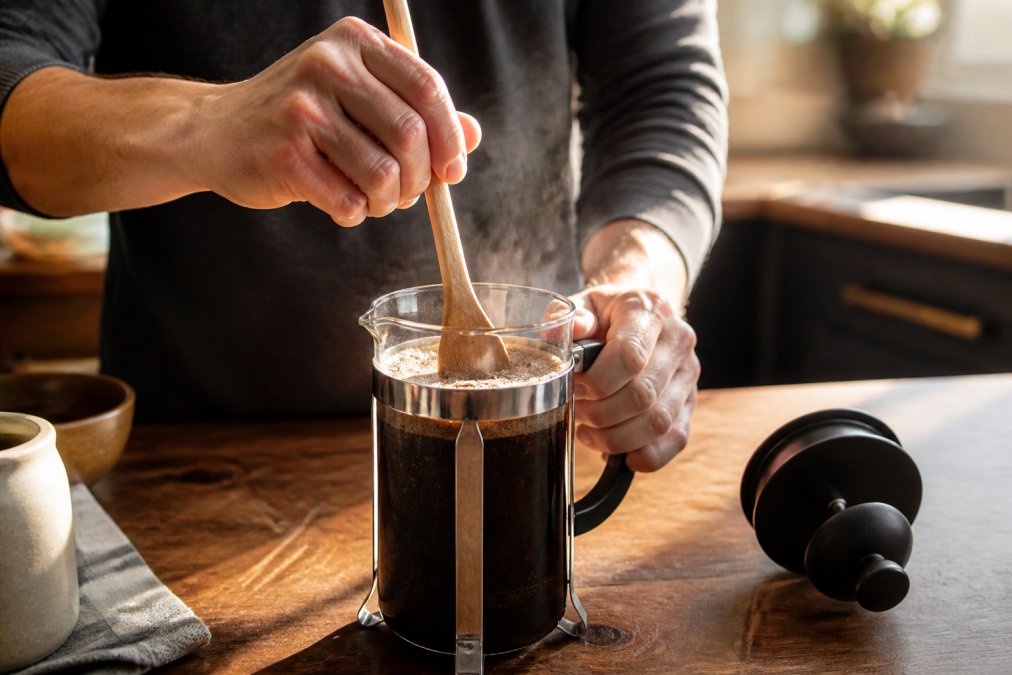
The "break" is the step most home brewers skip, and it is the easiest upgrade you can make. About four minutes into the steep, a crust of grounds and foam forms on the surface, buoyed up by carbon dioxide still escaping from the coffee, fresh beans release more gas, which is why a bag roasted last week floats a thicker crust than one roasted two months ago.
Why the Timing of the Break Matters
The moment you break the crust is a real extraction decision, not just cleanup. Break too early, say at two minutes, and you disturb the bed while extraction is still ramping up, stirring fines into suspension where they slip through the mesh as grit. Break too late and the floating grounds have been extracting unevenly the whole time, so part of your dose is over-extracted and part under-extracted in the same pot.
Skimming the Foam for a Cleaner Cup
After you break the crust, a layer of foam and floating fines rises to the surface. Skimming it off with a spoon before you press is the single most effective way to reduce sediment. Those fines are small enough to pass through the mesh filter, and they turn a French press from clean and full-bodied into muddy and gritty. A quick skim removes most of them before they reach the plunger.
The Plunge and the Pour
Here is the full sequence:
- Add coarse grounds to the pre-warmed carafe.
- Pour water at 195°F to 205°F, saturating all the grounds.
- Start your timer and let the bloom phase settle for 30 seconds.
- Stir gently once, then fit the lid with the plunger pulled up.
- At four minutes, break the crust with a spoon and skim the foam.
- Press the plunger slowly, about 20 to 30 seconds of steady pressure.
- Pour immediately into your cup or a separate carafe.
That slow press matters. Slamming the plunger down forces fines through the mesh and adds grit. Steady, even pressure lets the bed compact gradually and keeps the filter doing its job. If the plunger fights you, your grind is too fine, back off the grind rather than forcing it down.
Decanting vs. Leaving It in the Press
Decanting means pouring the brewed coffee out of the press into a separate carafe or mug immediately after pressing. Leaving it in the press keeps the liquid in contact with spent grounds, which continue to extract and turn the coffee bitter within minutes.
Conclusion
Getting the steep time right is the difference between a flat cup and one that tastes like the roaster intended. Four minutes, a coarse grind, water just off the boil, and a 1:15 ratio get you most of the way there. From that baseline, adjust one variable at a time until the cup matches your taste.
Frequently Asked Questions
Can you steep French press coffee too long?
Yes. Past 8 minutes, the brew keeps pulling compounds that add bitterness and a dry, chalky mouthfeel. The 4-minute mark is a guideline, not a law, but going beyond 8 minutes rarely improves flavor. If you want a stronger cup, add more coffee grounds rather than more time. A coarser grind also slows extraction, giving you a wider window before over-extraction sets in.
Does grind size affect French press steep time?
It does. A coarse grind exposes less surface area, so it needs the full 4 minutes to extract properly. A finer grind extracts faster, so you should shorten the steep to 3 minutes or less to avoid bitterness. The best grind size for French press is coarse, roughly the texture of sea salt, because the mesh filter lets finer particles through and into your cup.
Should I stir my French press coffee while it steeps?
Stir once at the start, right after adding water, to ensure all grounds are saturated. Then leave it alone. Stirring during the steep agitates the bed and speeds up extraction, which can push the brew toward bitterness. After 4 minutes, break the crust with a spoon and skim off the foam before pressing. That single stir at the beginning is enough.
How do I make my French press coffee taste better?
Start with freshly roasted beans, like Beverly Blend's single-origin options at $19.99, ground coarse just before brewing. Use a 1:15 coffee-to-water ratio, water at 195-205F, and a 4-minute steep. Decant immediately after pressing to stop extraction. Medium roasts such as Brazil Santos or Colombia work well because their cocoa and berry notes hold up to the immersion method without turning bitter.