

What Is the Best Mug for Cold Brew Coffee?
Last Updated: October 24, 2026
Quick Summary
The best cold brew mug matches how you actually drink cold brew: concentrate drinkers need 15-20 oz of headroom to dilute, ready-to-drink drinkers want 15-20 oz with cold retention, and iced latte drinkers need 20-25 oz. A double-wall vacuum-sealed stainless steel cold brew mug with a tight screw-on lid holds cold longest and stays dry.
- Ice can take a third of a 20 oz mug, which then holds only 12 to 14 oz of liquid.
- A 20 oz mug is the sweet spot for most people drinking diluted concentrate with ice.
- Most heat enters an insulated mug through the lid, so a tight-sealed lid matters most.
- Ceramic suits desk sipping within the hour but offers no cold retention and no lid.
- A press-in lid is fine for a desk but is not leakproof in a bag; choose screw-on for commuting.
Table of Contents
- Start With How You Drink Cold Brew
- Choosing the Best Insulated Coffee Mug for Cold Drinks
- Finding the Best Iced Coffee Cup for Your Serving Size
- What Makes a Leakproof Iced Coffee Tumbler Actually Leakproof
- Why a Cold Brew Mug With Lid Beats an Open Cup
- Material Trade-Offs: Ceramic, Enamel, and Stainless Steel
- Match Your Cold Brew Mug to Your Routine
- Frequently Asked Questions
Start With How You Drink Cold Brew
The best cold brew mug matches how you actually drink cold brew, not the highest price tag. Work out whether you pour concentrate, drink it ready-made, or build an iced latte, that answer narrows the field faster than any spec sheet.
At Beverly Blend, we sell the coffee and the drinkware. The split that matters:
- Concentrate drinkers dilute to taste, so they need a mug that holds a measured ratio without overflowing.
- Ready-to-drink drinkers want a large vessel that keeps a full pour cold for hours.
- Iced latte drinkers need room for milk, ice, and a straw.
Concentrate, Ready-to-Drink, or Iced Latte
A cold brew mug is a drinking vessel sized to hold cold coffee, ice, and often milk without sweating onto your desk.
Concentrate is the strongest starting point. If you brew your own, our guide on how to make cold brew with a French press walks through grind and steep time first.
Ready-to-drink cold brew is already diluted, so you want capacity and cold retention, plus a lid if you carry it between rooms.
Watch out: buying a 12 oz mug for concentrate and then adding ice and milk leaves almost no room to stir.
Choosing the Best Insulated Coffee Mug for Cold Drinks
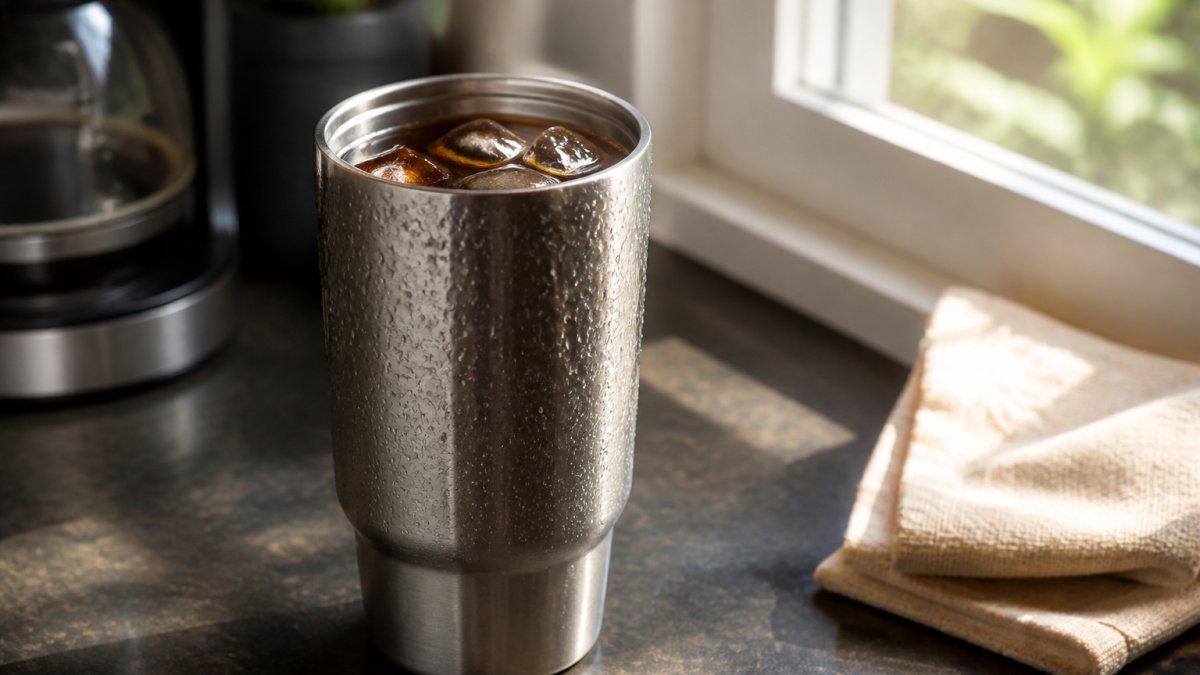
The best insulated coffee mug for cold drinks is a double-wall vacuum-sealed stainless steel vessel with a tight lid: the vacuum gap blocks heat transfer and slows ice melt. Single-wall cups sweat and warm up quickly.
What the Vacuum Gap Actually Does
A vacuum-sealed mug has two stainless steel walls with the air pulled out between them. With no air to carry heat, room-temperature energy struggles to reach your drink and cold struggles to escape. That is why ice in a good vacuum mug lasts noticeably longer than in a single-wall cup.
A vacuum mug typically keeps ice largely intact for several hours, while a single-wall cup leaves diluted, lukewarm coffee within an hour. Exact time depends on fill level, starting temperature, and how often you open the lid, so treat package hour claims as best case, not guarantee.
The Lid Is Half the Insulation
Most heat enters an insulated mug through the lid, not the walls. A screw-on lid with a gasket and small drinking opening traps cold air above the drink; a wide-open top or loose press-in lid lets it spill out every time you lift the cup. Between two vacuum mugs at similar prices, the tighter-sealed lid usually holds cold longer.
Condensation and Sweat
Condensation forms when room-air moisture hits a surface colder than the dew point. A single-wall cup filled with ice water drops well below that threshold, so water beads outside and rings your desk. A vacuum mug keeps the outer wall near room temperature and stays dry. At a desk or in a bag next to a laptop, that is the difference between a dry surface and a wet one.
How to Judge Cold Performance Before You Buy
You cannot test a mug in the store, but you can read the construction:
- Seamless interior: a one-piece stainless interior with no welded seam is easier to clean and less likely to trap residue.
- Wide mouth for ice: a mouth wide enough to drop in standard ice cubes saves you from crushing ice or using a separate tray.
- Gasket quality: a removable silicone gasket that compresses firmly is the part that fails first; a stiff or thin gasket will weep.
Our Stainless Steel Travel Mug is built for exactly this: it fits into most car cup holders and has a spill-proof plastic lid. The 40 oz includes a plastic straw and screw-on lid. One honest limitation: hand-wash only.
If you want to see the full spec and buy one, you can shop the stainless steel travel mug in both sizes.

Finding the Best Iced Coffee Cup for Your Serving Size
Serving size decides the best iced coffee cup more than brand or finish: too small forces constant refills, too large waters down a small pour. With cold brew, the number on the cup is not what you get to drink. Ice takes up space, and pouring concentrate into a full-size mug either overflows it or weakens the drink. Size for the finished drink, including ice and dilution.
The Ice Displacement Problem
Ice is not free space. A standard cube displaces roughly an ounce, and a generous handful can take a third of a 20 oz mug before you pour.
The practical rule: add your ice first, then pour, and buy a mug that holds your full liquid pour plus the ice you actually use. If you like a lot of ice, size up one step from what the liquid alone would suggest.
Dilution Headroom for Concentrate
Cold brew concentrate is typically diluted one part concentrate to two or three parts water or milk, which is why concentrate drinkers need more headroom, not less. A 4 to 6 oz pour becomes 12 to 18 oz once diluted, before ice. A 15 to 20 oz mug handles that; a 12 oz mug does not.
How Cup Shape Affects Melt
A tall, narrow mug exposes less surface area to the air than a short, wide one of the same capacity, so ice melts more slowly. A wide, bowl-shaped cup looks generous but lets ice sit in contact with warm air. Sip slowly and favor a taller profile; drink fast and shape matters less.
Ceramic Coffee Mug, 11 oz 15 oz 20 oz, Dishwasher & Microwave Safe →
Capacity by Drink Style
| Drink Style | Typical Pour | Recommended Capacity | Why |
|---|---|---|---|
| Cold brew concentrate, diluted | 4-6 oz concentrate + water | 15-20 oz | Room to dilute and add ice |
| Ready-to-drink cold brew | 10-14 oz | 15-20 oz | Full pour plus ice |
| Iced latte | 8-12 oz plus milk | 20-25 oz | Headroom for milk and foam |
| All-day sipper | Multiple refills | 40 oz | Fewer trips, more ice |
A 20 oz mug is the sweet spot for most people: it holds a diluted concentrate pour with ice and leaves room to stir. Go to 40 oz only if you genuinely drink that much in one sitting, a large cup with a small pour just means more surface area for ice to melt against.
What Makes a Leakproof Iced Coffee Tumbler Actually Leakproof
A leakproof iced coffee tumbler stays sealed because of a gasket, a locking or threaded lid, and a lid that seats flush against the rim.
Three things separate a genuinely leakproof tumbler from one that just claims to be:
- A removable silicone seal that sits inside the lid and compresses when closed.
- A threaded or locking lid rather than a lid that simply presses in.
- A flush rim with no gaps where liquid can pool and escape.
The removable seal is the part people ignore and the part that fails first. Pull it out weekly, rinse it, and dry it fully before reseating.
Watch out: a press-in lid is fine for a desk, but it is not leakproof in a bag.
Why a Cold Brew Mug With Lid Beats an Open Cup
A cold brew mug with lid wins on three fronts: temperature, spill prevention, and odor. The lid traps cold air, blocks accidental spills, and keeps your drink from picking up fridge or desk smells.
Temperature retention is the obvious benefit: a lid slows the exchange of cold air for warm room air, so ice lasts longer.
There is a cleaning angle too: lids and seals need attention, but they keep dust and debris out.
For iced coffee specifically, a lid also holds cold foam in place instead of letting it collapse against open air.
Material Trade-Offs: Ceramic, Enamel, and Stainless Steel
Ceramic, enamel, and stainless steel each suit a different cold brew habit: ceramic for desk sipping, enamel for packing light, stainless steel for insulation and travel.
Ceramic is flavor-neutral and heavy enough to feel stable on a desk. Our ceramic coffee mug comes in 11, 15, and 20 oz, is dishwasher and microwave safe, and the 20 oz handles a diluted concentrate pour with ice.

Enamel is light and tough, which makes it the camping and travel pick. The enamel camper mug is compact and clips to a pack, but it is hand-wash only, and enamel's porous surface stains over time.

Stainless steel insulates and resists dents. It is the only one of the three that meaningfully holds cold, and it is the right choice if your drink needs to survive a commute.
| Material | Cold Retention | Weight | Lid Option | Best For |
|---|---|---|---|---|
| Ceramic | Low | Heavy | No | Desk sipping |
| Enamel | Low | Light | No | Camping, travel |
| Stainless steel | High | Medium | Yes | Commuting, all-day cold |
Match Your Cold Brew Mug to Your Routine
Your routine is the final filter and usually settles the choice in one pass. A desk worker, a commuter, and a camper need three different cups, and buying for someone else's routine is the most common cold brew mug mistake we see.
Use this decision framework:
- Desk, drink within the hour: ceramic, 15-20 oz, no lid needed.
- Commute or bag carry: stainless steel with a screw-on lid, 25 oz.
- Making your own concentrate: pair any mug with coarse-ground beans; our cold brew coffee grounds are ground for the job.
A common mistake is buying one cup for every scenario. Pick the routine you actually have on a normal Tuesday, and let the other cases go.
Frequently Asked Questions
What kind of mug is best for cold brew coffee?
The best cold brew mug depends on where you drink it. For commuting or desk work, an insulated stainless steel travel mug holds cold temperature longest and resists condensation. For slow sipping at home, a ceramic mug in the 15 oz or 20 oz size gives you room for ice and concentrate. Look for a tight lid, a material that will not hold onto odors, and a capacity that matches your typical pour.
Should you use an insulated mug for cold brew?
Yes, if you plan to sip over an hour or more. Insulated double-wall construction slows heat transfer, so ice melts more slowly and your drink stays undiluted. It also stops condensation from forming on the outside, which protects your desk or car console. Beverly Blend's Stainless Steel Travel Mug is built for this, with a spill-proof lid and a 25 oz or 40 oz capacity.
Is stainless steel or glass better for cold brew?
Stainless steel wins on durability and cold retention, and it will not shatter in a bag or car cup holder. Glass is flavor-neutral and easy to inspect for residue, but it is heavier and breakable. Ceramic sits in the middle: it is flavor-neutral, dishwasher safe, and comfortable to hold, but it does not insulate. Pick stainless for travel, ceramic for home.
Do you need a lid for a cold brew mug?
A lid is worth having for three reasons: it slows warming, it prevents spills, and it keeps dust and fridge odors out if you store your cold brew in the mug. A cold brew mug with lid also travels better in a work bag. If you drink your cold brew within 15 minutes at home, an open ceramic mug is fine.
Most people overthink the cup and underthink the coffee, but the two work together: a good mug keeps a good brew cold, and it cannot rescue a weak one. Beverly Blend roasts to order so the flavor and aroma are there before the ice goes in, and our drinkware is built to carry it. Start with the stainless steel travel mug if you commute, or browse the full range and get the cup that fits your routine.
