

How to Make Cold Brew With French Press
Table of Contents
- What You'll Need to Make Cold Brew With French Press
- Cold Brew Coffee Ratio for French Press Brewing
- Best Coffee Grind for Cold Brew in a French Press
- Step-by-Step Cold Brew Brewing Instructions
- How Long to Steep Cold Brew for Best Results
- How to Store Homemade Cold Brew Concentrate
- Serving and Dilution Ratios for Cold Brew
- Common Mistakes to Avoid When Brewing Cold Brew
- Frequently Asked Questions
Last Updated: September 19, 2026
What You'll Need to Make Cold Brew With French Press
Learning how to make cold brew with french press requires just a few items:
- A French press (32 oz or larger works best)
- Coarse ground coffee
- Filtered water
- A spoon or stirring rod
- A fine mesh filter or cheesecloth (optional, for extra filtering)
- An airtight container for storage
Quality beans matter. Beverly Blend's cold brew coffee is specifically blended for this method, with dark French roast and coarse grind. This unique blend makes the perfect, most satisfying cup. It contains no additives, nothing artificial, just 100% coffee.

Use filtered or bottled water, tap water introduces chlorine and minerals that interfere with extraction.
Cold Brew Coffee Ratio for French Press Brewing
The standard ratio is 1 part coffee to 4 parts water by weight, creating a concentrate you'll dilute later.
Here's how to measure it:
- For a 32 oz French press: Use 2 oz coffee and 8 oz water
- For a 48 oz French press: Use 3 oz coffee and 12 oz water
- For a 64 oz French press: Use 4 oz coffee and 16 oz water
Without a scale, use volume: one part coffee to four parts water. A standard coffee scoop holds about 0.5 oz of coarse grounds.
This ratio produces a concentrate. Dilute 1:1 with water for regular strength, or adjust to taste. A 1:3 ratio (one part coffee to three parts water) yields bolder flavor with less total yield.
Best Coffee Grind for Cold Brew in a French Press
Cold brew needs a coarse grind, think sea salt or breadcrumbs. A finer grind over-extracts during the 12-24 hour steep, creating bitterness and sediment.
Coarse grind slows extraction, reduces sediment, makes straining easier, and lets water saturate grounds evenly.
Beverly Blend's cold brew coffee is a dark French roast and the grounds are very coarse. If grinding your own, use your grinder's coarsest setting, it should look noticeably larger than drip coffee grounds.
Test your grind by feel: it should feel slightly gritty, not powdery. Coarse grounds extract slower, yielding cleaner, less acidic, smoother coffee than hot-brewed coffee from the same beans.
Step-by-Step Cold Brew Brewing Instructions
Here's how to make cold brew with french press from start to finish.
Step 1: Add Grounds and Water
Start with a clean, dry French press. Add your coarse grounds first, then pour cold filtered water slowly over them.
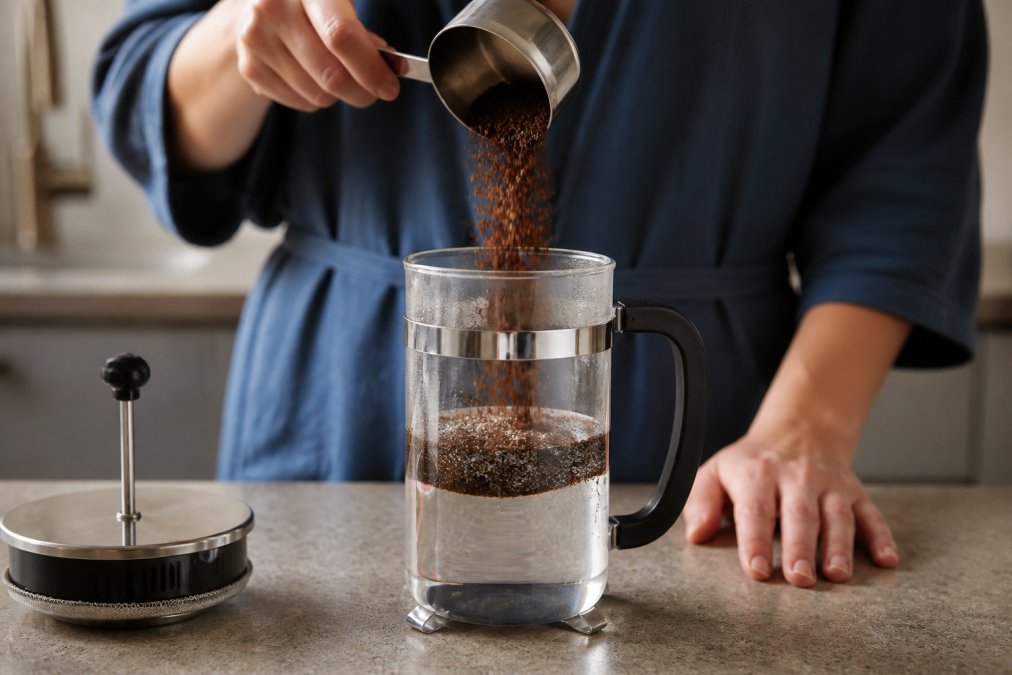
Pour the water in stages. Add half the water, let it sit for 10 seconds, then add the rest. This helps the grounds absorb water evenly.
The goal is to saturate all the grounds.
Step 2: Stir and Saturate
Stir gently for about 10 seconds with a long spoon to ensure full contact. Some grounds will float, that's normal and they'll sink as they absorb water.
Step 3: Cover and Steep
Place the lid on your French press without pressing the plunger. Set it on your counter or in the refrigerator. Room temperature steeping takes 12-24 hours; refrigerator steeping takes 18-24 hours. Most people prefer 16-20 hours for strong, balanced flavor without harshness.
Step 4: Strain the Coffee
Slowly press the plunger down with steady, even pressure until it reaches the grounds, don't force it further. Pour concentrate into a clean container; it keeps for two weeks refrigerated. For an ultra-clean cup, strain through a fine mesh filter or cheesecloth.
How Long to Steep Cold Brew for Best Results
Steeping time controls extraction and flavor. Understanding this helps you dial in exactly what you want.
How to Store Homemade Cold Brew Concentrate
Store concentrate in an airtight glass container in the back of the refrigerator for two weeks. Label with the brew date. Never store at room temperature, it can develop mold or off-flavors within hours. For large batches, freeze in ice cube trays for one month.
Serving and Dilution Ratios for Cold Brew
Cold brew concentrate is not ready to drink straight. You dilute it to create your final cup. But dilution isn't one-size-fits-all, the ratio depends on your drink type, serving method, and personal preference. This section provides a practical cheat sheet for converting your concentrate into specific beverages.
The Foundation: Basic Dilution Ratios
The standard ratio is 1 part concentrate to 1 part water for regular strength. Adjust: 1:2 for lighter, 1:0.5 for stronger, 1:0.25 for extra-strong. Use any measuring vessel.
Dilution Cheat Sheet for Specific Drinks
Here's how to convert your concentrate into popular cold brew drinks:
Iced Cold Brew (Classic)
- 2 oz concentrate + 2 oz cold water + ice
- Pour over ice in a tall glass, stir, and serve immediately
- The ice will melt slightly and dilute further, so start with equal parts
Iced Cold Brew Latte
- 2 oz concentrate + 4-6 oz cold milk + ice
- Pour concentrate over ice, add cold milk, stir
- Use 4 oz milk for a stronger latte, 6 oz for a creamier, milder drink
- Works with any milk: dairy, oat, almond, or coconut
Hot Cold Brew Latte (Café-Style)
- 2 oz concentrate + 6 oz warm milk (heated to 150-160°F)
- Pour concentrate into a cup, add warm milk, stir
- Do not heat the concentrate itself; the warm milk does the heating
- This creates a smooth, less acidic hot coffee drink
Cold Brew with Cream
- 2 oz concentrate + 1-2 oz heavy cream + 2-4 oz cold water + ice
- Pour concentrate over ice, add cream, then water to taste
- The cream creates a rich, velvety texture
Iced Americano-Style (Diluted)
- 1 oz concentrate + 3-4 oz cold water + ice
- For those who prefer a lighter, more refreshing drink
- Similar strength to a traditional iced Americano
Cold Brew Float
- 2 oz concentrate + 1-2 oz cold water + ice + 1 scoop vanilla ice cream
- Pour concentrate and water over ice, top with ice cream
- The ice cream melts into the cold brew, creating a dessert-like drink
Nitro-Style Cold Brew (Smooth & Creamy)
- 2 oz concentrate + 4 oz cold water + ice
- Pour into a blender with 0.5 oz heavy cream or oat milk and 3-4 ice cubes
- Blend for 5-10 seconds until frothy
- Pour into a glass and serve immediately
- The aeration creates a smooth, nitrogen-like mouthfeel
Accounting for Ice Melt
Ice is a hidden dilution factor. When you pour cold brew over ice, the ice will melt over 10-15 minutes, diluting your drink by 20-30%. To compensate:
- Use a stronger concentrate ratio initially. Instead of 1:1 concentrate to water, use 1:0.75 or 1:0.5 if serving over ice
- Use larger ice cubes. They melt slower than small cubes, giving you more time to drink before over-dilution
- Serve in a chilled glass. A cold glass slows ice melt
- Drink quickly. The first few sips are always the strongest
Batch Dilution for Multiple Servings
If you're making cold brew for a group or the week ahead, you can pre-dilute your concentrate:
For 4 servings of regular-strength cold brew:
- 8 oz concentrate + 8 oz water = 16 oz total
- Divide into 4 glasses (4 oz each)
- Serve over ice or with milk
For 8 servings of regular-strength cold brew:
- 16 oz concentrate + 16 oz water = 32 oz total
- Store in a pitcher in the refrigerator
- Pour 4 oz per serving over ice
For a concentrate-only approach (maximum flexibility):
- Store your full concentrate undiluted in the refrigerator
- Dilute each serving individually based on preference
- This gives you the most control but requires diluting each time
Temperature Considerations
The temperature of your dilution liquid affects the final drink:
- Cold water: Creates a refreshing, crisp iced drink. Best for hot weather
- Room temperature water: Slightly less refreshing but easier to prepare
- Warm milk: Creates a smooth hot drink without heating the concentrate itself
- Ice: Dilutes as it melts; account for this in your initial ratio
Sweeteners and Flavor Additions
Cold brew concentrate pairs well with additions:
- Simple syrup: Add 0.5-1 oz per serving before diluting. Dissolves easily in cold liquid
- Honey: Stir into warm milk before adding concentrate for a hot drink
- Vanilla extract: Add a few drops per serving for vanilla-flavored cold brew
- Cinnamon: Sprinkle on top or stir into the concentrate
- Chocolate syrup: Add 1-2 tablespoons for a mocha-style drink
Start with small amounts and adjust to taste. Cold brew's smooth flavor profile accepts additions without becoming muddy or over-complicated.
Common Mistakes to Avoid When Brewing Cold Brew
Most cold brew failures come from a handful of preventable mistakes.
Frequently Asked Questions
What is the best ratio for cold brew in a French press?
Use a 1:4 coffee-to-water ratio by weight as your starting point. For example, 1 cup of coarse grounds to 4 cups of filtered water. This produces a strong concentrate you can dilute to taste. Some brewers prefer 1:5 for a lighter concentrate. Adjust based on your flavor preference and the specific bean origin you're using.
How long should cold brew steep in a French press?
Steep for 12 to 24 hours at room temperature. Most brewers find 18 to 20 hours optimal for balanced extraction without excessive bitterness or tannins. Shorter steeps (12 hours) produce lighter, more acidic results. Longer steeps (24 hours) create fuller-bodied, bolder concentrates. Check the flavor at 12 hours and adjust your next brew accordingly.
Can I use hot water to speed up cold brew in a French press?
No. Cold brew relies on immersion brewing at room temperature to extract flavor gradually and reduce acidity. Hot water triggers rapid extraction, creating a different flavor profile and defeating the purpose of cold brew. If you need coffee quickly, traditional hot brewing is more appropriate. The slow extraction process is what makes cold brew smooth and less bitter.
How do I prevent sediment and sludge in my cold brew?
Use a coarse grind and a mesh filter or paper filter inside your French press plunger. After steeping, press slowly and stop before reaching the bottom where sediment collects. Decant the liquid into a separate container, leaving the sludge behind. For extra-smooth cold brew, pour through a fine mesh strainer or cheesecloth a second time. This removes fine particles and tannins that cause cloudiness.