

Best Light Roast Coffee for Morning: 5 Picks for 2026
Table of Contents
- Why Light Roast Coffee Works for Mornings
- Light Roast vs Dark Roast Caffeine Content: The Facts
- 1. Breakfast Blend: The Balanced Morning Starter
- 2. Ethiopia Natural: Fruit-Forward Single-Origin
- 3. Gourmet Donut Shop: Smooth Light-Medium Option
- 4. Tanzania: Floral and Bright for Slow Mornings
- How to Brew Light Roast Coffee at Home
- Best Brewing Methods for Light Roast: A Quick Guide
- Frequently Asked Questions
Last Updated: September 6, 2026
Why Light Roast Coffee Works for Mornings
Light roast coffee is a lightly roasted bean that preserves the origin character of the coffee, delivering a crisp, tea-like body with pronounced acidity and clarity rather than heavy roast flavors. If you are searching for the best light roast coffee for morning drinking, you want a cup that wakes up your palate without the bitter, smoky weight that dark roasts often carry. At Beverly Blend, we roast to order specifically so those delicate floral and fruit-forward notes survive the journey to your kitchen counter.

The morning cup sets the tone for the day, and a bright, clean brew feels lighter on the stomach while still delivering the ritual comfort you crave. Many coffee drinkers assume a darker bean means a stronger jolt, but the opposite is often true. A light roast preserves more of the bean's natural complexity, making it an ideal choice for slow mornings when you want to actually taste your coffee rather than simply drink it for the caffeine.
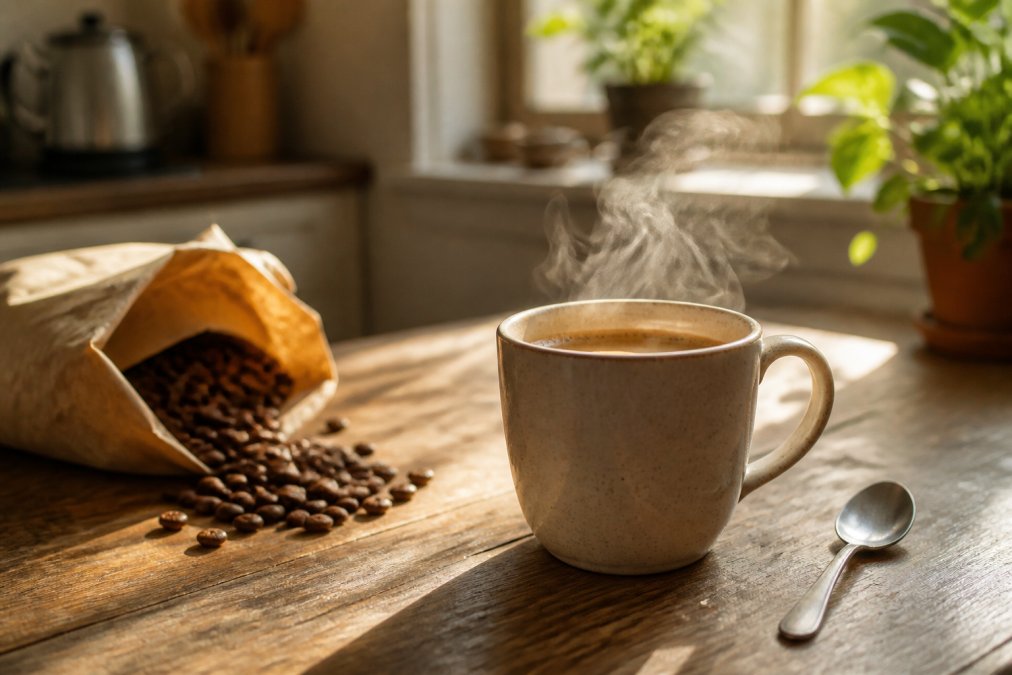
Below, we break down five specific picks, explain the caffeine reality, and show you exactly how to brew light roast coffee at home.
Light Roast vs Dark Roast Caffeine Content: The Facts
The light roast vs dark roast caffeine content debate is settled by weight, not by roast level. A scoop of light roast contains marginally more caffeine than the same scoop of dark roast because the beans are denser, having lost less water mass during a shorter roasting process (peer-reviewed research).
However, the difference is negligible in practice, roughly a few milligrams per cup. The real caffeine variable is the coffee variety itself, with Robusta beans containing roughly double the caffeine of Arabica. This is why a light roast Arabica will not necessarily wake you up faster than a dark roast blend that includes Robusta.
For those who want extra caffeine without sacrificing the bright profile of a light roast, a medium roast blend with added Robusta offers a practical middle ground. The Specialty Coffee Association has published extensive research on roast profiles and their effect on solubility and extraction, which clarifies why density matters more than color when measuring caffeine content Specialty Coffee Association research on roast profiles and extraction.
1. Breakfast Blend: The Balanced Morning Starter
Our top pick for the best light roast coffee for morning routines is the Beverly Blend Breakfast Blend, a lightly roasted mix of South American coffees that behaves like a gentle alarm clock for your taste buds. This is the light roast coffee for morning drinkers who want brightness but not the sometimes startling acidity of a single-origin African bean.
The tasting notes tell the story: walnuts, mild apple, a slight raisin sweetness, and a whisper of toffee. These coffees are grown at high mountain elevations and processed using environmentally friendly washed methods with sun drying, which keeps the cup clean and the flavors transparent. It is a forgiving coffee, one that tastes excellent even if your pour-over technique is still a work in progress.
- Best for: Drinkers transitioning from dark to light roasts who want familiarity with more clarity
- Tasting profile: Walnuts, mild apple, raisin, toffee
- Roast level: Light
- Price: $19.99 per 12 oz bag
The Breakfast Blend is the definition of a reliable daily driver, priced at $19.99 for a 12 oz bag, which lands it in the expected range for specialty roasted-to-order coffee National Coffee Association guide to buying fresh coffee.
2. Ethiopia Natural: Fruit-Forward Single-Origin
Ethiopia Natural is the light roast coffee for morning drinkers who want their first cup to taste like a discovery, not a routine. This single-origin coffee comes from smallholder farmers in the Sidama Zone, grown at 1700 to 1900 meters above sea level, and the altitude shows in every sip.

The beans are processed using the full natural method, sorted by hand and dried on raised beds, which allows the fruit sugars to ferment into the bean itself. The result is a cup with milk chocolate depth, bright fruit notes, and a caramel finish that lingers pleasantly. If you have ever wondered why specialty coffee reviews use words like "fruit-forward" and "complexity," this is the coffee that makes those terms click.
- Best for: Adventurous drinkers who want a dessert-like cup without added sugar
- Tasting profile: Milk chocolate, fruity, caramel
- Roast level: Medium-light
- Altitude: 1700 to 1900 meters
- Variety: Indigenous heirloom cultivars
What most guides miss is that natural-processed coffees like this one need a slightly longer rest period than washed coffees. The fruit sugars continue to develop for up to two weeks post-roast, so buy ahead if you have an important morning brewing session planned. This is also the pick to choose when you want to taste the terroir of Ethiopia in your own kitchen.
3. Gourmet Donut Shop: Smooth Light-Medium Option
Gourmet Donut Shop is the light roast coffee for morning drinkers who find most light roasts too delicate but still want more flavor than a standard breakfast blend offers. This is a light-medium roast that bridges the gap, delivering a stronger flavor presence while keeping the cup smooth and approachable.

The tasting notes lean comfort food: cocoa, caramel, toffee, and mild fruits. It is the coffee equivalent of a warm bakery on a cool morning, familiar and satisfying without being boring. For remote professionals who brew a pot and sip it through a long video-call-heavy morning, this blend holds its flavor as it cools better than most lighter roasts.
- Best for: Drinkers who want a stronger flavor than light roasts but less bitterness than dark
- Tasting profile: Cocoa, caramel, toffee, mild fruits
- Roast level: Light-medium
- Price: $19.99 per 12 oz bag
The one limitation is that this blend is less distinctive than the single-origin options on this list. You trade some exotic complexity for everyday drinkability, which is a fair exchange for a coffee you will finish before the week is out.
4. Tanzania: Floral and Bright for Slow Mornings
Tanzania is the light roast coffee for morning drinkers who treat the first cup of the day as a meditative ritual rather than a caffeine delivery system. This medium-light single-origin coffee comes from small cooperative farmers in the Mbeya region, grown at 1200 to 1900 meters in clay mineral soils.
The fully washed process and raised-bed drying produce an exceptionally clean cup with tasting notes of pear, floral jasmine, and strawberry. The acidity here is bright and sparkling, almost wine-like, which makes it a fascinating contrast to the chocolate-forward Ethiopia Natural. If you enjoy pour-over brewing where you can control every variable, this coffee rewards attention.
- Best for: Pour-over enthusiasts and slow-morning ritualists
- Tasting profile: Pear, floral, jasmine, strawberry
- Roast level: Medium-light
- Process: Fully washed, dried on raised beds
- Variety: Bourbon and Kent
The acidity is the star here, but it is also the potential pitfall. Brewed too aggressively, with water that is too hot or a grind that is too fine, this coffee turns sharply sour. Use water just off the boil and a slightly coarser grind than you would for a dark roast to let the floral notes shine instead of the sharp edges.
How to Brew Light Roast Coffee at Home
Learning how to brew light roast coffee at home starts with understanding that light roasts are denser and less soluble than dark roasts, so they need more energy to extract properly. The most common mistake is treating them like dark roasts, which produces a sour, weak cup that tastes nothing like the tasting notes promised.
The key variables are water temperature, grind size, and brew time. Light roasts need hotter water, typically 200 to 205 degrees Fahrenheit, to extract the sugars locked inside the dense bean structure. Your grind should be finer than what you would use for a dark roast, but the exact setting depends on your brewing equipment.
Water chemistry matters more than most home brewers realize. Specialty coffee is roughly 98 percent water, so if your tap water is heavily chlorinated or mineral-heavy, it will mask the subtle notes you paid for.
| Grind Setting | Best For | Brew Time | Water Temperature |
|---|---|---|---|
| Fine (table salt) | Pour-over V60 | 2.5 to 3 minutes | 200 to 205 degrees F |
| Medium-fine | Chemex | 3.5 to 4 minutes | 200 to 205 degrees F |
| Medium (coarse sand) | Drip machine | 4 to 5 minutes | 195 to 200 degrees F |
| Coarse | French press | 4 minutes | 200 to 205 degrees F |
The ratio matters just as much as the grind. Start with 1 gram of coffee for every 16 grams of water, roughly 2 tablespoons of whole bean coffee per 6 oz cup, and adjust from there based on your taste.
Best Brewing Methods for Light Roast: A Quick Guide
The best brewing methods for light roast coffee prioritize control over convenience, which is why pour-over methods dominate the conversation. A V60 or Chemex gives you direct command over water flow and brew time, letting you highlight the clarity and brightness that make light roasts special.
For the best brewing methods for light roast coffee, the pour-over family leads, but the French press deserves more credit than it gets. The metal mesh filter allows more natural oils through, producing a fuller body that can soften the sharp acidity of a bright single-origin. The tradeoff is less clarity, since the mesh lets fine particles through that a paper filter would catch.
- Pour-over (V60 or Chemex): Best for clarity and flavor transparency, requires a gooseneck kettle for control
- French press: Best for fuller body and ease, forgiving of technique errors
- AeroPress: Best for single cups and travel, produces a clean cup with short brew time
- Drip machine: Best for convenience, but only with a machine that reaches proper water temperature
The AeroPress is the dark horse of light roast brewing. Its short brew time and paper filter produce a clean, tea-like cup that suits the delicate nature of light roasts, and it is nearly impossible to over-extract with the standard recipe. For remote professionals brewing a single cup between meetings, it is often the most practical choice.
Whichever method you choose, freshness is non-negotiable. Light roasts lose their volatile aromatic compounds faster than dark roasts, so buy whole bean coffee and grind only what you need immediately before brewing. Pre-ground coffee, even from a quality roaster, will taste flat within days of opening the bag.
Choosing the best light roast coffee for morning drinking comes down to matching the roast profile to your palate and your brewing setup. Beverly Blend roasts every order to guarantee maximum flavor and aroma, delivering directly to your door so the beans arrive at their peak. Whether you start with the balanced Breakfast Blend or explore the fruit-forward Ethiopia Natural, each bag is priced at $19.99 with no subscription required. Get started with Beverly Blend and turn your morning ritual into the best part of your day.
Frequently Asked Questions
Does light roast coffee have more caffeine than dark roast?
Yes, by volume. Light roast beans are denser because they spend less time in the roaster, so a scoop of light roast contains slightly more caffeine than the same scoop of dark roast. The difference is small, usually around 10-15 mg per cup. If you want a bigger caffeine boost, try a blend with robusta beans, like Breakfast Blend +.
How should you brew light roast coffee for the best flavor?
Use water just off a boil, around 200-205°F, and grind slightly finer than you would for dark roast. A pour-over setup like a V60 or Chemex highlights the bright, floral notes. Aim for a 1:16 coffee-to-water ratio and a total brew time near 3 minutes. Adjust grind size if the cup tastes sour or bitter.
What is the best coffee to start my morning with?
A light roast with moderate acidity and a smooth finish works well before food. Breakfast Blend offers walnut and toffee notes with a gentle apple sweetness, making it easy to drink black or with milk. If you prefer more fruit-forward flavors, Ethiopia Natural brings milk chocolate and caramel that pairs well with breakfast pastries.
What is the healthiest coffee to have in the morning?
Light roast coffee retains more chlorogenic acid, an antioxidant that can help regulate blood sugar. For the cleanest cup, choose a single-origin coffee processed with the washed method, like Tanzania. Avoid added sugars and flavored syrups. Freshly roasted beans delivered within days of roasting also preserve more of the beneficial compounds.