

Coffee Flavor Notes Explained for Beginners
Table of Contents
- What Are Coffee Flavor Notes?
- Are Flavors Added to Coffee?
- How to Taste Coffee Like a Professional
- The Coffee Flavor Wheel Explained
- Why Can't I Taste the Notes?
- How Processing Methods Shape Flavor
- How to Tell If Coffee Beans Are Fresh
- Conclusion
- Frequently Asked Questions
Last Updated: September 10, 2026
What Are Coffee Flavor Notes?
Coffee flavor notes are the specific taste and aroma characteristics that tasters detect in a brewed cup, described using familiar reference points like chocolate, citrus, or caramel. According to Specialty Coffee Association's flavor research, these descriptors help standardize how the industry communicates what a coffee actually tastes like. This guide from Beverly Blend breaks down the vocabulary, the science, and the practical steps so you can taste with confidence.
Here's what most beginners get wrong: they expect the bag's description to hit them over the head. It won't. Flavor notes are subtle reference points, not added ingredients. Once you understand that distinction, everything about tasting coffee starts to make sense.
Are Flavors Added to Coffee?
No. Coffee flavor notes come entirely from the bean itself. The chocolate, berry, or citrus you read on a bag develops through the plant's genetics, the soil and altitude where it grew, how the fruit was processed after harvest, and how the roaster applied heat. Nothing is injected, sprayed, or added.
That surprises people. Many assume a "blueberry" note means someone flavored the batch. In reality, the same chemical compounds found in actual blueberries occur naturally in certain Ethiopian coffees. Your brain recognizes the pattern and labels it.
The distinction matters when you shop. Flavored coffee, the kind with added syrups or oils, tastes artificial and one-dimensional. Single-origin specialty coffee like Beverly Blend's Ethiopia Natural carries its fruit character from the Sidama Zone growing region, not from a bottle.

| Term | What It Means | Where It Comes From |
|---|---|---|
| Flavor notes | Natural taste descriptors | Bean genetics, origin, process, roast |
| Flavored coffee | Added syrups or oils | Applied after roasting |
| Tasting profile | The roaster's summary | Cupping evaluation |
How to Taste Coffee Like a Professional
Professional tasting follows a repeatable protocol. You do not need a lab, just attention and a consistent method.
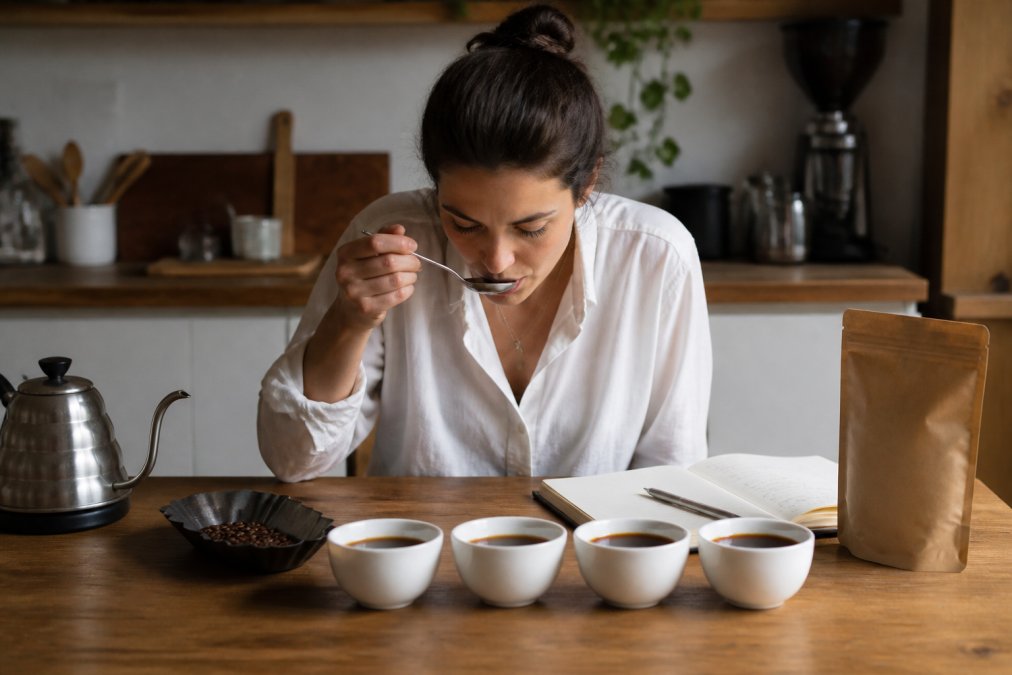
- Smell the dry grounds before brewing. Most of what you will taste starts here.
- Brew with a consistent ratio, roughly 1 gram of coffee to 16 grams of water.
- Slurp from a spoon. This spreads the liquid across your palate and pulls aroma into your nasal cavity.
- Pause and note the first impression. Sweetness? Acidity? Bitterness?
- Wait for the finish, the flavor that lingers after you swallow.
- Write down three words, even if they feel obvious. Vocabulary builds with repetition.
A common mistake is tasting too hot. Let the cup cool for a few minutes. Heat masks delicate notes, and many flavors only appear as the coffee drops toward room temperature.
The Coffee Flavor Wheel Explained
The coffee flavor wheel explained simply is a circular chart that organizes taste descriptors from broad categories at the center to specific notes at the outer ring. The Specialty Coffee Association flavor wheel groups everything under nine main families, including fruity, sweet, nutty, and roasted. Think of it less as a menu and more as a map: you start in the middle with a vague impression and walk outward until you hit a word that fits.

Most beginners treat the wheel like a test they are failing. That is backwards. The wheel exists to give you language for sensations you already have but cannot name. Used well, it becomes a diagnostic tool that tells you what to adjust next.
How to Walk the Wheel
Work from the center outward in three passes.
- First pass, the family. Ask one question: does this cup lean fruity, sweet, nutty, or roasted? Pick the closest family even if you are unsure. A guess is more useful than a blank.
- Second pass, the subcategory. Inside "fruity," decide between berry, citrus, dried fruit, or tropical. Inside "sweet," choose between brown sugar, caramel, vanilla, or honey.
- Third pass, the specific note. Only now do you reach for the outer ring: blueberry versus raspberry, lemon versus orange, milk chocolate versus dark chocolate.
A Worked Example
Say you brew a cup and the first thing you notice is a bright, mouth-watering sensation on the sides of your tongue. You are not sure what it is.
- Center: it is not sweet or roasted, so you start at fruity.
- Middle ring: the brightness feels sharp rather than jammy, so you move toward citrus rather than berry.
- Outer ring: it reminds you of the smell of a lemon peel, not orange juice, so you land on lemon.
You have just gone from "I don't know" to "lemon" in three questions. That is the entire method.
Using the Wheel Diagnostically
The wheel also helps you troubleshoot. If a bag promises "stone fruit" and you taste only generic sweetness, the wheel tells you which family you are missing, you are stuck at the center and never reached the outer ring. That usually points to a brewing problem rather than a bean problem. If a bag promises "floral" and you taste "bitter," you have landed in the wrong family entirely, which often means the coffee is over-extracted.
The wheel is a vocabulary tool, not a test. Nobody expects you to nail "dried fig" on your first attempt. Use it to find language for what you already taste, and use the direction you travel, inward or outward, as a clue about what to change next.
Why Can't I Taste the Notes?
If the bag promises dark chocolate and you taste only "coffee," you are not broken and the roaster is not lying. A handful of fixable issues are usually at play, and the trick is to test them in order rather than changing everything at once.
Step 1: Rule Out Staleness
Stale beans are the most common culprit. Oxygen and time flatten the volatile aroma compounds that carry flavor notes, leaving a dull, papery, or cardboard-like cup. Check the roast date, not the expiration date. Most practitioners find peak flavor within roughly two to four weeks of roasting, with a noticeable decline after that. If your bag has no roast date, that alone may explain the flat cup.
Step 2: Check Your Brewing Variables
If the beans are fresh, the problem is almost always in the brew. Three variables matter most for beginners:
- Grind size. Too coarse and water rushes past the grounds without pulling out flavor, giving you a weak, sour, or hollow cup. Too fine and you over-extract, producing bitterness that buries the delicate notes. For a drip brewer, start medium; for a pour-over, start medium-fine; for a French press, start coarse.
- Water temperature. Water that is too hot scalds the grounds and pushes bitterness forward; water that is too cool under-extracts and leaves the cup sour and thin. Aim for roughly 195-205°F for most methods. If you do not own a thermometer, let a kettle sit for about 30 seconds after it boils before pouring.
- Ratio. A weak ratio dilutes everything, including the notes. Start around 1 gram of coffee to 16 grams of water by weight, then adjust. If the cup tastes watery, add coffee before you change anything else.
Step 3: Consider Your Palate and Memory
A third culprit is expectation. Your brain filters unfamiliar tastes through memory. If you have never eaten a fresh fig, you cannot identify one in a cup, you will file it under "sweet" and move on. This is not a flaw; it is how flavor memory works. The fix is to eat the reference foods. Taste a real blueberry, a real dark chocolate square, a real lemon peel, and note what each one actually smells and tastes like. Your vocabulary grows from your pantry, not from the bag.
The One-Variable Rule
The single biggest mistake beginners make is changing everything at once. If you buy new beans, adjust the grind, and change your water temperature in the same week, you learn nothing about which change helped.
Change one variable at a time and taste the result. Start with fresher coffee. If that does not solve it, adjust grind. Then water temperature. Then ratio. Most people solve the problem within two or three brews once they slow down and isolate the cause.
If you have worked through all three steps and the cup still tastes flat, the notes may simply be subtle, and that is normal. Flavor notes are reference points, not guarantees. Some coffees whisper.
How Processing Methods Shape Flavor
Processing method refers to how the coffee fruit is stripped from the bean after harvest, and it changes flavor dramatically. The washed process removes the fruit before drying, producing clean, bright cups with pronounced acidity. The natural process dries the whole fruit around the bean, pushing heavy fruit sweetness and fermented notes into the final cup. Honey process sits between the two, leaving some mucilage intact for a rounded sweetness.
This is where origin and process meet terroir. The same variety grown on the same farm can taste like two different coffees depending on how it was processed. Beverly Blend's Sumatra, wet-hulled in the Aceh region, shows how a specific method produces its syrupy body and earthy depth.
How to Tell If Coffee Beans Are Fresh
Freshness is the most overlooked factor in tasting. A simple rule: check the roast date, not the expiration date. Bags with only a "best by" stamp tell you nothing useful. Look for a printed roast date within the last two to four weeks for peak flavor.
Whole beans stay fresh longer than pre-ground. Once ground, coffee loses volatile aroma compounds within days. Store beans in an airtight container away from light, heat, and moisture. Skip the freezer unless you are storing long-term in a sealed vacuum bag.
Beverly Blend roasts to order, which means the beans ship shortly after roasting rather than sitting on a shelf. That timeline matters when you are trying to taste the notes on the label. UC Davis Coffee Center research has documented how storage conditions affect the volatile compounds responsible for aroma, and the takeaway is consistent: fresher is better.
Conclusion
Learning to taste coffee flavor notes is a skill, and like any skill it rewards patience and repetition. Start with fresh beans, taste deliberately, and build your vocabulary one cup at a time. The gap between a forgettable cup and a memorable one usually comes down to freshness and method, not luck.
At Beverly Blend, we roast to order so the beans reach you close to peak flavor, and we source single-origin lots that carry genuine, traceable character. Our Colombia brings dried orange and berry, our Guatemala delivers bright fruit and butterscotch, and every bag ships fresh. If you are ready to taste what the notes actually mean, order a bag and brew with intention.

Frequently Asked Questions
How do you describe coffee tasting notes?
Start with broad categories like fruity, nutty, or chocolatey, then get specific. For example, instead of just 'fruity,' say 'dried orange' or 'berry.' Use the coffee flavor wheel as a guide. Practice with different coffees and keep a tasting journal. Over time, your sensory vocabulary will expand naturally.
What is the 15-15-15 rule for coffee?
The 15-15-15 rule is a simple guideline for consistent brewing: use 15 grams of coffee per 15 ounces of water, and aim for a 15-minute window between grinding and brewing. This helps maintain freshness and balance. Adjust ratios to taste, but it's a solid starting point for beginners.
Do flavor notes mean there are additives in the coffee?
No. Flavor notes are inherent to the coffee bean, shaped by origin, roast, and processing. They describe natural tastes you might perceive, not added flavors. For example, a natural Ethiopian coffee can taste like blueberries without any additives. If you see 'flavored coffee,' that's different; it has added syrups or oils.
How can I improve my coffee palate?
Taste widely and mindfully. Try coffees from different origins and processes. Slurp to aerate the coffee and spread it across your palate. Compare with friends and discuss what you taste. Keep a journal. Over time, your ability to identify specific notes will improve. Beverly Blend's single-origin offerings provide excellent variety for practice.
What is the difference between aroma and flavor in coffee?
Aroma is what you smell; flavor is what you taste. Most of what we call 'flavor' actually comes from retronasal olfaction, where aromas travel from the back of your mouth to your nose. That's why a coffee's aroma can strongly influence its perceived flavor. Pay attention to both to fully appreciate your cup.
How do I know if my coffee beans are fresh?
Fresh beans have a strong aroma and a visible sheen of oils (for darker roasts). Check the roast date on the bag; ideally, use within 2-4 weeks of roasting. When brewed, fresh beans produce a lively bloom (bubbles) when hot water hits the grounds. Stale beans taste flat and papery. Beverly Blend roasts to order, so you get maximum freshness.