

How to Make Iced Tea for Summer: A Complete Guide
Table of Contents
- What You'll Need to Make Iced Tea
- Step-by-Step: How to Make Iced Tea for Summer
- Cold Brew vs Hot Brew Iced Tea: Which Method Wins?
- Iced Tea Brewing Time: Getting It Right
- How to Sweeten Iced Tea Naturally
- Best Tea Leaves for Iced Tea
- Flavor Variations and Summer Pairings
- Common Mistakes to Avoid
- Frequently Asked Questions
Last Updated: September 12, 2026
What You'll Need to Make Iced Tea
Making iced tea for summer starts with four things: quality tea, good water, the right vessel, and patience. This Beverly Blend guide covers both brewing methods, the timing that prevents bitterness, and the flavors that work when the temperature climbs.
Iced tea is brewed at higher strength and chilled, or steeped in cold water for hours. The first takes minutes; the second most of a day. Both hold up over ice without tasting watered down.
The gear list is short:
- Tea, loose-leaf or bags, roughly 1.5 times the hot-tea amount
- Water, filtered, because chlorine flattens delicate aromas
- A heatproof pitcher or large mason jar, glass is best; it won't hold flavors
- A fine-mesh strainer, only for loose-leaf
- Ice, citrus, and sweetener, added at serving, not during brewing
Step-by-Step: How to Make Iced Tea for Summer
The fastest path to a good glass is the hot brew method: about 20 minutes, most of it waiting.
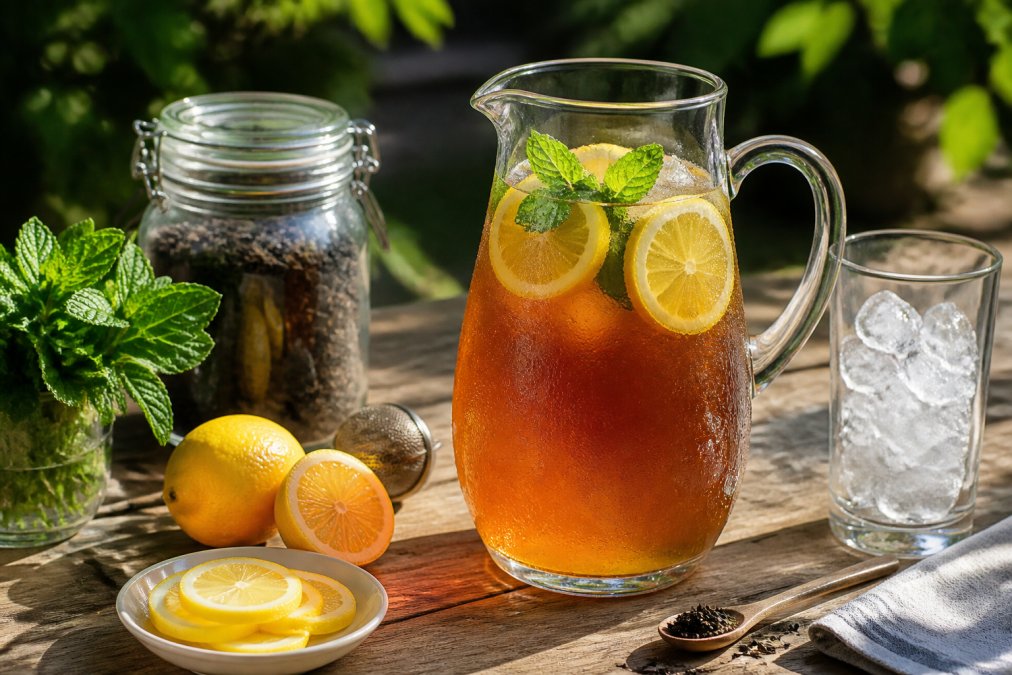
Hot Brew Method
Total time: 20 minutes | Difficulty: Beginner
- Boil fresh filtered water, then let it rest a minute. Rolling water scorches green and white teas.
- Add tea at roughly 1.5 times your hot-tea ratio, about 4 to 6 teaspoons of loose-leaf or 4 to 5 bags per quart of concentrate.
- Steep 4 to 5 minutes for black tea, 2 to 3 for green, 5 to 7 for herbal blends.
- Strain the leaves or pull the bags; don't let them sit in the pitcher.
- Pour the concentrate over ice, or refrigerate and dilute at serving.
Expected result: A clear, aromatic tea that stays flavorful as the ice melts.
Cold Brew Method
Cold brew trades speed for smoothness. Combine tea and cold filtered water at about 1 tablespoon loose-leaf per cup, cover, and refrigerate 8 to 12 hours. Strain and serve over ice.
The long, cool steep pulls less bitterness, so cold brew forgives a heavy hand with the scoop. It also keeps longer in the fridge, making it better for batch brewing ahead of a gathering.
Cold Brew vs Hot Brew Iced Tea: Which Method Wins?
Hot brew wins on speed and aroma; cold brew wins on smoothness and shelf life. Pick based on when you need the tea.
| Factor | Hot Brew | Cold Brew |
|---|---|---|
| Time to ready | 20 minutes | 8-12 hours |
| Flavor profile | Brighter, more aroma | Smoother, less tannic |
| Bitterness risk | Higher if over-steeped | Very low |
| Fridge life | 2-3 days | 3-5 days |
| Best for | Same-day cravings | Parties, meal prep |
If you're making tea for tonight, boil the kettle. If you're hosting Saturday, start a jar Thursday and let the refrigerator do the work.
Iced Tea Brewing Time: Getting It Right
Iced tea brewing time is the biggest variable between a clean, refreshing glass and one that tastes like steeped bark. These are working ranges, not hard rules, leaf size, cut, and freshness shift the window.
| Tea type | Hot brew steep | Cold brew steep | Water temp (hot brew) |
|---|---|---|---|
| Black (Assam, Ceylon) | 4-5 min | 8-12 hrs | 200-212°F |
| Green | 2-3 min | 6-8 hrs | 160-175°F |
| White | 3-4 min | 6-8 hrs | 175-185°F |
| Oolong | 3-4 min | 8-10 hrs | 185-195°F |
| Herbal (hibiscus, rooibos, mint) | 5-7 min | 8-12 hrs | 212°F |
| Pu-erh | 3-5 min | 8-12 hrs | 200-212°F |
Tannins are the polyphenols in tea leaves that create astringency and bitterness. They extract faster as temperature and steep time rise. Caffeine follows a similar curve, which is why a long cold steep still delivers a lift despite tasting smoother than a hot brew of the same leaf.
Why the window is narrower than it looks
Two things compress the usable steep time once you're brewing for ice:
- Concentration. A concentrate uses roughly 1.5 times the leaf of a hot cup, so every extra minute extracts more tannin per ounce than in a normal mug.
- Chilling. Cold mutes aromatics and amplifies bitterness perception. A steep that tastes fine warm can read as harsh at 40°F.
A common mistake is assuming iced tea needs a longer steep because it's served cold. It doesn't, concentration comes from more tea, not more time.
Troubleshooting by taste
- Harsh or drying finish, over-steeped or water too hot. Cut the next batch by 60 seconds or drop the water temp 10°F.
- Flat, watery, or "tea-colored water", under-leafed or under-steeped. Add leaf before time; time turns bitter fastest.
- Cloudy after chilling, tea cream, the natural complex of caffeine and polyphenols dropping out at cold temperatures. Harmless; a splash of hot water or lemon clears it.
- Muddy, dull color, usually hard water. See the water quality note below.
- Bitter only in the last glass, dilution from melting ice, not steep time. Switch to a concentrate.
Water quality: the variable most guides skip
Tap water chemistry matters more for iced tea than for almost any other cold drink, because you taste the water at full strength. Two things to watch:
- Chlorine and chloramine. Municipal systems add these to disinfect, and both flatten delicate aromas (the EPA). A carbon filter pitcher removes most chlorine; chloramine needs a filter rated for it.
- Mineral content. Very hard water pulls more tannin and can leave a chalky mouthfeel. Very soft or distilled water extracts poorly and tastes thin. Aim for moderate mineral content, if your tap is extremely hard, a 50/50 blend of tap and filtered or bottled water often brews better than either alone.
If you change one thing about your process, change the water before the tea.
How to Sweeten Iced Tea Naturally
The trick to sweetening iced tea naturally is dissolving the sweetener before it hits the cold liquid. Granulated sugar sinks and stays gritty; simple syrup mixes instantly and lets you sweeten by the glass rather than the batch.
Simple syrup is equal parts sugar and water, heated just until the sugar dissolves, then cooled. It keeps in the refrigerator about a month (foodsafety.gov).
Other options that work well:
- Honey, stir into the hot concentrate while it's still warm, since honey won't dissolve in cold tea
- Agave, slightly sweeter than sugar, so use about two-thirds the amount
- Maple syrup, adds a soft, warm note that suits black tea and chai-style blends
- Fruit juice, peach or mango nectar sweetens and flavors at once
Sweeten lightly and let people adjust their own glass. An over-sweet batch can't be fixed; an under-sweetened one just needs a drizzle.
Best Tea Leaves for Iced Tea
The best tea leaves for iced tea have high body and low astringency, because cold mutes delicate top notes and amplifies bitterness. Assam and Ceylon are classic, but fruity herbal blends and mint-forward green teas often perform better over ice than hot.
Beverly Blend's summer-friendly options map neatly onto the methods above:
- Mango Treat, a fruity tea with a hint of mango that works hot or iced. It's $20.99, and the fruit-forward profile means it needs little or no sweetener.
- Moroccan Mint, green tea with fresh mint, smooth hot and noticeably better cold. Also $20.99.
- Hibiscus Berry Tea, organic hibiscus, rosehips, orange peel, and rooibos with blueberry, passionfruit, and mango notes. Low astringency, high body, high sweetness. Built for cold brewing. $20.99.
- Peach Paradise, peach, cranberry, and rose in an herbal blend that's refreshing both hot and cold. $20.99.
For a full pitcher, the hibiscus blend is the standout: natural sweetness, deep color, and it holds up to a long cold steep without going flat.


Flavor Variations and Summer Pairings
Once the base method is dialed in, flavor is where iced tea gets interesting. The rule: add flavor to the concentrate, not the finished glass.
Try these combinations:
- Citrus and mint, lemon or lime zest plus a handful of fresh mint in the hot concentrate. The zest releases oils that survive chilling better than juice does.
- Stone fruit, sliced peaches or nectarines muddled into the pitcher, best with black tea or an herbal base.
- Cucumber and basil, a lighter, more savory profile that suits green tea
- Ginger and honey, steep fresh ginger slices with the tea, sweeten with honey while warm
- Berry infusion, frozen berries dropped into the pitcher double as ice cubes and flavor
Pairing iced tea with food follows wine logic: fruity herbal blends cut through grilled chicken and salads, mint-forward green teas suit lighter fare and spicy dishes, and bold black tea stands up to barbecue.
Common Mistakes to Avoid
Most iced tea problems trace back to one of six causes. Here's what each does to the glass, and how to fix it.
1. Over-steeping, then over-sweetening
The most common failure pattern: leaves stay in too long, tannins extract past the pleasant point, and the drinker reaches for sugar to mask the astringency. Pull the leaves at the time mark. If the tea still tastes weak, add leaf next time, not minutes.
2. Brewing at full strength and pouring over ice
The ice melts, the tea dilutes, and the last glass tastes like water with a hint of color. Brew a concentrate at 1.5 to 2 times normal strength, chill it, then pour over ice. The ice dilutes the concentrate into a balanced glass instead of diluting a correct one into a weak one.
3. Ignoring water quality
Chlorine and mineral content vary by municipality, and both affect aroma and body. Filtered water changes the final glass more than switching tea brands does. If your tap is very hard, blending it half-and-half with filtered or bottled water often brews better than either alone.
4. Storing it wrong
Iced tea keeps 2 to 3 days refrigerated when hot-brewed and 3 to 5 days when cold-brewed (the FDA). Keep it covered, tea absorbs nearby smells, and an open pitcher picks up everything from leftovers to cut onions. Glass beats plastic, which retains odors.
5. Dumping the whole batch over ice at once
Pour by the glass and keep the rest cold. A pitcher on a hot table loses its chill fast, and re-icing a diluted batch never recovers. Outdoors, set the pitcher in a bowl of ice rather than adding ice directly.
6. Forgetting the caffeine-free crowd
A summer gathering usually includes kids, pregnant guests, and people avoiding caffeine after mid-afternoon. If every pitcher is black or green tea, those guests get water. Brew at least one caffeine-free option, hibiscus, rooibos, peppermint, chamomile, or a fruit tisane, and label it. Herbal blends cold-brew beautifully and hold their color, making them the easiest pitcher to batch ahead.
Bonus: the waste angle
Summer entertaining generates a lot of single-use plastic. Three free swaps:
- Loose-leaf over bagged for batch brewing. Less packaging per serving, and spent leaves go straight into the compost.
- Reusable glass or metal straws instead of disposable ones. They also don't get soggy mid-sip.
- Compost the spent leaves. Tea leaves are nitrogen-rich and break down quickly in a backyard bin. If you use bags, check whether they're paper or plastic, many mainstream bags contain polypropylene, which won't compost. Paper bags and loose-leaf will.
Frequently Asked Questions
What is the secret to making good iced tea?
The secret is using enough tea and avoiding over-steeping. For hot brew, use 6-8 tea bags per gallon of water and steep for 4-5 minutes for black tea or 2-3 minutes for green tea. For cold brew, use 8-10 tea bags and steep in the refrigerator for 8-12 hours. Always remove the tea bags before refrigerating to prevent bitterness from tannins. A pinch of baking soda can also soften the flavor if your water is hard.
How many tea bags for 1 gallon of iced tea?
Use 6-8 regular tea bags for hot brew iced tea, or 8-10 tea bags for cold brew. If you prefer stronger tea, add 1-2 extra bags. For loose-leaf tea, use 1 ounce (about 6 tablespoons) per gallon. The type of tea matters too: black tea needs fewer bags than herbal tea because it has a bolder flavor. Always taste after brewing and adjust for your next batch.
Should you use boiling water for iced tea?
Yes, for hot brew iced tea, use boiling water for black and herbal teas. For green tea, let the water cool to about 175°F (80°C) before pouring to avoid bitterness. For cold brew iced tea, never use boiling water; use cold or room-temperature water and steep in the refrigerator. The best tea leaves for iced tea depend on your method, but black tea like Ceylon or Assam works well for hot brew, while green and herbal teas shine in cold brew.
How long does homemade iced tea last in the refrigerator?
Homemade iced tea lasts 3-5 days in the refrigerator when stored in a covered pitcher or jar. For best flavor, drink it within 3 days. If you sweeten with simple syrup or honey, the tea may last slightly longer because sugar acts as a preservative. Always discard iced tea if it smells sour, looks cloudy, or has visible mold. To extend shelf life, keep the pitcher sealed and avoid adding fresh fruit or herbs until serving.