

Is Organic Loose Leaf Tea Worth It?
Table of Contents
- The Case for Organic Loose Leaf Tea
- Loose Leaf Tea vs Tea Bags: The Quality Difference
- Health Benefits and Pesticide Residues
- Cost-Per-Cup Breakdown: Is It Actually More Expensive?
- How to Brew Loose Leaf Tea for Maximum Flavor
- Sustainability and Environmental Impact
- The Verdict: When Organic Loose Leaf Tea Makes Sense
- Frequently Asked Questions
Last Updated: September 18, 2026
The Case for Organic Loose Leaf Tea
Is organic loose leaf tea worth it? For discerning tea drinkers, the quality difference between loose leaf and commercial tea bags justifies the premium. Beverly Blend's approach to sourcing tea ensures that each cup delivers maximum flavor and aroma.
Loose Leaf Tea vs Tea Bags: The Quality Difference
Loose leaf tea uses full-leaf or large-piece tea, while commercial tea bags contain fannings and dust, broken fragments that release compounds faster, creating a muddier, more astringent cup that peaks quickly and fades.
Full-leaf tea allows 3-5 steepings, with each infusion revealing deeper flavors as leaves unfurl. Tea bags exhaust their flavor in a single steep.
Flavor complexity is where loose leaf separates itself. Beverly Blend's Jasmine blend with hand-plucked jasmine blossoms paired with green tea offers a harmony of fruity flavors on a medium bodied green tea base.
Tea bags restrict water circulation around leaves. Loose leaf in an infuser allows full contact, extracting more polyphenols and L-theanine, the amino acid responsible for tea's calming properties.
| Characteristic | Loose Leaf | Tea Bags |
|---|---|---|
| Leaf Grade | Full leaves, large pieces | Fannings, dust fragments |
| Steepings Possible | 3-5+ | 1 |
| Flavor Complexity | Rich, nuanced, terroir-driven | Flat, one-dimensional |
| Infusion Quality | Complete leaf expansion | Limited by bag material |
| Cost Per Cup | Higher upfront, lower per-cup | Lower upfront, higher per-cup |
| Environmental Impact | Minimal packaging | Microplastics, bleached paper |
A simple glass infuser or ceramic pot works best for loose leaf, letting you watch leaves unfurl and adjust steeping time visually, control tea bags don't offer.
Health Benefits and Pesticide Residues
Organic certification means tea was grown without synthetic pesticides, herbicides, or fertilizers. Since you steep the leaves directly in water, this matters more than for foods you can peel or wash.
Non-organic tea plants are often treated with synthetic chemicals to manage pests and increase yield. Steeping those leaves extracts chemical residues along with beneficial compounds. Organic tea eliminates this exposure.
A lesser-known concern with conventional tea bags is microplastic contamination. Many are manufactured from nylon or PET and sealed with microplastics. A single tea bag can release billions of microplastic particles into your cup. Loose leaf tea eliminates this entirely, since there's nothing between the leaf and your water except your infuser.
Polyphenols, antioxidants, and L-theanine are present in both organic and conventional tea. Organic loose leaf delivers these benefits without the chemical load or microplastic particles.
Many commercial herbal blends use non-organic ingredients. Transparency in sourcing matters when you're consuming something daily.
Cost-Per-Cup Breakdown: Is It Actually More Expensive?
A package of loose leaf tea costs more upfront than grocery-store tea bags, but the cost-per-cup tells a different story.
A single package of loose leaf tea yields roughly 10-15 cups. At $20.99 per package, that's approximately $1.40 to $2.10 per cup.
A box of 20 conventional tea bags costs $3-5 ($0.15-0.25 per bag), but you get only one steep per bag.
With loose leaf, you get 3-5 steepings from a single serving. At 3 steepings per serving, that's roughly $0.50 per infusion, higher than a tea bag, but the difference narrows over time.
The real financial advantage emerges through shelf-life and storage efficiency.
- Bulk buying: A 4-ounce package stores for months without quality loss. Tea bags require multiple box purchases over the same period.
- Minimal packaging waste: Loose leaf comes in one airtight container. Tea bags come in individual wrappers, a box, and sometimes a secondary carton.
- No stale-tea penalty: Loose leaf stays fresher longer, so you don't discard half-stale boxes of degraded tea bags.
Real-world cost comparison over one year:
How to Brew Loose Leaf Tea for Maximum Flavor
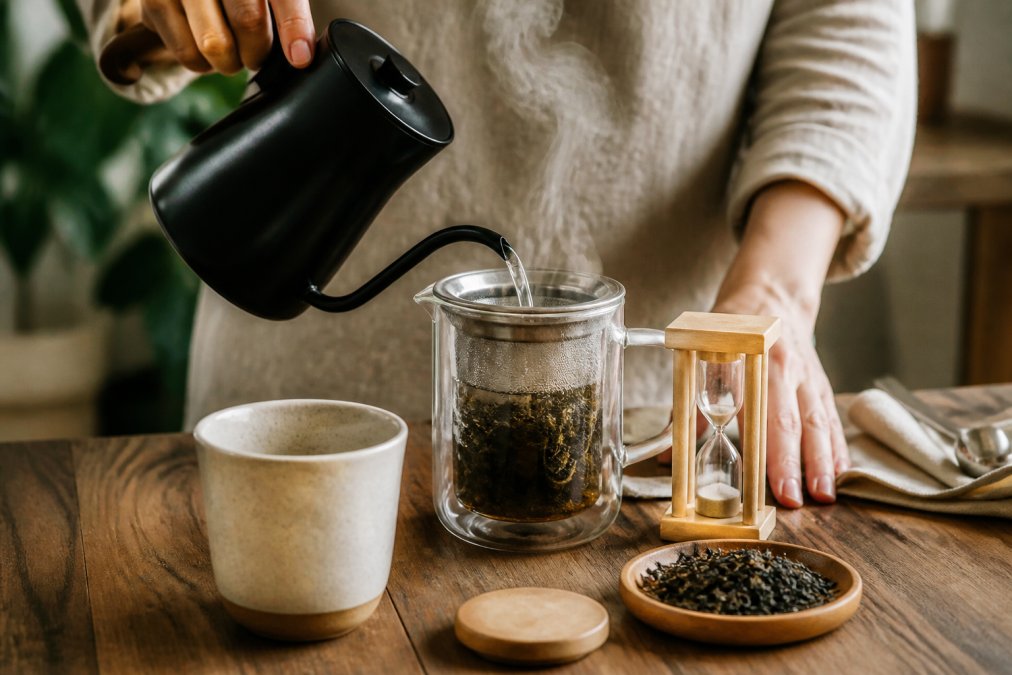
Proper brewing technique unlocks loose leaf tea's full potential: water temperature, steeping time, and leaf-to-water ratio.
For black teas like Beverly Blend's Earl Grey, use 195-212°F water, 2.5 grams per 12 ounces, and steep 5-10 minutes to extract bold, malty notes and bergamot oil without bitterness.
Green teas like Jasmine are delicate: use 160-180°F water and steep 3-5 minutes to preserve subtle fruity flavors. Jasmine yields multiple steepings, first brings brightness, second reveals deeper floral notes, third becomes smooth and silky.
Herbal teas like Hibiscus Berry handle boiling water (212°F) and 5-10 minute steeps without becoming bitter.

A mesh infuser basket allows full leaf expansion. A gaiwan or small teapot lets you observe leaves opening and adjust steeping time by sight.
Use more leaves for stronger tea rather than steeping longer, which creates bitterness. Use less leaf for lighter tea and stick to recommended time.
Filtered water prevents mineral buildup and ensures natural flavors come through without chlorine or tap-water notes.
Sustainability and Environmental Impact
Many commercial tea bags are bleached and sealed with microplastics that leach into your cup when steeped. Loose leaf eliminates this exposure entirely.
Loose leaf comes in minimal, recyclable or compostable packaging. Tea bags generate significantly more waste: the bag, staple, individual wrapper, and outer box.
Organic certification and direct sourcing ensure you're getting what you paid for.
The Verdict: When Organic Loose Leaf Tea Makes Sense
Organic loose leaf tea is worth it if you drink tea regularly and value flavor, health transparency, and environmental responsibility. Cost-per-cup is competitive with multiple steepings, and quality difference is immediately noticeable.
It's not worth it if you drink tea casually or prefer convenience over ritual. Grocery-store tea bags are adequate for occasional drinkers.
For home-based professionals and tea enthusiasts, premium tea elevates your daily ritual without significant additional expense. Beverly Blend's selection, from bold Masala Chai to delicate Jasmine, offers variety that keeps daily tea drinking interesting.
The real question is whether the benefits align with your priorities.
The difference between a forgettable cup and one that genuinely improves your day comes down to quality and attention. Beverly Blend's meticulously sourced loose leaf teas are designed for drinkers who take their daily ritual seriously. Each blend, from the refreshing Hibiscus Berry Tea to the timeless Earl Grey, delivers the flavor complexity and aroma that make loose leaf worth the investment. Start with a single blend and experience the difference that full-leaf quality makes.

Frequently Asked Questions
Does organic tea actually have fewer pesticides than conventional tea?
Yes. Organic tea is grown without synthetic pesticides or fertilizers, which means significantly lower pesticide residues in your cup. Conventional tea may contain residual pesticide compounds even after processing. Organic certification requires third-party verification of growing practices, so you have documented assurance that your tea meets strict standards. This matters especially for tea, since leaves are steeped directly in water and you consume the entire infusion.
Is loose leaf tea better than tea bags?
Loose leaf tea delivers superior flavor and quality for several reasons. Whole leaves retain more of their essential oils, antioxidants, and polyphenols compared to the dust and fannings found in most tea bags. Loose leaf also allows for multiple steepings, stretching the value of each purchase. The larger leaf particles create better water circulation during infusion, resulting in a more complex, nuanced flavor profile. Tea bags often contain microplastics from the bag material itself, which loose leaf avoids entirely.
How much does organic loose leaf tea cost per cup?
Premium organic loose leaf tea like Beverly Blend's offerings at $20.99 typically costs $1.40 to $2.10 per cup depending on leaf weight and steeping count. A standard 2.5g to 3g serving brews one 12-ounce cup, and most quality loose leaf teas can be steeped 2-3 times from the same leaves, effectively reducing the per-cup cost by 30-50%.
What makes Beverly Blend's loose leaf tea different?
Beverly Blend sources whole-leaf, organic tea blends like Earl Grey, Jasmine, and Masala Chai, each crafted for multiple steepings and flavor complexity. Their teas are loose leaf only, meaning no dust, fannings, or microplastics from bags. Each blend includes specific brewing instructions (temperature and time) to maximize the infusion quality. The organic certification ensures no synthetic pesticide residues.