

Airtight Containers for Coffee Bean Aroma: A Buyer's Guide
Last Updated: October 22, 2026
Quick Summary
Airtight containers coffee beans are stored in protect aroma by blocking oxygen, moisture, light, and heat exposure. Whole beans in a quality airtight container with minimal headspace hold peak flavor for three to four weeks when stored in a cool, dark cupboard.
- Fill airtight containers so beans occupy 75-80% of space to minimize oxygen contact while allowing the lid to close easily.
- Whole beans stay fresh far longer than ground coffee, which loses peak flavor within days due to increased surface area exposure to oxygen.
- Stainless steel containers offer complete light protection and durability, while ceramic and BPA-free plastic provide visibility but less long-term reliability.
- A worn gasket loses its grip after 50+ open-and-close cycles, gradually letting air in and degrading freshness even in sealed containers.
- Store beans in a cool, dark cupboard away from heat sources and appliances for best results; freezer storage works for bulk quantities portioned into smaller containers.
Table of Contents
- Why Airtight Containers Matter for Coffee Bean Aroma
- How to Store Coffee Beans for Maximum Freshness
- Seal Performance: What Keeps Aroma Locked In
- Best Coffee Storage Containers: Materials and Light Protection
- Vacuum Coffee Canisters: Do They Outperform Standard Airtight Seals?
- Storage Location Trade-Offs: Counter, Cupboard, Refrigerator, and Freezer
- Measuring Coffee Bean Freshness and Aroma Retention Over Time
- Common Storage Mistakes That Damage Aroma
- Frequently Asked Questions
Why Airtight Containers Matter for Coffee Bean Aroma
The moment coffee beans are roasted, they begin losing flavor and aroma. Oxygen exposure, moisture, light, and heat are the four enemies of freshness.
In a standard jar or bag, oxygen seeps in constantly, triggering oxidation that breaks down the oils behind coffee's aroma.
Beverly Blend roasts coffee to order because freshness is critical.
How to Store Coffee Beans for Maximum Freshness
Proper storage goes beyond sealing a container. Location, bean size, and headspace all matter.
Whole Beans vs. Ground Coffee Storage
Whole beans stay fresh far longer than ground coffee (Carbon monoxide emission rates from roasted whole bean and ground coffee). Grinding exposes exponentially more surface area to oxygen, so ground coffee loses peak flavor within days while whole beans hold quality for weeks.
Buy whole beans and grind just before brewing. If you must store ground coffee, use an airtight container and consume it within one week.
Capacity and Headspace Considerations
Container size matters more than most people realize. Too large a container leaves excess air above the beans, and that headspace oxygen degrades your coffee over time.
Fill airtight containers coffee is stored in so beans occupy about 75-80% of the space, minimizing oxygen contact while leaving room to open and close the lid without spilling.
Seal Performance: What Keeps Aroma Locked In
Not all seals are created equal. A loose seal lets oxygen in steadily; a quality seal keeps beans fresh week after week.
One-Way Valves and Degassing
Many coffee bags and some canisters include a one-way valve that lets carbon dioxide escape after roasting (degassing) while blocking oxygen.
If your airtight container has a one-way valve, don't block it.
For containers without a valve, test the lid by pressing down firmly and listening for a slight resistance or click that confirms the seal is working.
Gasket Quality and Repeated Use
The rubber or silicone gasket inside your lid does the real work, and after 50+ open-and-close cycles many gaskets lose their grip.
If you open your airtight container daily, inspect the gasket every few weeks and replace it if compressed, cracked, or flattened.
A worn gasket lets air in gradually, one of the most overlooked reasons beans lose freshness even in "airtight" containers.
Best Coffee Storage Containers: Materials and Light Protection
Container material affects how well your beans are protected, with trade-offs between durability, light protection, and ease of use.
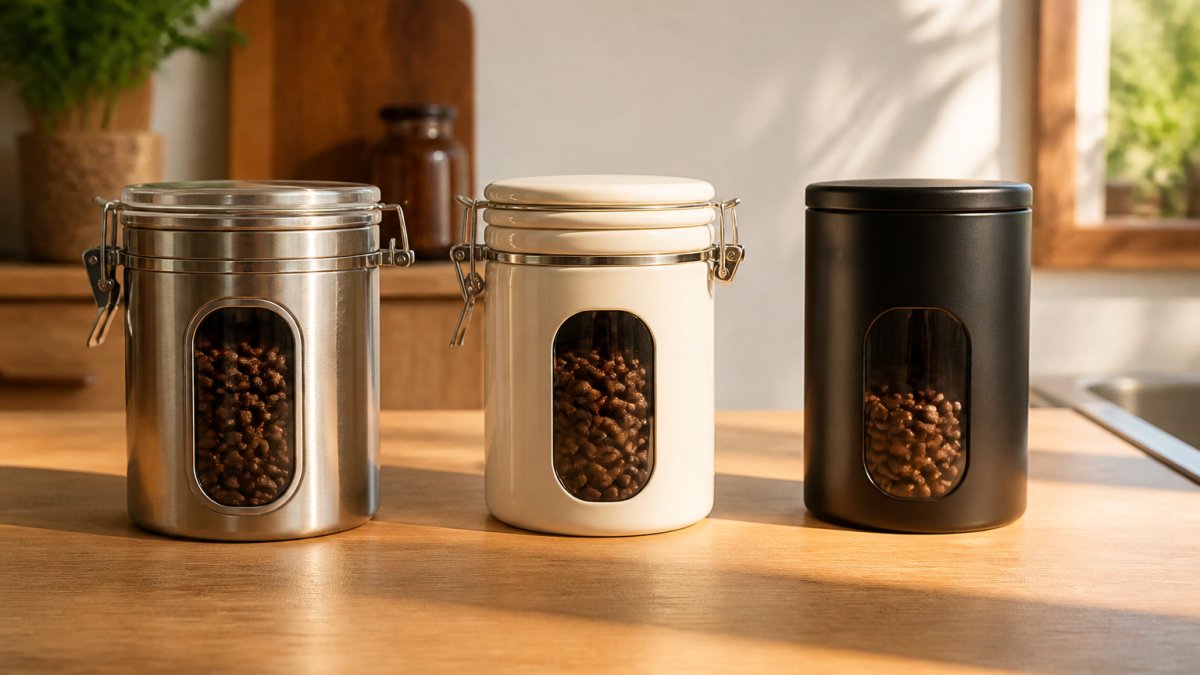
Stainless Steel vs. Ceramic vs. BPA-Free Plastic
Stainless steel offers excellent durability and complete light protection, doesn't retain odors, and resists drops.
Ceramic provides light protection with some visibility through a window or translucent glaze.
BPA-free plastic is lightweight, affordable, and often has a clear window.
For maximum aroma retention, stainless steel wins. For convenience and visibility, ceramic with a window or quality plastic is practical.
Vacuum Coffee Canisters: Do They Outperform Standard Airtight Seals?
Vacuum-sealed containers remove air actively, creating a seal stronger than a standard airtight lid. The question is whether the extra cost delivers real benefits.
It depends on your timeline.
Vacuum canisters cost more, require a pump or valve, and are bulkier to refill.
The real advantage is consistency: a standard airtight seal degrades slightly each time you open it, while a vacuum seal can be re-pumped to restore full protection.
Storage Location Trade-Offs: Counter, Cupboard, Refrigerator, and Freezer
Where you place your airtight container affects freshness as much as the container itself. Use this decision guide to match location to usage.
Countertop: Convenient but Exposed
Countertop storage works if the spot stays out of direct sunlight and away from the stove, oven, dishwasher, or coffee maker. A counter that swings from cool morning to warm afternoon forces beans through temperature cycles, and each cycle pushes aroma compounds out of the bean. It's best for beans you'll finish within two weeks and kitchens that stay roughly between 60°F and 75°F.
Cupboard or Pantry: The Default Best Choice
A cupboard or pantry is dark, temperature-stable, and out of the way, making it the best default for most home coffee drinkers. Beans in an airtight container in a cool, dark cupboard typically hold peak aroma for three to four weeks. Keep the container on a lower shelf away from the stove and refrigerator exhaust, and avoid the shelf directly above a heat-generating appliance.
Refrigerator: Useful Only With a Protocol
The refrigerator slows oxidation, but moisture is the problem: every time you pull a cold container into a warm kitchen and open it, condensation forms on the beans and inside the lid, accelerating staling and promoting mold. If you refrigerate, use a truly airtight container, keep it in the coldest, most stable part of the fridge (not the door), and let it reach room temperature before opening.
Freezer: Best for Bulk and Long-Term Storage
The freezer is the most effective option for storing beans a month or longer, but it carries the same condensation risk plus one trade-off: frozen beans become brittle and can shatter when ground straight from the freezer. Portion beans into smaller airtight containers or vacuum-sealed bags before freezing, so you thaw only what you'll use in a week, and let each portion reach room temperature in its sealed container before grinding.
A Simple Decision Rule
- Finish a bag in under two weeks: cupboard or a shaded countertop spot.
- Finish a bag in two to four weeks: cupboard, ideally a lower shelf away from heat.
- Buy in bulk or store for a month or more: freezer, portioned into smaller airtight containers.
The One-Way-Valve Bag Question
If your beans arrived in a bag with a one-way valve, you have a decision: keep them in the bag or transfer them. The valve lets carbon dioxide escape after roasting while limiting oxygen ingress, and for the first week or two after roast the bag is doing useful work.
Measuring Coffee Bean Freshness and Aroma Retention Over Time
Most storage advice stops at "keep it airtight." The more useful question is how you know your setup is actually working. Aroma is the easiest indicator to track, and a simple side-by-side protocol lets you compare containers, locations, and seal types over several weeks instead of guessing.
A Repeatable Aroma-Tracking Protocol
You don't need lab equipment to run a fair comparison, just the same coffee, the same starting point, and a consistent way to score what you smell and taste.
- Start with one roast, split evenly. Buy a single bag of whole beans and divide it into equal portions across the containers or locations you want to test. Label each portion with the date.
- Score aroma on a fixed schedule. On day 0, day 3, day 7, day 14, and day 21, open each container and rate the aroma on a simple 1-5 scale: 5 = vibrant and complex, 3 = muted but recognizable, 1 = flat or papery. Close the lid immediately after each sniff.
- Brew a fixed cup. On the same schedule, grind the same weight of beans at the same setting and brew with the same method, water temperature, and ratio. Taste side by side and note body, sweetness, and any stale or cardboard notes.
- Record, don't rely on memory. A short log of date, container, aroma score, and tasting note turns impressions into a comparison you can act on.
This protocol is not a laboratory measurement, but it is consistent, and consistency is what most storage claims lack. A container that scores a 4 or 5 on day 14 is doing its job; one that drops to a 2 by day 7 is not.
What the Scores Usually Reveal
A common pattern is that differences between a good airtight container and a vacuum canister are small in the first week and widen after two to three weeks. Location matters as much as the container: the same canister on a sunny counter and in a dark cupboard can produce noticeably different scores by day 14. If your log shows a steep drop between day 7 and day 14, the likely culprits are headspace, a worn gasket, or a warm storage spot, in that order.
Whole Beans vs. Ground Coffee: Why the Clock Runs Faster
Grinding exposes far more surface area to oxygen, so ground coffee loses aroma much faster than whole beans: ground coffee is best consumed within about a week, while whole beans in a good airtight container can hold quality for three to four weeks. If you buy pre-ground, choose a smaller container sized to a week's supply and keep headspace minimal. If you buy whole beans, a larger container is fine as long as you fill it to roughly 75-80% and grind just before brewing.
Seal Performance After Repeated Use
A seal that works on day one is not proof it will work on day thirty: gaskets compress, hinges loosen, and vacuum pumps lose their pull. After every cleaning or refill, press the lid down and listen for the resistance or click that tells you the seal is engaging, and inspect the gasket for cracks, flattening, or residue.
Common Storage Mistakes That Damage Aroma
Most people make at least one of these mistakes without realizing it costs them flavor.
Leaving the container open between uses. Each time you open an airtight container, you let oxygen in and aroma out.
Choosing containers based on looks alone. A beautiful jar that doesn't seal properly is worse than a plain plastic container with an excellent seal.
Buying more than you'll use in a month. Even in perfect conditions, beans decline after four weeks. Buying smaller quantities more frequently beats buying large amounts and hoping for the best.
Frequently Asked Questions
Should you store coffee beans in an airtight container?
Yes. Airtight containers prevent oxygen exposure, which causes oxidation and degrades coffee oils and flavor compounds. They also block moisture and humidity, which can make beans stale or moldy. An airtight seal with a gasket or vacuum mechanism is essential for preserving aroma and extending freshness beyond 1-2 weeks.
Is a vacuum-sealed coffee canister better than a standard airtight one?
Vacuum canisters remove air more completely than standard airtight seals, slowing oxidation further. However, the difference is modest if a standard canister has a quality gasket and one-way valve. Vacuum canisters cost more and require more effort to open and close. For many home coffee enthusiasts, a well-sealed standard canister performs nearly as well at lower cost.
How long do coffee beans stay fresh in a sealed container?
Whole beans in a sealed, opaque airtight container stay fresh for 2-4 weeks. Ground coffee loses aroma faster, typically within 1-2 weeks. Storage location matters: a cool, dark cupboard extends freshness longer than a warm countertop. Refrigerator or freezer storage can extend freshness to 1-2 months if the seal remains tight and condensation is avoided.
Should coffee beans be stored in a clear or opaque container?
Opaque containers are better. Light exposure, especially UV rays, degrades coffee oils and flavor compounds. Opaque stainless steel, ceramic, or dark-tinted plastic containers block light completely. Clear containers look attractive but compromise freshness. If you use a clear canister, keep it in a dark cupboard rather than on a lit countertop.
Storing coffee properly isn't complicated, but it's easy to get wrong. The right airtight container, paired with smart location choices, ensures every cup tastes as good as the moment those beans were roasted. At Beverly Blend, we roast to order so your beans arrive at peak freshness. From that point forward, your storage container becomes the guardian of that quality. Choose wisely, and you'll taste the difference every morning.
