

Art of Tea vs Verve Coffee: Which Is Better?
Table of Contents
- Art of Tea vs Verve Coffee: Head-to-Head Comparison
- How We Evaluated Both Brands
- Product Range: Loose Leaf Tea vs Specialty Coffee
- Brewing Methods and Equipment Compared
- Caffeine Content in Tea vs Coffee
- How to Make Iced Tea for Summer and Iced Coffee
- Pricing Breakdown and Value for Money
- Which One Should You Pick?
- Frequently Asked Questions
Last Updated: September 7, 2026
Choosing between Art of Tea and Verve Coffee is a question of which ritual you want to build your day around. Both sit at the top of the specialty beverage world, yet they serve different cravings. The "art of tea vs verve coffee comparison" rarely comes down to quality, it comes down to matching the right product to your habits, caffeine tolerance, and palate.
Art of Tea vs Verve Coffee: Head-to-Head Comparison
The short version: Art of Tea is a loose leaf tea specialist focused on organic, hand-crafted blends and ceremonial-grade sourcing. Verve Coffee is a California-born roaster known for bright, fruit-forward single origin coffees and a surf-culture aesthetic. One delivers a quiet, multi-steep experience; the other delivers a loud, immediate caffeine hit.
| Feature | Art of Tea | Verve Coffee |
|---|---|---|
| Primary Product | Loose leaf tea | Specialty coffee beans |
| Focus | Organic, hand-crafted blends | Single origin, fresh roasted |
| Flavor Profile | Floral, sweet, smooth | Bright, fruity, complex |
| Caffeine Delivery | Gradual, moderate | Fast, high |
| Best For | Slow ritual, multiple steepings | Quick morning jolt, espresso |
| Price Point | Premium | Premium |
These brands rarely compete for the same cup, you might drink Verve's espresso in the morning and Art of Tea's jasmine in the afternoon. This comparison is less about crowning a champion and more about which one fits your lifestyle.

How We Evaluated Both Brands
To move beyond marketing claims, we built a structured framework that pits Art of Tea against Verve Coffee on five weighted criteria that determine your daily experience.
| Criterion | Weight | What We Measured |
|---|---|---|
| Sourcing & Transparency | 20% | Traceability of origin, direct trade relationships, and clarity of supply chain information. |
| Flavor Complexity & Profile | 25% | Depth of flavor, balance, and distinctiveness of the core product line (e.g., Art of Tea's Earl Grey Creme vs. Verve's Sermon blend). |
| Brewing Flexibility & Forgiveness | 20% | How much room for error the product allows, and its adaptability to different brewing methods (e.g., multi-steeping for tea, cold brew for coffee). |
| Caffeine & Physiological Impact | 20% | The actual caffeine content per serving and the resulting energy curve (fast spike vs. sustained release). |
| Value Per Serving | 15% | The cost per 8 oz cup, accounting for re-steeping potential and recommended brew ratios. |
The Head-to-Head Results:
-
Sourcing & Transparency: Verve provides farm-level traceability for its single origins, often naming the specific producer. Art of Tea offers organic certification and a commitment to direct trade, but its blends are less transparent about the specific origin of each leaf component. Edge: Verve for origin specificity, though Art of Tea wins on organic integrity.
-
Flavor Complexity: Art of Tea's Earl Grey Creme is a masterclass in balance, the bergamot is bright but not sharp, and the vanilla creme adds a smooth, sweet finish that lingers. Verve's Sermon is a dark, chocolatey espresso with a heavy body and a distinct, almost smoky finish. Edge: Tie, they are both exceptional in their categories, but the flavor profiles are so different that a direct comparison is like comparing a symphony to a rock concert.
-
Brewing Forgiveness: This is where the categories diverge most. Art of Tea's loose leaf is remarkably forgiving. If you steep it for 4 minutes instead of 3, it won't become bitter; it just gets slightly stronger. You can even re-steep the same leaves 2-3 times, each infusion revealing a new layer. Verve's coffee is the opposite. A 15-second over-extraction on your espresso machine or a water temperature that's 10°F too hot will produce a harsh, bitter cup. Edge: Art of Tea for ease of use.
-
Caffeine & Physiological Impact: A standard 8 oz cup of Verve's Sermon brewed as a pour-over contains roughly 150-180 mg of caffeine, delivering a rapid spike in alertness within 15 minutes (the FDA). Art of Tea's Earl Grey Creme, steeped for 3 minutes, yields approximately 40-60 mg of caffeine (PubMed). This is a slower-release compound, often producing a steadier, less jittery focus that can last for several hours. Edge: Depends on your need, Verve for an immediate jolt, Art of Tea for sustained clarity.
-
Value Per Serving: A 12 oz bag of Verve's Sermon costs around $20 and yields roughly 20 cups, or about $1.00 per cup. A 4 oz pouch of Art of Tea's Earl Grey Creme costs around $18, but because you can re-steep the leaves, you can get 40-50 cups from it, bringing the cost down to $0.36-$0.45 per cup. Edge: Art of Tea on pure economics.
The 'winner' depends entirely on your priorities. If you value origin transparency and an immediate caffeine hit, Verve justifies its premium. If you value organic integrity, a forgiving brew, and lower cost-per-cup, Art of Tea is a strong choice.
Product Range: Loose Leaf Tea vs Specialty Coffee
Art of Tea offers an extensive loose leaf collection spanning green, black, white, oolong, and herbal varieties. Their blends lean toward the floral and the delicate, with organic certification as a recurring theme. Verve Coffee, by contrast, focuses almost entirely on coffee beans, with a rotating menu of single origins and seasonal blends.
For tea drinkers, Art of Tea's range rewards exploration. A fine jasmine green tea is medium-bodied, sweet, and silky, holding up well to multiple steepings, the signature of quality loose leaf.
Coffee roasters like Verve build their range around origin sourcing and roasting profiles, you choose by region, process, and roast date. Tea offers variety in flavor and ceremony; coffee offers depth within a narrower category.
Brewing Methods and Equipment Compared
Brewing loose leaf tea and specialty coffee demand different equipment, and this is where many home brewers get stuck. Tea requires temperature control and time; coffee requires precise ratios and technique.
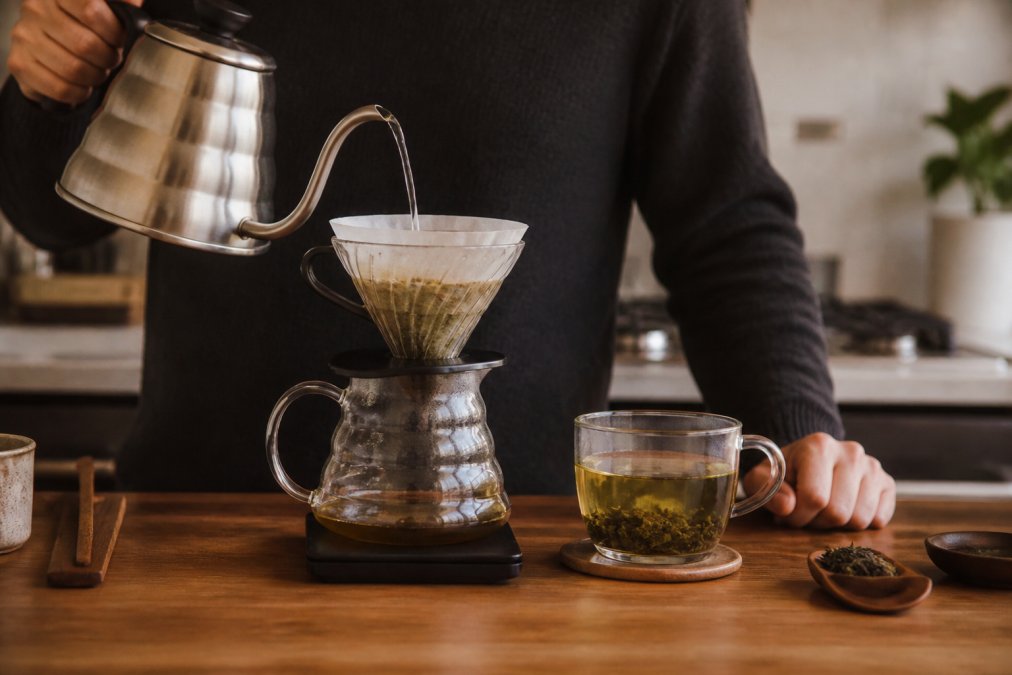
For tea, the essentials are a variable-temperature kettle and an infuser. Green teas brew best around 175°F, black teas at a full boil, with steeping times of two to four minutes. The margin for error is forgiving.
For coffee, the pourover method requires a gooseneck kettle, a filter, and a scale. Water should sit near 200°F, and extraction time depends on grind size. Coffee is less forgiving, a few seconds of over-extraction can ruin a cup.
This equipment gap explains why most households gravitate to one category: tea's parameters are gentle, coffee's are exacting.
Caffeine Content in Tea vs Coffee
The difference between Art of Tea and Verve Coffee isn't just flavor, it's how the caffeine makes you feel. The physiological impact depends on the form of caffeine, the co-factors present, and how you brew.
The Numbers, Grounded in Reality:
-
Verve Coffee (e.g., Sermon Blend): A standard 8 oz cup of filter coffee contains 150-200 mg of caffeine. Espresso is more concentrated (about 63 mg per 1 oz shot), but you typically consume less volume. The caffeine is unbound, meaning it's rapidly absorbed into your bloodstream, peaking in about 30-45 minutes. This produces a sharp spike in alertness and cortisol.
-
Art of Tea (e.g., Organic Earl Grey Creme): An 8 oz cup steeped for 3 minutes contains 30-50 mg of caffeine. However, tea leaves contain L-theanine, an amino acid that modulates caffeine's effects. L-theanine promotes a state of calm focus, slowing down the caffeine absorption and preventing the 'jittery' spike. The result is a smoother, more sustained energy curve that can last 4-6 hours without the crash.
The Brewing Parameter Effect: You Can Change the Dose
You are not locked into a single caffeine dose, you have control over the extraction.
-
For Tea (Art of Tea): The caffeine content in your cup is directly proportional to steeping time and water temperature.
- Steep Time: A 2-minute steep of a green tea yields less caffeine than a 5-minute steep. For black teas, a 3-minute steep is the sweet spot for flavor; a 5-minute steep will extract significantly more caffeine and tannins, making the cup more astringent.
- Water Temperature: Steeping at a full boil (212°F) extracts more caffeine than steeping at 175°F. If you want a lower-caffeine cup, use cooler water and a shorter steep.
- The Re-Steep Factor: Art of Tea's whole leaf teas can be re-steeped. The first steep contains the majority of the caffeine (about 60%). The second steep contains significantly less (about 25%), and the third steep is mostly flavor with minimal caffeine. This allows you to control your intake across the day.
-
For Coffee (Verve): Caffeine extraction is less variable than tea, but you still have levers to pull.
- Brew Ratio: A higher coffee-to-water ratio (e.g., 1:15 vs. 1:18) will produce a stronger, more caffeinated cup.
- Roast Level: Contrary to popular belief, light roasts contain slightly more caffeine by volume than dark roasts because the roasting process burns off some caffeine. Verve's light roasts (like their single origins) will give you a marginally higher caffeine kick per bean than their darker blends.
- Cold Brew: Cold brewing extracts caffeine efficiently but slowly. A 12-hour cold brew concentrate can have a higher caffeine concentration per ounce than hot coffee, but you typically dilute it with water or milk.
The Practical Takeaway:
- Morning (6-9 AM): Your cortisol levels are naturally peaking. A Verve espresso or pour-over will amplify this, giving you a powerful start. The high caffeine dose is appropriate here because your body is primed for alertness.
- Mid-Morning (10 AM - 12 PM): Switch to an Art of Tea black tea (like their Earl Grey or a Breakfast Blend). Steep it for 2-3 minutes. The L-theanine will smooth out the cortisol drop, maintaining focus without the second-cup jitters.
- Afternoon (1-3 PM): If you need a pick-me-up, opt for an Art of Tea green or oolong. Steep at 175°F for 2 minutes. This provides a gentle lift that won't interfere with your evening sleep cycle.
- Post-3 PM: Avoid both. The half-life of caffeine is 5-6 hours. A 3 PM coffee will leave 50% of its caffeine in your system at 9 PM, potentially disrupting deep sleep phases.
By understanding these mechanisms, you can use both brands strategically as precise tools for managing energy, focus, and sleep quality.
How to Make Iced Tea for Summer and Iced Coffee
How to make iced tea for summer is simple: brew double-strength tea, cool it, and pour over ice. For a half-gallon pitcher, use six teaspoons of loose leaf tea, steep for four minutes, then strain and refrigerate.
How to make iced tea for summer works best with bold teas that hold their flavor when diluted. A full-bodied breakfast blend stands up well to ice and sweetener; jasmine green tea makes a delicate option that needs no sugar.
Iced coffee follows a similar logic. Cold brew requires steeping coarse grounds in cold water for 12 to 18 hours. The result is smoother and less acidic than hot-brewed coffee poured over ice.
| Beverage | Brew Time | Ratio | Best Tea/Coffee |
|---|---|---|---|
| Iced Tea | 4 minutes | 1 tsp per 6 oz | Breakfast Blend tea |
| Cold Brew | 12-18 hours | 1:8 coffee to water | House Blend coffee |
| Hot Pourover | 3 minutes | 1:16 coffee to water | Single origin beans |
Pricing Breakdown and Value for Money
Both brands sit at the premium end, but cost per serving tells a different story. Coffee uses more material per cup: a 12 oz bag yields roughly 20 cups, while a 4 oz pouch of loose leaf tea yields 30 to 40 cups since the leaves are re-steeped.

Tea often delivers more servings per dollar, but value is not just cup count. Fresh roasted coffee offers a flavor intensity tea cannot replicate, and many drinkers happily pay for that daily experience.
For a balanced home setup, consider a medium roast house blend for mornings and a quality loose leaf tea for the afternoon. Together they cost less than a daily café habit, and you control the brewing parameters.
Which One Should You Pick?
Pick Verve Coffee if your priority is a bold, high-caffeine cup with complex origin flavors and you are willing to invest in brewing precision. Pick Art of Tea if you want a gentler, more varied ritual with multiple steepings and a wider flavor palette.
For many people, the answer is both. Starting with fresh roasted coffee and transitioning to loose leaf tea in the afternoon can provide the caffeine needed without overloading the system.
If you want to build a routine around both, Beverly Blend offers a curated path. Our House Blend delivers a smooth, medium-bodied coffee with nutty and sweet chocolate notes, ideal for pour-over or drip. For the afternoon switch, the Jasmine green tea brings a sweet, silky finish that re-steeps beautifully. Both are roasted and packed to order, so the flavor arrives at your door at its peak.
Frequently Asked Questions
Is Art of Tea a good brand?
Yes, Art of Tea is a well-regarded artisan brand known for its organic, hand-crafted loose leaf blends. Their sourcing emphasizes quality control and direct relationships with growers. Teas like Jasmine and Masala Chai get high marks for flavor depth and freshness. If you value organic certification and complex tasting profiles, Art of Tea is a strong choice for your daily tea ritual.
Is Verve a good coffee brand?
Verve Coffee Roasters is a respected specialty coffee brand with a strong following. They are known for their single origin offerings, fresh roasted beans, and distinct roasting profiles that highlight origin sourcing. Their retail experience and subscription service are popular among coffee enthusiasts. If you prefer a bright, clean cup with clear flavor notes, Verve is a solid option.
How does the caffeine content in tea vs coffee affect my choice?
A standard cup of coffee typically contains 95 mg of caffeine, while black tea has about 45 mg and green tea around 30 mg per 8-ounce cup. Coffee provides a quicker, more pronounced energy spike, which suits a morning wake-up. Tea offers a milder lift with L-theanine, which can promote calm focus without jitters. Choose based on when you need energy and how sensitive you are to caffeine.
Can I find both high-quality tea and coffee from the same source?
Yes, some retailers like Beverly Blend specialize in both artisan coffee and loose leaf tea. This lets you buy fresh roasted coffee for the morning and hand-crafted tea for the afternoon from one place. Look for brands that offer roasted to order coffee and organic tea options to ensure you are getting maximum flavor and aroma in every cup.
What should I look for when choosing between loose leaf tea and specialty coffee?
Consider your brewing setup, flavor preferences, and caffeine tolerance. Loose leaf tea requires proper steeping time and water temperature, and it often allows for multiple steepings, which adds value. Specialty coffee demands a good grinder and a pourover or espresso machine. Specialty tea offers diverse tasting profiles, while coffee delivers bold, complex notes that vary by roast.
Choosing between Art of Tea and Verve Coffee ultimately comes down to your caffeine needs and your preferred brewing ritual. Coffee delivers intensity and speed; tea offers gentleness and variety. Beverly Blend simplifies the decision by bringing both worlds together, with carefully sourced beans roasted to order and hand-selected loose leaf teas delivered fast. Get started with Beverly Blend and build a daily ritual that moves from a bright morning cup to a calming afternoon steep.