

Brewing Temperature Impact on Coffee and Tea Flavor
Table of Contents
- How Brewing Temperature Affects Coffee and Tea Extraction
- The Ideal Coffee Brewing Temperature for Maximum Flavor
- Understanding Under-Extracted vs Over-Extracted Coffee
- Tea Brewing Temperature by Type: Green, Black, and Herbal
- How Temperature Shapes Aroma, Body, and Sensory Profile
- Temperature Control in Practice: Methods and Measurement
- Frequently Asked Questions
Last Updated: October 10, 2026
How Brewing Temperature Affects Coffee and Tea Extraction
The brewing temperature coffee tea relies on is one of the most direct levers you have over the final flavor of your beverage. When you brew coffee or tea, hot water dissolves soluble compounds from the grounds or leaves, a process called extraction. The hotter the water, the faster and more aggressively this extraction happens. Understanding this relationship is essential to getting consistent, flavorful results every time you brew.
Water temperature determines which compounds dissolve and how quickly. Lower temperatures extract slowly and selectively, pulling out sweet and bright notes first; higher temperatures extract faster and more completely, risking bitter compounds. The ideal brewing temperature is a balance point where you get desired flavors without harsh or astringent ones.
A few degrees difference can shift your cup from balanced to sour or from smooth to bitter, which is why precision matters.
The Ideal Coffee Brewing Temperature for Maximum Flavor
The ideal coffee brewing temperature sits between 195 and 205 degrees Fahrenheit. Most specialty coffee professionals target 200 degrees as a reliable middle ground. At this temperature, water extracts coffee grounds evenly, pulling out the complex sugars and acids that create balance, sweetness, and body without over-extracting bitter compounds.
Brewing temperature coffee tea matters more than brew time alone. Coffee brewed at 185 degrees for five minutes tastes thin and sour; at 205 degrees for three minutes it tastes fuller and more balanced. Brewing temperature coffee flavor profiles so dramatically because you're controlling extraction speed.
Light roasts benefit from slightly hotter water, around 205 degrees, because their denser structure resists extraction. Dark roasts often work better at 195 degrees because they're already more soluble and extract quickly. Medium roasts sit comfortably in the 200-degree range. Our roasted-to-order coffees are crafted with these ranges in mind, ensuring maximum flavor and aroma from the moment they arrive at your door.
If your water is too hot (above 210 degrees), you'll pull out excessive tannins and bitter compounds. If it's too cool (below 190 degrees), extraction stalls and you'll taste sourness and weakness. The window is narrow but forgiving, staying within 195-205 degrees keeps you in the zone where extraction balances flavor.
Understanding Under-Extracted vs Over-Extracted Coffee
Under-extracted coffee happens when water isn't hot enough or contact time is too short. The result tastes sour, thin, and weak, like the coffee is missing its body and sweetness. You're pulling out the bright acids before the sugars and oils have time to dissolve.
Cold brew uses room-temperature water intentionally, requiring 12-24 hours of steeping to extract enough soluble compounds.
Over-extracted coffee occurs when water is too hot or contact time is too long. The cup tastes bitter, harsh, and astringent, like you've pulled out every possible compound, including the ones you don't want. Over-extraction is why over-steeped French press coffee tastes unpleasant, and why leaving grounds in contact with 212-degree water for more than four minutes often produces a harsh result.
The difference between under and over-extraction comes down to brewing temperature and time working together. A hotter temperature speeds extraction, so you need less time. A cooler temperature slows it, so you need more time. The goal is to hit the extraction sweet spot, roughly 18-22% of the coffee's soluble solids dissolving into your cup, where flavor balance peaks.
Tea Brewing Temperature by Type: Green, Black, and Herbal
Tea is fundamentally different from coffee: tea types have narrow optimal temperature windows because tea leaves and their flavor compounds are more temperature-sensitive than coffee.
Oxidation, the chemical process when tea leaves are exposed to air during processing, determines flavor compounds and their solubility. Black tea is fully oxidized (80-100%), oolong partially oxidized (20-80%), white tea minimally oxidized (0-12%), and green tea unoxidized (0-2%).
Black tea brews best at 200-212 degrees Fahrenheit. Full oxidation makes black tea compounds robust and less prone to astringency. At 205-212 degrees, black tea reaches full extraction in 3-5 minutes, releasing bold, malty flavor and deep color.
Oolong tea brews best at 195-205 degrees Fahrenheit. Partial oxidation creates both delicate, floral notes and deeper, fruity or roasted notes. A five-minute steep at 200 degrees releases both flavor layers without bitterness.
White tea brews best at 160-180 degrees Fahrenheit. Minimal processing preserves delicate, natural sweetness and floral notes. A three- to four-minute steep at 170 degrees produces a pale, naturally sweet cup. Water above 185 degrees over-extracts, pulling out harsh tannins.
Green tea is the most temperature-sensitive tea, brewing best at 160-180 degrees Fahrenheit. Water above 185 degrees over-extracts, pulling out harsh tannins; below 155 degrees under-extracts. Japanese green teas like matcha and sencha are especially sensitive due to higher chlorophyll and amino acid content.

Herbal tea (not from Camellia sinensis) benefits from boiling water at 212 degrees. Strong plant material like mint, chamomile, rooibos, and hibiscus requires aggressive extraction.
Comparing tea and coffee extraction: Coffee extraction happens quickly (2-4 minutes) because hot water dissolves ground particles rapidly. Tea extraction is slower because whole leaves unfurl gradually.
How Temperature Shapes Aroma, Body, and Sensory Profile
Brewing temperature changes which aromatic compounds end up in your cup. Volatile compounds that create aroma and bright flavor notes are more soluble in hotter water, making higher-temperature brews smell more intense.
Body, the full, heavy sensation on your palate, comes from oils, proteins, and dissolved solids. Hotter water extracts more, creating fuller body; cooler water extracts less, creating thinner mouthfeel. Cold brew tastes different from hot coffee because cooler extraction pulls fewer oils.
Sweetness perception changes with temperature: hot beverages taste sweeter because heat amplifies taste bud sensitivity to sugars. A cup perfectly balanced at 200 degrees may taste slightly sour once cooled.
Sensory profile, the overall impression of flavor, aroma, body, and mouthfeel, is shaped by temperature and contact time, which is why the same coffee brewed at different temperatures can taste entirely different.
Roasted Green Tea Powder | Smooth, Toasty & Rich in Umami →
Temperature Control in Practice: Methods and Measurement
Measuring water temperature accurately:
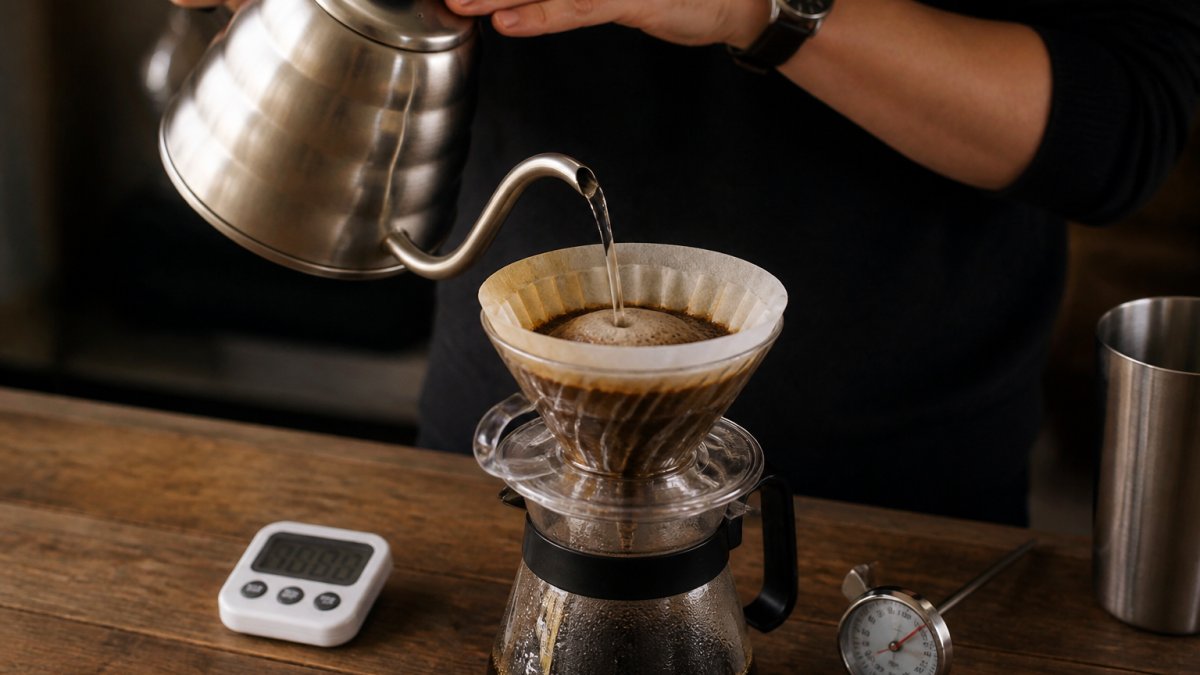
A gooseneck kettle with a built-in thermometer lets you heat water to an exact temperature and pour slowly. The thin spout improves pour control, affecting extraction consistency.
Digital instant-read thermometers are inexpensive (typically $10-20) and accurate to within ±1°F.
Electric kettles with preset temperature settings ($40-100) heat to your target temperature and hold it, eliminating the need to measure each time.
Without a thermometer, let boiling water cool 30 seconds before brewing black coffee or tea (drops to ~200-205°F), 3-4 minutes for green tea, or 1-2 minutes for oolong.
| Method | Temperature Accuracy | Best For | Cost | Pros | Cons |
|---|---|---|---|---|---|
| Gooseneck kettle with thermometer | ±2°F | Daily brewing, precision | $30-60 | Precise pouring, visual feedback | Requires reading thermometer each time |
| Instant-read thermometer | ±1°F | Any brewing method | $10-20 | Most accurate, works with any kettle | Requires manual measurement |
| Wait-and-estimate method | ±10°F | Quick brewing, simplicity | Free | No equipment needed | Least accurate, relies on consistency |
| Electric kettle with temperature setting | ±3°F | Convenience, repeatability | $40-100 | Automatic, holds temperature | Higher cost, less control over pouring |
Heat loss during brewing:
Water temperature drops as soon as it leaves the kettle, depending on temperature difference, surface area exposed to air, and vessel material.
Pour-over drippers cool water faster than immersion brewers because water is exposed to air.
Metal vessels retain heat better than ceramic or glass. Pre-heating is especially important for ceramic drippers; metal drippers and French presses lose heat more slowly.
For tea, a covered cup or teapot retains heat much better than an open mug, reducing heat loss by 30-40%.
Maintaining temperature during multi-stage brewing:
For pour-over coffee, pour slowly in stages (three to four pours over 3-4 minutes) to keep water temperature consistent and allow even extraction.
French press naturally maintains temperature better because grounds stay in contact with water.
Troubleshooting temperature-related flavor problems:
If coffee or tea tastes sour or weak, under-extraction is likely: increase water temperature by 5 degrees. If flavor improves, temperature was the issue.
Temperature is not the only variable affecting extraction. Grind size, dose, water chemistry, agitation, and brew ratio all interact with temperature. If adjusting temperature doesn't solve the problem, consider these variables:
- Grind size (coffee only): A finer grind increases surface area and speeds extraction. If you're brewing at 200 degrees and the coffee tastes sour, a finer grind may help more than raising temperature further.
- Dose: Using more coffee or tea increases the amount of soluble compounds available, which can mask under-extraction. If you increase dose without adjusting temperature or brew time, the cup may taste stronger but not necessarily more balanced.
- Water chemistry: Hard water (high mineral content) can slow extraction because minerals compete with coffee or tea compounds for space in the water. If your tap water is very hard, you may need slightly hotter water or a longer brew time to reach the same extraction level as someone with soft water.
- Agitation: Stirring or swirling during brewing speeds extraction by bringing fresh water into contact with grounds or leaves. If you're brewing at a lower temperature, gentle agitation can help compensate.
Frequently Asked Questions
What is the ideal brewing temperature for coffee?
The ideal coffee brewing temperature is between 195°F and 205°F (90°C to 96°C). Water in this range extracts soluble compounds effectively, balancing flavor, acidity, and body. Temperatures below 195°F result in under-extraction, producing weak or sour coffee. Above 205°F risks over-extraction, creating harsh, bitter flavors. Consistency matters: maintaining stable temperature throughout brewing ensures even extraction and repeatable results.
How does water temperature affect coffee flavor?
Water temperature directly controls how quickly soluble compounds dissolve from coffee grounds. Lower temperatures extract slower, leaving behind acids that create sourness and weakness. Higher temperatures extract faster, pulling out more compounds including bitter ones. The right temperature (195-205°F) extracts the full range of flavors: sweetness, acidity, body, and aroma. Temperature also affects volatile compounds responsible for aroma, so hotter water releases more fragrant notes.
Is 180°F hot enough to brew tea?
180°F works for some teas but not all. Green teas steep best at 160-180°F, so 180°F is appropriate for that type. Black teas need 195-212°F for proper extraction. Herbal teas typically need 200-212°F. Using water that's too cool for black or herbal tea results in weak, flat flavor. Using 180°F for green tea prevents over-extraction and bitterness. Always match water temperature to the specific tea type for best results.
What's the difference between under-extracted and over-extracted coffee?
Under-extracted coffee brews at too-low temperatures or for too-short contact time, leaving behind sour, weak, or thin flavors with little body. Over-extracted coffee results from excessive temperature, contact time, or both, pulling out bitter, harsh, or pungent compounds that overwhelm the cup. Under-extraction tastes sour and lacks sweetness; over-extraction tastes bitter and astringent. The right temperature and brew time balance these, delivering sweet, smooth, full-bodied coffee with clean acidity.
Should you use different water temperatures for green, black, and herbal tea?
Yes, each tea type requires a different temperature. Green tea steeps at 160-180°F to avoid bitterness and preserve delicate flavor. Black tea needs 195-212°F for full extraction and proper body. Herbal teas typically steep at 200-212°F to release their full sensory profile. Using the wrong temperature compromises flavor: too-cool water leaves herbal or black tea weak; too-hot water makes green tea bitter and harsh. Match temperature to tea type for optimal taste.
How can you control brewing temperature without a temperature-controlled kettle?
Use a standard kettle with a fast-read thermometer or an instant-read meat thermometer to measure water temperature after boiling. Let boiled water cool for 30 seconds to reach 200°F, or 2-3 minutes for 180°F. For green tea, boil water then let it cool before pouring. Insulated brewing vessels help maintain temperature stability during steeping. A gooseneck kettle gives better pouring control, improving brew consistency. These simple methods deliver repeatable results without expensive equipment.
How does brew time interact with water temperature?
Brew time and temperature work together to control extraction. Higher temperatures extract faster, so shorter contact time is needed (2-4 minutes for coffee). Lower temperatures extract slower, requiring longer steeping (3-5 minutes for green tea). If water is too cool, lengthening brew time won't fully compensate, leaving sourness. If too hot, extended contact over-extracts, creating bitterness. The right temperature-and-time combination ensures balanced extraction and consistent flavor across batches.