

How to Brew Coffee for Maximum Health
Table of Contents
- Why Brewing Method Matters for Coffee Health
- Paper vs Metal Coffee Filters: Health Impacts
- Step-by-Step: The Healthiest Brewing Process
- How to Reduce Coffee Acidity Without Sacrificing Flavor
- Healthy Coffee Additives That Enhance Benefits
- Common Brewing Mistakes That Reduce Health Benefits
- Frequently Asked Questions
Last Updated: September 28, 2026
Why Brewing Method Matters for Coffee Health
How to brew coffee for maximum health starts with understanding that the way you brew coffee determines how many beneficial compounds end up in your cup. Different brewing methods extract different amounts of polyphenols, antioxidants, and other compounds that affect your health.
Think of brewing like a conversation between water and coffee beans. The longer they talk, the more they exchange. Temperature, time, and contact all change what gets extracted. A French press brews differently than a pour-over, which brews differently than cold brew. Each method pulls out different things.
This matters because some brewing methods leave behind compounds that affect cholesterol levels. Others preserve more antioxidants. At Beverly Blend, we focus on roasting beans to order so you get maximum freshness, but learning how to brew coffee for maximum health is equally important. The right brewing technique unlocks the full health potential of quality beans.
The research is clear: your brewing method shapes your coffee's health profile as much as the beans themselves.
Paper vs Metal Coffee Filters: Health Impacts
Paper filters remove diterpenes and kahweol, two oils that can raise cholesterol levels. Metal filters let these compounds pass through into your cup.
This is the single biggest difference between brewing methods. Diterpenes are natural compounds in coffee oils. They're not harmful in small amounts, but regular consumption can affect your lipid profile. Paper filters trap them. Metal filters don't.
Here's the practical impact:
- Paper filters: Remove diterpenes and kahweol, lower cholesterol impact, lighter taste, less body
- Metal filters: Allow oils through, richer flavor, fuller body, higher diterpene content
- No filter (French press): Maximum oils, strongest flavor, highest diterpene levels
If you have high cholesterol or want to minimize diterpene intake, paper filters are your best choice. If you prioritize taste and don't have cholesterol concerns, metal filters work fine. Cold brew naturally filters out sediment without needing a filter, making it a middle ground.
The type of filter you use shapes your coffee's health profile more than almost any other variable. Choose based on your health goals, not just taste preference.
Step-by-Step: The Healthiest Brewing Process
Start with freshly roasted, freshly ground beans
Freshness matters more than people realize. Chlorogenic acid and other antioxidants begin breaking down the moment beans are roasted. After two weeks, they've degraded noticeably. After a month, they're significantly diminished.
Grinding immediately before brewing is non-negotiable. Ground coffee oxidizes fast. Whole beans stay fresh for weeks. Ground coffee stays fresh for hours. If you grind in the morning and brew at night, you've lost compounds.
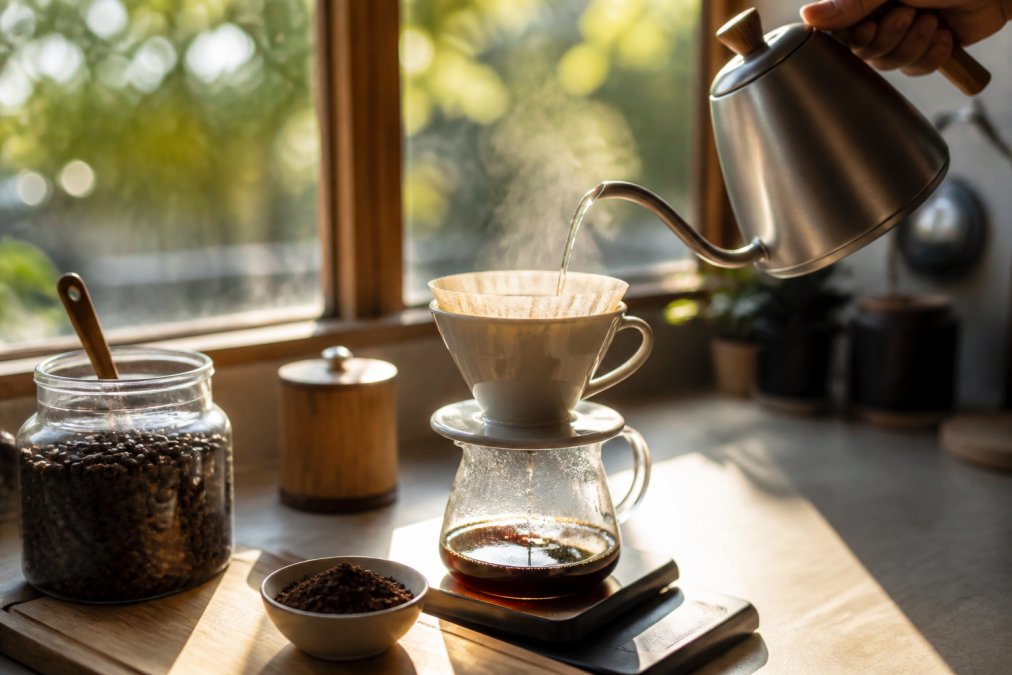
Beverly Blend roasts to order and ships fast, so your beans arrive at peak freshness. But the last step is yours: grind right before brewing. Buy a burr grinder if you don't have one. Blade grinders create uneven particle size, which ruins extraction.
Control water temperature and brewing time
Water temperature directly affects extraction. Too cold and you miss compounds. Too hot and you extract bitter ones alongside the good ones.
The sweet spot is 195-205°F. This temperature extracts polyphenols and antioxidants without pulling out excessive bitterness. Most electric kettles have a temperature setting. If yours doesn't, boil water and wait 30 seconds before pouring.
Brewing time varies by method:
- Pour-over: 3-4 minutes
- Drip coffee maker: 5-10 minutes
- French press: 4 minutes
- Espresso: 25-30 seconds
- Cold brew: 12-24 hours
Shorter brewing times preserve more acidity, which can be harder on your stomach. Longer brewing times reduce acidity naturally. If you have acid reflux or a sensitive stomach, let your coffee brew a bit longer or choose cold brew.
Choose your brewing method wisely
Each method extracts differently. Here's what matters for health:
Pour-over with paper filter: Best for cholesterol management. Removes diterpenes. Takes 5 minutes. Requires attention but gives you control.
Drip coffee maker with paper filter: Similar health benefits to pour-over. More convenient. Less control over variables.
French press: Full-bodied, rich flavor. No paper filter means diterpenes stay in your cup. Better for people without cholesterol concerns. Requires cleanup.
Coffee with Mushrooms Dark Roast →
Cold brew: Naturally low acidity. Less caffeine extraction than hot brew. Smooth taste. Takes time but requires minimal effort once started.
Espresso: Concentrated. Small serving size. Paper micro-filters used in some machines remove some diterpenes. Quick extraction means less time for compounds to break down.
Pick the method that fits your health goals and lifestyle. Consistency matters more than perfection. A brewing method you'll use daily beats a perfect method you abandon after a week.
How to Reduce Coffee Acidity Without Sacrificing Flavor
Coffee acidity irritates some stomachs, but acidity also carries flavor and antioxidant compounds. The real solution is managing acidity intelligently, not eliminating it, and water chemistry plays a larger role than most brewing guides acknowledge.
Water quality and mineral content are foundational. The pH and mineral composition of your brewing water directly affect how efficiently coffee extracts beneficial compounds like polyphenols and chlorogenic acid. Hard water (containing higher levels of magnesium and calcium) actually improves extraction and reduces perceived acidity because minerals buffer the sharp quinic acid that forms during brewing. Soft water or distilled water can make coffee taste sharper and more acidic because there's nothing to neutralize the acids being extracted.
If your tap water is very soft (below 50 ppm total dissolved solids), consider using a water filter that adds minerals back, or brew with bottled mineral water. If your water is hard, you're already getting a natural advantage, your coffee will taste smoother with less perceived bite.
Brew longer to naturally reduce acidity. Extended brewing time allows chlorogenic acid to convert more completely, reducing the sharp bite. French press at 4 minutes is noticeably less acidic than pour-over at 3 minutes. Cold brew at 12+ hours is the least acidic option because the lower temperature slows the conversion of chlorogenic acid to quinic acid, the compound responsible for coffee's sharp taste.
Use darker roasts strategically. Light roasts contain more chlorogenic acid, which converts to quinic acid during brewing and in your stomach. Dark roasts have less because the roasting process breaks down these acids through heat exposure. A dark roast brewed with filtered mineral water will be significantly smoother than a light roast brewed with soft water, even if both are brewed for the same time.
Add a pinch of salt. A tiny amount of salt (1/8 teaspoon per cup) neutralizes acids and enhances sweetness without adding flavor. This works because sodium ions chemically buffer acidic compounds. It sounds counterintuitive but is a practical technique used by specialty coffee professionals.
Choose lower-altitude beans. Beans grown at high altitudes (above 4,000 feet) develop more chlorogenic acid as a natural defense against UV exposure. Beans from lower regions are naturally smoother. This is subtle but measurable, a bean from 2,000 feet will taste noticeably less sharp than one from 6,000 feet, all else equal.
The combination approach works best. Use a darker roast, brew with filtered mineral water, extend your brewing time by 30 seconds, and add a pinch of salt. You'll get smooth coffee without sacrificing the antioxidants and polyphenols that make coffee healthy in the first place. The goal isn't to strip acidity entirely, it's to manage it so you get both flavor and health benefits.
Healthy Coffee Additives That Enhance Benefits
What you add to coffee matters as much as how you brew it, in fact, the wrong additives can completely erase the health benefits of a perfectly brewed cup. Most people don't realize that a single tablespoon of flavored syrup or processed creamer can introduce more sugar and additives than the coffee itself contains beneficial compounds.
Understand the health trade-off. A cup of black coffee contains roughly 200-550 mg of polyphenols and antioxidants, depending on brewing method. A tablespoon of standard flavored syrup adds 15-20 grams of sugar and often includes high-fructose corn syrup, artificial flavors, and caramel coloring. That single addition negates much of coffee's antioxidant benefit because your body must process the sugar spike, which triggers an inflammatory response that counteracts the anti-inflammatory compounds in the coffee. If you're brewing for maximum health, the additive choice is as important as the brewing method.
Additives that amplify health benefits:
Whole milk or cream: Adds fat, which slows caffeine absorption and reduces stomach irritation. Fat also helps your body absorb fat-soluble antioxidants more efficiently. Whole milk is superior to skim because the fat content matters for both taste and nutrient absorption.
Additives that undermine health benefits (avoid or minimize):
Common Brewing Mistakes That Reduce Health Benefits
Most people make at least one of these mistakes. They're easy to fix once you know about them.
Frequently Asked Questions
What is the healthiest way to brew coffee?
The healthiest brewing method combines freshly ground beans, water between 195-205°F, and a paper filter to remove cafestol and kahweol, diterpenes that can raise cholesterol levels. Pour-over, drip coffee, and Aeropress methods all work well. Brew for 4-5 minutes to maximize polyphenol extraction while keeping acidity manageable. Grind immediately before brewing to preserve antioxidants, and use filtered water for better extraction and fewer contaminants.
Does paper filtering coffee remove healthy compounds?
Paper filters remove cafestol and kahweol, which can elevate cholesterol, but they preserve most beneficial compounds like chlorogenic acid and polyphenols. In fact, removing these lipids makes the remaining antioxidants more bioavailable. Metal filters allow oils to pass through, which means more diterpenes reach your cup, a trade-off if you're concerned about cholesterol levels. Paper filtering is the better choice for maximum health benefits.
What are the healthiest things to add to your coffee?
Cinnamon enhances antioxidant content without adding empty calories. Unsweetened plant-based milk preserves the coffee's health profile better than sugar-heavy creamers. If you want functional benefits, consider our mushroom-infused coffee blends, such as the Coffee with Mushrooms Dark Roast, Coffee with Mushrooms Medium Roast, or Instant Coffee with Mushroom, which are infused with Lion’s Mane, Cordyceps, and Reishi mushrooms. Avoid syrups and excessive sugar, which reduce the relative antioxidant benefit per calorie consumed.
How does roast level affect the health benefits of coffee?
Light roasts retain more chlorogenic acid, a powerful antioxidant associated with reduced inflammation and better metabolic health. Dark roasts develop different polyphenol profiles and are slightly lower in caffeine, making them gentler on the stomach for some people. Medium roasts, like those used in specialty-grade arabica beans, balance antioxidant content with flavor complexity. Choose based on your acidity tolerance and desired antioxidant profile rather than roast darkness alone.