

Light Exposure and Coffee Bean Quality
Table of Contents
- How Light Exposure Affects Coffee Bean Quality
- Light Damage in Green vs. Roasted Coffee Beans
- How to Store Coffee Beans to Prevent Light Damage
- UV Light Effects on Coffee Beans and Oxidation
- Coffee Bean Packaging: Choosing the Right Container
- Roasted Coffee Shelf Life: Timeline and Storage Best Practices
- Testing Coffee for Light Exposure Damage
- Protecting Your Coffee Investment
- Frequently Asked Questions
Last Updated: October 9, 2026
How Light Exposure Affects Coffee Bean Quality
Light exposure is one of the most overlooked factors in coffee storage, degrading the flavor, aroma, and sensory qualities that make specialty coffee worth buying.
At Beverly Blend, our roast-to-order model means your beans are fresh when they ship, but what happens next depends on you.
The damage happens at the molecular level. Light energy breaks down flavor and aroma compounds: chlorogenic acid oxidizes faster, and volatile oils dissipate.
Visible Light vs. UV Light: What's the Difference
Visible light and UV light both damage coffee, but they work differently. Visible light accelerates oxidation and degrades flavor compounds.
Most people think sunlight is the main culprit, but it's the UV content, not brightness. A bright fluorescent bulb causes less damage than an hour of direct sunlight.
Treat all light as a threat: storage in darkness is always the better choice.
Light Damage in Green vs. Roasted Coffee Beans
Light affects green and roasted coffee beans differently because their structure and composition change during roasting.
Green Coffee Beans and Light Sensitivity
Green beans stored in light develop discoloration as chlorophyll breaks down, and light begins oxidizing the flavor precursors that develop during roasting.
If green beans are exposed to light before roasting, you're starting with damaged raw material.
For home roasters: storing green beans in clear containers on a shelf degrades them before they hit the roaster.
Roasted Coffee Beans: Heat, Color, and Light Interaction
Roasted beans are more vulnerable to light than green beans.
Light exposure roasted coffee beans causes visible changes: color fades, surface oils break down faster, and aroma weakens.
Roast degree matters.
The practical difference: in sealed, opaque containers, a light roast stays fresh 4-6 weeks and a dark roast 3-4 weeks.
How to Store Coffee Beans to Prevent Light Damage
Storage isn't complicated, but it matters. Three factors control how long your beans stay fresh: light, temperature, and humidity.
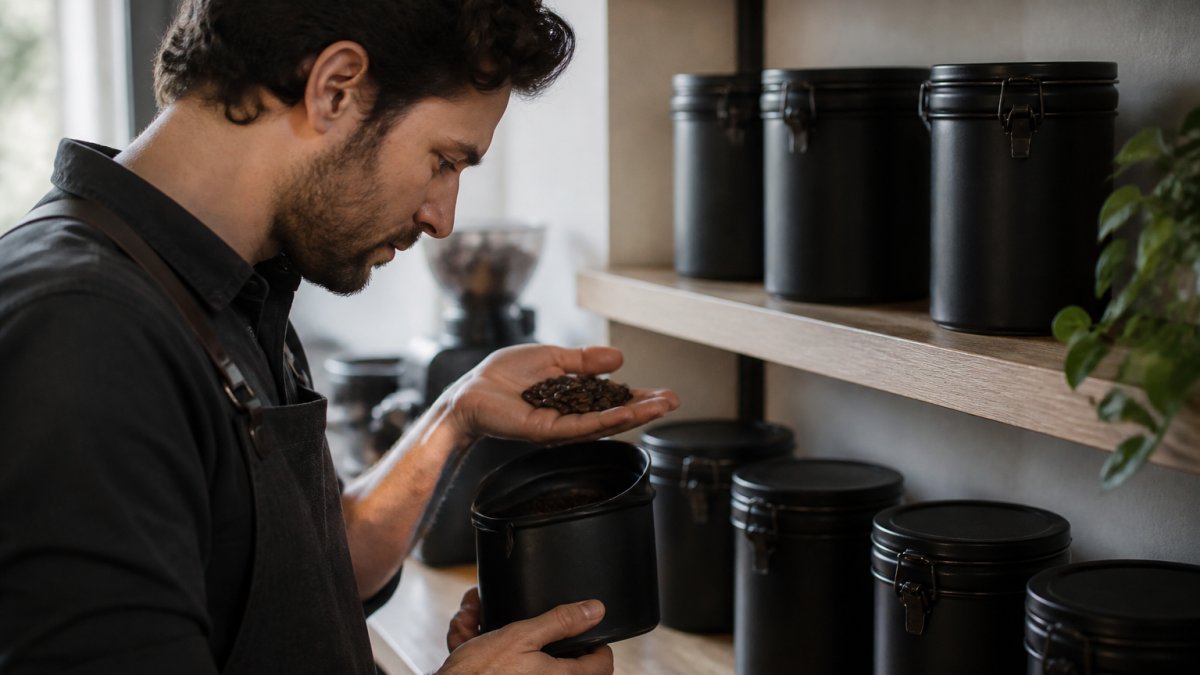
Temperature, Humidity, and Light Control
Keep your beans in a cool, dark, dry place. Cool means between 50-70°F (10-21°C). Most home kitchens are warmer, which accelerates staling.
But light is the fastest threat. Darkness is non-negotiable.
The ideal setup is an opaque, airtight container in a cupboard away from the stove and dishwasher. A pantry shelf works; a kitchen drawer or closet is better.
Avoid these common mistakes:
- Storing beans in clear glass jars on the counter
- Keeping beans near a sunny window
- Using clear plastic containers
Airtight containers control moisture, but opaque containers control light.
UV Light Effects on Coffee Beans and Oxidation
UV light accelerates oxidation faster than visible light alone, but the more useful question is how to tell light damage apart from the heat, oxygen, and humidity that usually accompany it. Sunlight on a counter delivers all four stressors at once, so blaming light for every stale cup overstates the case.
What Light Actually Does at the Molecular Level
Coffee's aroma comes from volatile organic compounds, aldehydes, ketones, furans, and sulfur-containing molecules, sensitive to photon energy. UV photons carry more energy than visible-light photons, driving photochemical reactions visible light alone cannot. The practical consequences:
- Lipid oxidation in surface oils. The thin oil film on roasted beans reacts with oxygen; UV accelerates the radical chain reaction that produces rancid, cardboard-like notes.
- Chlorogenic acid degradation. Chlorogenic acids contribute acidity and body. They degrade faster under light, which flattens perceived brightness.
- Volatile loss. Aroma compounds migrate out of the bean matrix faster when the surface is warmed and energized by light.
Isolating Light from Heat, Oxygen, and Humidity
To isolate what light alone does, change one variable at a time:
- Same roast, same roast date. Split a single bag so bean age and roast profile are identical.
- Same container type. Use identical opaque containers for the dark control and identical clear containers for the light sample, the only difference should be light transmission.
- Same temperature. Keep both samples in the same cupboard or drawer so temperature and humidity match. Do not put one near a window and one in a pantry; that confounds light with heat and humidity swings.
- Same oxygen exposure. Seal both the same way. If you use valve bags, use valve bags for both.
- Defined light dose. A common approach is a few hours of indirect daylight per day versus total darkness, held for two to four weeks.
Without this control, a 'light-damaged' sample is really a 'light-plus-heat-plus-humidity' sample, and you cannot attribute the flavor change to light.
What to Expect from Direct Sunlight
Direct sunlight contains the full UV spectrum plus infrared heat. A few hours on a sunny countertop can dull aroma and fade surface color, and the beans' surface temperature can rise well above ambient, adding heat-driven staling on top of the light effect.
The Practical Takeaway
Eliminating light is the easiest variable to control. But to understand why your coffee went flat, separate the variables: light fades color and mutes top-note aromatics first, heat accelerates overall staling, oxygen drives rancidity, and humidity drives mold and dulls acidity. Treating them as one problem makes the fix harder than it needs to be.
Coffee Bean Packaging: Choosing the Right Container
Packaging is where light protection either happens or fails. The choice is a trade-off between light blocking, oxygen control, and how the container fits your routine.
Opaque, Clear, and UV-Filtering Packaging Compared
| Packaging type | Light blocking | Oxygen control | Notes |
|---|---|---|---|
| Foil-lined or metallized bags | Excellent, blocks essentially all visible and UV light | Good when resealed; one-way valve helps | The default for most specialty roasters |
| Brown kraft paper | Good, blocks most visible light, partial UV | Poor unless lined | Best as an outer layer over a sealed inner bag |
| Opaque plastic or ceramic canisters | Excellent | Depends on lid seal | Look for a gasket or screw lid |
| Stainless steel canisters | Excellent | Good with airtight lid | Non-reactive, easy to clean |
| Tinted glass | Partial, typically lets a meaningful share of light through | Good with airtight lid | Not a reliable light barrier over weeks |
| Clear glass or clear plastic | None | Varies | Worst choice for light protection |
UV-filtering films and coatings exist for glass and plastic, but their effectiveness varies by product and wavelength range. Treat them as a partial measure, not a substitute for an opaque container.
Valve Bags and Airtight Seals
One-way valve bags let carbon dioxide escape after roasting without letting oxygen back in. The valve addresses oxygen, not light: a valve bag on a sunny shelf is still light-exposed.
Airtight seals matter for moisture and oxygen control. Zip-top bags work if fully sealed. Canisters with gaskets work. Anything that creates a real seal reduces oxygen exposure.
Storage Placement: Where the Container Goes Matters as Much as What It Is
Even a good container fails in the wrong spot. Placement guidance:
- Best: an interior cupboard, a closed drawer, or a pantry shelf away from the stove and dishwasher.
- Acceptable: a countertop spot that never receives direct or strong indirect daylight, with an opaque container.
- Avoid: windowsills, open shelving near windows, above the refrigerator (heat), above or beside the oven (heat and moisture), and anywhere a clear container is visible to daylight.
Matching Packaging to How You Drink Coffee
The right container depends on your pace:
- Daily espresso or pour-over, finishing a bag in 2-3 weeks: a foil-lined valve bag resealed tightly and stored in a dark cupboard is usually enough.
- Slower consumption, 4+ weeks per bag: an opaque, airtight canister in a dark cupboard gives more margin.
- Buying in bulk and freezing: portion into opaque, airtight bags or containers, remove as much air as practical, and store in the freezer. Light protection still applies inside the freezer if the door is opened frequently.
The Combination That Works
The strongest setup combines an opaque material, an airtight seal, and storage in darkness, addressing light, oxygen, and moisture at once. If you must compromise, prioritize opacity and darkness first, the cheapest and most effective fixes.
Roasted Coffee Shelf Life: Timeline and Storage Best Practices
How long does roasted coffee stay fresh? The answer depends on storage conditions.
Peak Freshness Window
Roasted coffee is best consumed within 2-4 weeks of roasting, when flavor and aroma peak. After 4 weeks, quality declines even in ideal storage.
The timeline assumes proper storage: opaque, airtight container in a cool, dark place. Light exposure coffee beans shortens this window dramatically.
This is why Beverly Blend roasts to order: you receive beans within days of roasting, so you start with maximum freshness, then storage conditions determine how long it lasts.
Signs Your Beans Have Lost Quality
Stale coffee has recognizable signs: weak or absent aroma, flat taste lacking brightness and complexity, and thin or missing crema on espresso.
If your coffee tastes muted or dull, storage is likely the culprit, light exposure, heat, or humidity have degraded the beans.
Prevention is cheaper than replacement: proper storage takes no effort, just darkness and an airtight container.
Testing Coffee for Light Exposure Damage
You can assess whether light has damaged your beans by examining them and tasting them.
Visual inspection shows color changes: light-exposed beans look dull and faded, sometimes slightly bleached, compared to beans stored in darkness.
The real test is taste.
If unsure, brew the same coffee stored in darkness versus in light.
Protecting Your Coffee Investment
Light exposure coffee beans is preventable with no special equipment, just darkness and an airtight container.
Your coffee is worth protecting. Proper storage ensures you actually taste the carefully sourced, expertly roasted beans you paid for.
The steps are simple:
- Buy opaque, airtight containers
- Store beans in a cool, dark cupboard or drawer
- Keep beans away from sunlight, windows, and heat sources
Beverly Blend delivers fresh beans to your door, roasted specifically for your order. The quality starts with our sourcing and roasting.
Frequently Asked Questions
Does light exposure damage coffee beans?
Yes, light exposure degrades coffee beans through oxidation and breakdown of compounds responsible for flavor and aroma. Both visible light and UV radiation accelerate this process. Roasted beans are particularly vulnerable because their increased surface area and lower moisture content make them more reactive to light. Green coffee beans, while more stable, also suffer quality loss under prolonged light exposure. Proper storage in opaque, airtight containers significantly slows this degradation and preserves the sensory qualities that make specialty coffee worth buying.
How should you store coffee beans to protect their quality?
Store beans in opaque, airtight containers away from direct sunlight, heat sources, and windows. A cool, dark cupboard or pantry is ideal. Maintain low humidity to prevent moisture absorption. For whole beans, use them within 2-4 weeks of roasting for peak flavor. Ground coffee degrades faster, so grind only what you'll use within a few days. Vacuum-sealed or valve-sealed bags work well for unopened packages.
Does UV light affect coffee bean flavor more than visible light?
UV light is more damaging than visible light because it carries higher energy and penetrates deeper into bean structure, causing faster oxidation and breakdown of aromatic compounds. However, visible light also contributes to quality loss over time, especially in bright kitchen environments. The combined effect of UV and visible light is more harmful than either alone. This is why opaque packaging is essential, it blocks both UV and visible light. Even indirect sunlight through a window can degrade beans if they're stored in clear containers, so darkness is your best defense.
How long does roasted coffee stay fresh, and does light affect the timeline?
Roasted coffee remains good for 2-4 weeks with proper storage. Light exposure shortens this window significantly. Beans stored in clear containers exposed to sunlight may lose noticeable freshness within 1-2 weeks, while those in opaque, airtight containers maintain quality for the full 4-week window. Ground coffee degrades faster due to increased surface area exposed to oxygen and light, use it within 3-5 days.
Protecting your coffee's flavor starts the moment it arrives. Light exposure coffee beans is the fastest way to waste premium coffee. Store in darkness, keep the seal tight, and your beans will taste as fresh as the day they were roasted. When you're ready to experience coffee that actually tastes like what you ordered, Beverly Blend's roast-to-order approach ensures maximum freshness from roaster to cup.