

Store Coffee Beans for Long-Term Freshness
Table of Contents
- The Enemies of Coffee Freshness
- How Long Do Coffee Beans Stay Fresh
- Best Coffee Storage Containers for Peak Flavor
- Freezing Coffee Beans for Long-Term Storage
- Temperature and Environment Control
- Whole Bean vs. Ground Coffee Storage
- Recognizing Stale Coffee Beans
- Sustainable Storage Solutions That Preserve Quality
- Frequently Asked Questions
Last Updated: September 26, 2026
The Enemies of Coffee Freshness
To store coffee beans freshness, you must understand how volatile aromatic compounds degrade after roasting. Four factors accelerate this breakdown: light, air, moisture, and heat. Light triggers oxidation and breaks down oils. Oxygen flattens flavor over time. Moisture introduces mold risk and causes beans to swell. Heat speeds up all degradation pathways, which is why cool storage beats warm environments.
The roast date matters most. Coffee degasses (releases CO2) for 7-14 days after roasting, during which flavor improves as CO2 escapes and oils redistribute. After this window closes, every day in warm, bright conditions costs you complexity and depth. Most people buy premium beans then store them poorly, erasing the roaster's work within weeks.
How Long Do Coffee Beans Stay Fresh
Coffee beans stay fresh for 2-4 weeks in an airtight container at room temperature. After this window, flavor noticeably declines as aromatic compounds evaporate and oxidation accelerates.
The Degassing Window and Its Impact on Shelf Life
Fresh-roasted beans release CO2 for 7-14 days after roasting. As CO2 escapes, it carries aromatic compounds to the surface and oils redistribute. During this window, flavor improves. A bean roasted 3 days ago tastes better than one roasted 1 day ago.
Once degassing completes around day 14, the bean's chemistry stabilizes and environmental factors begin breaking down desired compounds. Beans roasted 30 days ago have lost the degassing advantage and are entering decline.
Storage method directly impacts degradation speed. Beans in opened bags lose quality within 5-7 days as oxygen penetrates kraft paper or thin plastic. Beans in airtight containers (glass jar with rubber seal or vacuum-sealed bag) lose quality much more slowly.
Timeline by Storage Method
Room-temperature airtight storage: 2-4 weeks of peak flavor.
Opened bag or original packaging: 5-7 days before noticeable flavor loss.
Whole beans vs. ground coffee: Whole beans maintain peak flavor for 2-4 weeks. Ground coffee loses quality within 3-5 days even in airtight containers due to 20 times more surface area.
Freezer storage: 3-6 months when properly sealed. Cold slows oxidation, though frozen beans may taste slightly flatter than room-temperature beans of the same age.
Temperature as the Accelerator
Temperature is the most critical variable after degassing. Every 10-degree increase roughly doubles flavor degradation rate. A bean at 65°F degrades half as fast as one at 75°F. Cool pantries (65-70°F) preserve freshness longer than warm counters (75-80°F). Consistency matters as much as absolute temperature, steady 70°F is better than fluctuating 65-80°F, which causes beans to expand and contract, allowing oxygen penetration.
Humidity's Hidden Impact
Humidity accelerates degradation by allowing moisture to penetrate airtight containers over weeks, causing beans to absorb water and swell, and by promoting mold growth. In climates above 60% relative humidity, use desiccant packets (silica gel) inside your storage container.
Best Coffee Storage Containers for Peak Flavor
Airtight Containers vs. Original Packaging
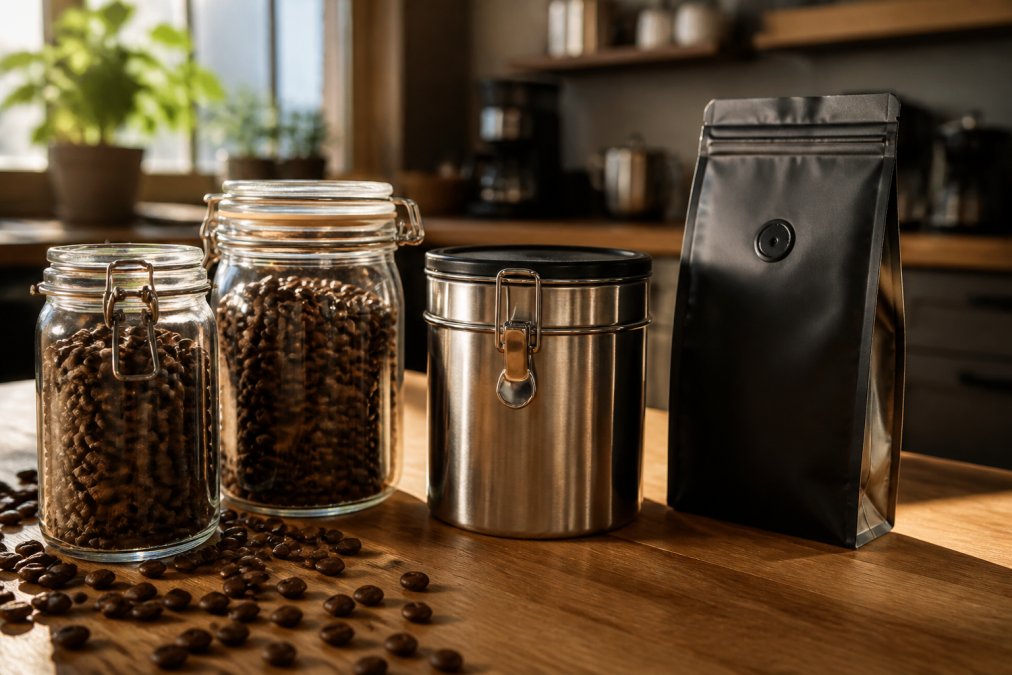
Original coffee bags allow oxygen permeation and flatten flavor after 2-3 weeks. Airtight glass jars with rubber seals or stainless steel containers provide superior protection by blocking light, preventing oxygen exchange, and keeping moisture out. Test seal integrity by filling with water, sealing, and inverting over a sink, if water leaks, oxygen will too.
The Role of Aroma Protection Valves
One-way aroma protection valves allow CO2 to escape while preventing oxygen entry during the first 7-14 days after roasting. After degassing closes, an airtight seal without a valve works equally well. Valves are temporary tools during active degassing, not substitutes for proper container design and cool storage.
Freezing Coffee Beans for Long-Term Storage
Freezing extends shelf life from 4 weeks to 3-6 months. Divide beans into weekly portions before freezing to prevent repeated temperature fluctuations, which allow condensation to form and accelerate staling.
Understanding Freezer Burn and How to Prevent It
Freezer burn occurs when ice crystals form on bean surfaces, damaging the outer layer. This happens when moisture sublimates in dry freezer air. Prevent freezer burn with proper packaging by removing oxygen and minimizing air exposure:
Vacuum-sealed bags (best option): Removes oxygen and prevents moisture sublimation. Beans last 4-6 months with minimal flavor loss.
Multiple layers of airtight protection: Seal beans in a glass jar, then place inside a freezer-safe ziplock bag. Less effective than vacuum sealing but better than single bags. Beans last 3-4 months.
Single-layer bags (not recommended): Beans develop visible freezer burn within 4-6 weeks.
Thawing Without Condensation: The Critical Step
Condensation is the most common freezing mistake. When cold beans warm up, the temperature difference between the bean surface and the surrounding air causes moisture in the air to condense directly onto the beans. This introduces liquid water that accelerates staling immediately upon thawing.
The solution is simple but non-negotiable: Never open frozen beans while they are still cold. Let beans reach room temperature completely while still sealed in their container. This process takes 30-60 minutes depending on portion size and room temperature.
Here's the correct thawing protocol:
- Remove the sealed container from the freezer.
- Leave it on the counter, unopened, for 30-60 minutes. The beans will gradually warm to room temperature while still sealed.
- Only after the container feels warm to the touch should you open it. At this point, the beans and the air inside the container are at the same temperature, so no condensation forms.
- Use the beans immediately or transfer them to an airtight pantry container for the next week.
If you open the container while it's still cold, condensation will form on the beans within seconds.
Choosing Between Freezer and Pantry Storage
Freezing is ideal if you buy beans in bulk (2-3 months' worth) or want to preserve a limited-edition roast. The trade-off is minor flavor flattening: frozen beans may taste slightly less complex than room-temperature beans of the same age, but they retain far more flavor than room-temperature beans stored for 3-6 months.
Grinding Frozen Beans
Do not grind beans while they are frozen or partially thawed. Grinding cold beans can damage your grinder and produce uneven particle size. Always allow beans to reach room temperature before grinding. If you plan to use frozen beans, remove them from the freezer 30-60 minutes before grinding.
Temperature and Environment Control
Room temperature storage (65-70°F) is ideal for beans you'll use within 4 weeks. This range slows oxidation without introducing the complexity of freezing. Avoid storing coffee above 75°F or in areas with temperature swings, like kitchens near stoves or windows.
Whole Bean vs. Ground Coffee Storage
Whole beans preserve their volatile aromatic compounds because they have minimal surface area exposed to oxygen. A single whole bean can stay fresh for 4 weeks in proper storage. The same coffee, ground into powder, loses quality within 3-5 days.
Recognizing Stale Coffee Beans
Stale beans lose their aroma first. Open a bag and smell it, fresh beans have a rich, complex scent with notes of chocolate, fruit, or nuts depending on the roast. Stale beans smell flat or cardboard-like. If the aroma is weak, the flavor will be too.
Sustainable Storage Solutions That Preserve Quality
Glass jars with rubber seals are reusable indefinitely and reduce packaging waste compared to buying new bags every month. Stainless steel containers last decades. Both options are better for the environment than single-use coffee bags, even premium ones with aroma protection valves.
Frequently Asked Questions
How long do coffee beans stay fresh after roasting?
Whole coffee beans stay fresh for 2-4 weeks after roasting when stored in an airtight container away from light, heat, and moisture. Peak flavor occurs within the first 2-3 weeks. Ground coffee degrades faster, typically staying fresh for 1-2 weeks.
Can I store coffee beans in the freezer for long-term freshness?
Yes, freezing extends coffee bean shelf life significantly, but only when done correctly. Freeze whole beans in airtight, vacuum-sealed containers or Mylar bags to prevent freezer burn and condensation. Remove only the amount you need and return the rest immediately to prevent thermal stress. Frozen beans can maintain quality for 3-6 months, though they begin losing aromatic compounds over time. Thaw frozen beans before grinding to avoid moisture damage.
What's the best container for storing coffee beans?
Airtight containers with opaque or dark exteriors work best. Look for containers with aroma protection valves that allow carbon dioxide to escape during degassing while blocking oxygen entry. Stainless steel, glass with sealed lids, and Mylar bags all offer excellent preservation. Avoid clear containers that expose beans to light, which accelerates oxidation and flavor loss. Beverly Blend's resealable pouches maintain freshness until you transfer beans to your preferred storage container.
Should I store coffee in the refrigerator?
Refrigerators are not ideal for coffee storage. Temperature fluctuations and moisture from condensation damage aromatic compounds and accelerate staling. If you must refrigerate, use an airtight, vacuum-sealed container to minimize condensation exposure. Room-temperature storage in a cool, dark cupboard is superior. Reserve refrigeration only for ground coffee in sealed containers if your kitchen temperature exceeds 75°F, and always use within 1-2 weeks for best flavor.
Storing coffee properly isn't complicated, but it does require intention. The difference between beans stored on a kitchen counter and beans stored in an airtight container in a cool pantry is dramatic, one week versus four weeks of peak flavor. Beverly Blend's roasted-to-order model ensures your beans arrive at their freshest, and proper storage from day one preserves that quality. Start with whole beans, keep them sealed and cool, and you'll taste the difference every morning.