

Artisan Coffee Subscription No Commitment
Table of Contents
- What Makes an Artisan Coffee Subscription Worth Your Money
- Freshly Roasted Coffee Delivery: The Real Difference
- How to Choose a Coffee Subscription That Fits Your Taste
- Coffee Subscription Cancellation Policy: Why Flexibility Matters
- Subscription Frequency and Delivery Windows
- Cost Per Cup: Breaking Down the Real Value
- Addressing Subscription Fatigue Before It Starts
- Conclusion
Last Updated: August 20, 2026
What Makes an Artisan Coffee Subscription Worth Your Money
The real question isn't whether you should buy artisan coffee, it's whether a subscription model actually fits how you drink it. Many coffee enthusiasts hesitate because they worry about commitment, waste, or ending up with beans they don't like sitting on the shelf. An artisan coffee subscription no commitment solves that problem by letting you control the frequency, pause whenever you want, and skip months without penalty.
Beverly Blend understands this tension. The brand's approach centers on roasted-to-order freshness paired with genuine flexibility. You're not locked into a contract. You can adjust delivery schedules, cancel anytime, or simply pause your subscription if life gets busy. That freedom matters more than most guides acknowledge.
What separates a worthwhile artisan coffee subscription from an expensive mistake comes down to three things: how fresh the beans actually are when they arrive, how much control you have over what gets sent, and whether the per-cup cost justifies the premium over grocery store alternatives. Below, we'll break down exactly what to look for and show you how to find an option that matches your actual coffee habits, not the habits you think you should have.
Freshly Roasted Coffee Delivery: The Real Difference
The gap between "fresh" and "actually fresh" is wider than most people realize. Freshly roasted coffee delivery means the beans were roasted within days of shipping, not weeks. This matters because coffee begins losing flavor compounds immediately after roasting. By day 14, you've lost significant aromatic complexity. By day 30, you're drinking stale coffee that tastes flat no matter how good the original bean was.
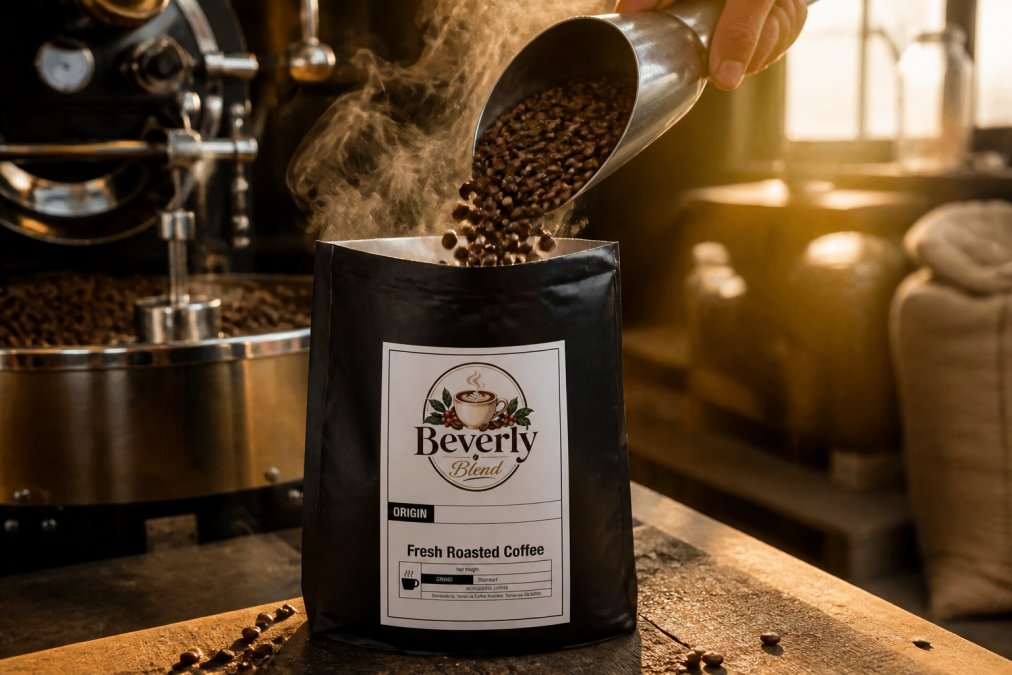
Beverly Blend's roast-to-order model means your beans are roasted after you place the order, not sitting in a warehouse. The timeline from roasting to your door typically runs 3-5 days. That's the sweet spot for peak flavor. You're tasting what the roaster intended, not a degraded version.

Compare this to most grocery store coffee, which was roasted months ago. Even "premium" brands at specialty retailers often sit 2-3 weeks before reaching shelves. By the time you brew it, you're tasting the ghost of what it could have been.
The roast profile matters too. A light roast preserves origin characteristics, the fruity, floral, acidic notes that make a Peru single-origin taste different from an Ethiopia. A dark roast develops chocolate, caramel, and molasses tones through longer roasting. A medium roast splits the difference. Fresh delivery only works if the roast profile matches what you actually want to taste.
How to Choose a Coffee Subscription That Fits Your Taste
Choosing the right artisan coffee subscription starts with understanding your own preferences, not what the internet says you should like. The biggest mistake is signing up for a curated selection service when you actually want control over what arrives each month.
Roast Profiles and Flavor Notes
Your roast preference is the foundation. If you love bright, acidic, fruity coffees, light roasts are non-negotiable. If you prefer smooth, chocolatey, low-acid cups, dark roasts are your lane. Medium roasts work if you want balance. The problem is that many subscriptions don't let you specify roast preference, they send whatever they decide you need.
Flavor notes matter, but they're also subjective. One roaster's "chocolate and caramel" might taste like "burnt and bitter" to someone else. The best subscriptions provide tasting notes with context: altitude, region, processing method, and grower information. This tells you WHY the coffee tastes a certain way, not just what adjectives the roaster assigned to it.
Beverly Blend's approach includes detailed tasting profiles. The Peru single-origin, for example, lists salted caramel, silky sweetness, and citrus notes, but also provides the altitude (1,100-1,700 meters), the processing method (gully washed and sun-dried), and the grower cooperative. This context helps you understand whether that specific bean will actually appeal to you.
Single-Origin vs. Blended Beans
Single-origin coffees come from one country, region, or even one farm. They showcase the unique characteristics of that terroir, the soil, altitude, climate, and processing method all influence the final cup. Ethiopia tastes different from Colombia tastes different from Peru, even if they're roasted to the same level.
Blended coffees mix beans from multiple origins to create a consistent flavor profile. A house blend might combine beans from three countries to achieve a balanced, approachable cup that tastes the same month to month. Blends are more forgiving, if one origin has an off-harvest, the blend still works.
The choice depends on your curiosity level. If you want to explore and compare, single-origins keep things interesting. If you want reliability and consistency, blends are safer. Many subscriptions offer both, letting you choose month by month. That flexibility matters more than being locked into one approach.
Grind Size and Brew Method Options
This is where most subscriptions fail. They send whole beans or pre-ground coffee, but they don't ask what you actually brew with. Someone using a French press needs coarse grounds. An espresso machine needs fine grounds. A pour-over needs medium. Pre-ground coffee for one method tastes mediocre in another.
The best subscriptions let you specify grind size, or better yet, send whole beans so you grind at home. Whole beans stay fresher longer. Grind size should be a checkbox option, not an afterthought.
Beverly Blend offers whole bean options, giving you control over grind timing. If you're ordering monthly, grinding fresh each week gives you the longest flavor window. Some subscriptions also offer brew method-specific recommendations, which helps if you're trying a new brewing technique.
Coffee Subscription Cancellation Policy: Why Flexibility Matters
The cancellation policy separates subscriptions you can actually commit to from ones that trap you. A no-commitment subscription means you can cancel, pause, or skip any month without penalty, explanation, or waiting period. No "you must give 30 days notice" clauses. No "cancellation fees." No "you're locked in for 3 months."
Many subscriptions advertise flexibility but bury restrictions in the fine print. Some require you to contact customer support to cancel, a deliberate friction point. Others auto-renew on a hidden schedule and make cancellation deliberately difficult. Avoid these entirely.
The best policy is instant cancellation through your account dashboard. Log in, click cancel, done. No email confirmation needed. No customer service interaction required. No waiting period. If a subscription makes cancellation harder than signup, that's a red flag about the company's actual values.
Beverly Blend's model emphasizes control. You manage your subscription through your account, adjust frequency whenever you want, and pause without losing your place. The approach acknowledges that coffee preferences change, budgets fluctuate, and life gets unpredictable. A good subscription adapts to your reality, not the reverse.
Subscription Frequency and Delivery Windows
How often you want coffee delivered depends on how much you drink and how fast you go through bags. Someone brewing two cups daily burns through a 12-ounce bag in about a week. A casual drinker might stretch it to three weeks.
Most subscriptions offer frequency options: weekly, bi-weekly, monthly, or custom schedules. The flexibility to change frequency month-to-month is crucial. You might want coffee every two weeks in summer when you're drinking less, then switch to weekly in winter when you're home more.
Delivery windows matter too. Some subscriptions ship on a fixed day. Others let you choose your shipping week. Knowing when to expect your order prevents the awkward moment when you run out of coffee before the next shipment arrives. A two-to-three-day shipping window gives you buffer room.
The roasting date should be recent, ideally within 2-3 days of shipment. Some subscriptions include the roasting date on the bag. Others don't. If they won't tell you when the beans were roasted, that's a sign they're not prioritizing freshness.
Cost Per Cup: Breaking Down the Real Value
The sticker price of artisan coffee is higher than grocery store coffee, but the real comparison lives in cost-per-cup, which accounts for how much coffee you actually drink and how many cups you get per bag.
A 12-ounce bag of artisan coffee typically costs $16-22 and yields 12-15 cups depending on your brewing method and strength preference. Here's how that breaks down across different consumption patterns:
Light drinker (1 cup daily, 7 cups per week):
- 12-ounce bag lasts 10-12 days
- Cost per cup: $1.33-1.83 (at $16-22 per bag)
- Monthly spend: $60-90 (3-4 bags)
- Grocery store equivalent: $0.50-0.75 per cup, $10-15 monthly
- Premium: $50-75 per month for fresh, quality coffee
Regular drinker (2 cups daily, 14 cups per week):
- 12-ounce bag lasts 5-6 days
- Cost per cup: $1.33-1.83
- Monthly spend: $120-180 (6-8 bags)
- Grocery store equivalent: $0.50-0.75 per cup, $20-30 monthly
- Premium: $100-150 per month
Heavy drinker (3+ cups daily, 21+ cups per week):
- 12-ounce bag lasts 3-4 days
- Cost per cup: $1.33-1.83
- Monthly spend: $180-270 (9-12 bags)
- Grocery store equivalent: $0.50-0.75 per cup, $30-45 monthly
- Premium: $150-225 per month
The premium is real, but it's not just about price, it's about what you're receiving. Freshness has a measurable flavor impact. A coffee roasted 3 days ago tastes noticeably brighter and more complex than one roasted 30 days ago. Single-origin beans showcase terroir (altitude, soil, processing method) that blended grocery store coffee can't match. Detailed tasting notes help you understand what you're tasting and why.
Sample packs offer a way to test the value proposition without full commitment. A 6-pack of 2-ounce samples costs $24.99 and lets you try 6 different roasts or origins. That's $4.16 per variety, or roughly $0.69 per cup at sample size. This is close to grocery store pricing, making it a low-risk entry point to evaluate whether the quality difference justifies the premium for your palate.

Subscription tiers can also improve value. Some services offer discounts for larger orders or longer commitments, though this conflicts with the no-commitment model. Look instead for frequency discounts: ordering every 4 weeks might be $18 per bag, while ordering every 2 weeks might be $17 per bag. Over a year, that $1 difference adds up to $26-52 in savings.
The cost-per-cup calculation should also factor in waste. If you subscribe but end up throwing away stale coffee because you overestimated your consumption, the real cost-per-cup is much higher. Honest consumption tracking, how long does a 12-ounce bag actually last you?, is essential before committing. Many subscriptions let you adjust frequency month-to-month, so you can dial in the right schedule without financial penalty.
Addressing Subscription Fatigue Before It Starts
Subscription fatigue is real. You sign up excited, receive two shipments, then the third arrives and you realize you still have half the previous bag sitting on your counter. Now you're drinking stale coffee from month two while month three piles up. The subscription that felt convenient becomes a source of guilt.
This happens because people underestimate how much coffee they actually drink, or because their habits change. Work from home becomes office commuting. Morning coffee ritual becomes grabbing something at a café. A subscription that made sense in September feels excessive by November.
The solution is honesty about your consumption. Track how long a 12-ounce bag actually lasts you. If it's three weeks, subscribe monthly. If it's five weeks, go every six weeks or request a custom schedule. Most subscriptions let you adjust, but you have to do it proactively.
The pause feature prevents fatigue without losing your subscription. If you're traveling, busy, or simply have enough coffee, pause for a month. No cancellation. No re-signup friction. Just pause and resume when you're ready. This flexibility is what separates subscriptions you'll stick with from ones you'll abandon.
Another angle: rotate through different flavor profiles. If you always get the same blend, it becomes routine. Trying single-origins from different regions keeps the experience interesting. Beverly Blend's sample packs work well here, variety prevents boredom without forcing you into a full commitment.

Choosing an artisan coffee subscription no commitment comes down to three decisions: Do you want fresh-roasted beans delivered regularly? Are you willing to pay a premium for quality and convenience? Can you find a service that actually gives you control over what arrives and when?
Beverly Blend checks all three boxes. The roast-to-order model ensures freshness, the flexible subscription lets you adjust frequency or pause anytime, and the detailed tasting profiles with single-origin options give you real choice. Start with the sample packs at $24.99 each to explore different roast profiles and flavor notes without overcommitting. If you find blends and origins you love, upgrade to regular deliveries and adjust your schedule based on actual consumption. The no-commitment structure means you can change your mind without friction.
Frequently Asked Questions
Is an artisan coffee subscription actually worth the cost compared to grocery store coffee?
Yes, if you value freshness and flavor. Artisan subscriptions deliver coffee roasted within days of arrival, while grocery store coffee sits on shelves for weeks. A single-origin roasted-to-order bean produces noticeably brighter flavor and aroma. The cost difference typically amounts to $0.50-$1.00 per cup more than commodity coffee, but the taste difference justifies it for daily drinkers who care about their morning ritual.
What should I look for in a flexible artisan coffee subscription?
Look for subscriptions that let you pause without penalty, skip deliveries, adjust frequency, and cancel anytime. Check if you can customize your selection, choose roast profiles, single-origin vs. blends, and grind size. The best options let you sample before committing with smaller starter packs. Avoid subscriptions that require long-term contracts or charge cancellation fees.
How do I know the coffee is actually fresh when it arrives at my door?
Check the roast date on the bag, it should be within 7-14 days of delivery. Roasted-to-order services print the exact roasting date, so you know precisely how fresh it is. Ask about the roast-to-delivery timeline; Beverly Blend roasts to order and ships quickly to lock in peak flavor. Whole bean coffee stays fresher longer than pre-ground, so choose whole bean if your brewer allows it.
Can I pause my coffee subscription instead of canceling?
Most flexible artisan subscriptions offer pause options that let you skip one or more deliveries without canceling entirely. This is ideal if you're working through a backlog or taking a break. Pause periods typically last 1-3 months, and you can resume whenever you're ready. Always confirm the pause policy before subscribing to ensure it matches your needs.
This article was written using GrandRanker