

7 Best Coffee Brewing Methods for Flavor Extraction
Last Updated: October 26, 2026
Quick Summary
The best coffee brewing methods for flavor extraction control grind size, water temperature, brew time, and the coffee-to-water ratio at once. Start at a 1:16 ratio with water at 195-205°F, then adjust one variable at a time. Pour-over delivers clarity and bright acidity, while French press and espresso build body and richness.
- Extraction yield is how much coffee dissolved; brew strength is how concentrated the cup tastes.
- Pour-over uses a paper filter and gravity for a clean, bright cup with high clarity.
- French press uses a metal mesh and full immersion for heavier body with more oils and sediment.
- Espresso doses 18 g for a 36 g yield and brews in 25-30 seconds.
- Cold brew with a coarse dark roast gives smooth, low-acid refreshment.
Table of Contents
- Coffee Extraction Techniques: How Brewing Methods Shape Flavor
- Pour-Over vs French Press: Two Paths to Flavor
- Coffee-to-Water Ratio for Brewing: The Golden Range
- Water Temperature for Coffee Brewing: Why 195-205°F Matters
- Espresso and Moka Pot: Pressure Brewing for Bold Flavor
- Cold Brew and AeroPress: Immersion Brewing for Smoothness and Control
- Troubleshooting Under-Extraction and Over-Extraction
- Choosing Your Brewing Method: A Flavor-First Decision Framework
- Frequently Asked Questions
Coffee Extraction Techniques: How Brewing Methods Shape Flavor
The best coffee brewing methods for flavor extraction share one trait: they control four variables at once, and that holds true across all coffee brewing methods. Grind size, water temperature, brew time, and the coffee-to-water ratio decide whether your cup tastes sweet and clear or muddy and bitter. Fresh beans give those variables a fair chance to work. This guide discusses brewing methods and the flavors they can produce.
Below, we'll discuss how brewing methods affect flavor. But first, here's what most brewing guides get wrong: they treat strength and extraction as the same thing, and confusing them is why so many home brewers chase the wrong fix.
Coffee extraction is the process of dissolving soluble flavor compounds, sugars, and oils from coffee grounds into water. Extraction yield is the percentage of the ground coffee's mass that dissolves into the cup, while brew strength measures the concentration of dissolved solids in the finished liquid. A cup can be strong and under-extracted at the same time, which is why tasting notes alone won't diagnose a bad brew.
Extraction Yield vs. Brew Strength: What's the Difference?
Extraction yield describes how much of the coffee dissolved; strength describes how concentrated the result tastes. Mixing them up leads to bad adjustments.
Think in two dials. Sour and thin means extraction is too low; bitter and drying means it ran too high. Weak but balanced means extraction is fine and you simply need more coffee per unit of water.
- Under-extracted: sour, salty, thin, sharp finish
- Over-extracted: bitter, dry, chalky, hollow middle
- Weak but balanced: add dose or reduce water
- Strong but balanced: dilute with hot water
That distinction matters because grind size and water temperature change extraction, while dose and water volume change strength. Fix the right dial.
Pour-Over vs French Press: Two Paths to Flavor
Pour-over and French press sit at opposite ends of the filter spectrum. Pour-over uses a paper filter and gravity for a clean, bright cup with high clarity. French press uses a metal mesh and full immersion for a heavier body with more oils and sediment. Grind size, contact time, and filtration affect the cup.
To compare them fairly, start with the same coffee, water, and dose. Here is a starting recipe for each method using a medium roast and a 1:16 ratio.
| Parameter | Pour-Over (V60-style) | French Press |
|---|---|---|
| Dose | 22 g | 22 g |
| Water | 352 g (12 oz) | 352 g (12 oz) |
| Grind | Medium-fine (table salt) | Coarse (sea salt) |
| Water temp | 200°F | 200°F |
| Total time | 3:00-3:30 | 4:00 steep + press |
| Filter | Paper | Metal mesh |
Pour-over rewards attention. A steady spiral pour keeps the coffee bed even, and the paper filter traps fine particles and some oils, so delicate notes like citrus and floral aromas come through clearly. The tradeoff is forgiveness: a sloppy pour channels water through weak spots. A 30-second bloom with twice the coffee's weight in water releases trapped carbon dioxide and prevents channeling later. If the bed drains too fast, grind finer; if it stalls, grind coarser.
French press is the more forgiving brewer. Coarse grounds steep fully submerged, so extraction is even by design. The mesh lets oils and fines into the cup, which mutes clarity but builds body. Expect a rounder, heavier texture and less sparkle than pour-over. Press slowly and stop before the plunger hits the bed to avoid agitating bitter fines.
A side-by-side tasting can help you compare the methods. Brew both with the same bean and water, cool to the same temperature, and note acidity, sweetness, body, and finish.
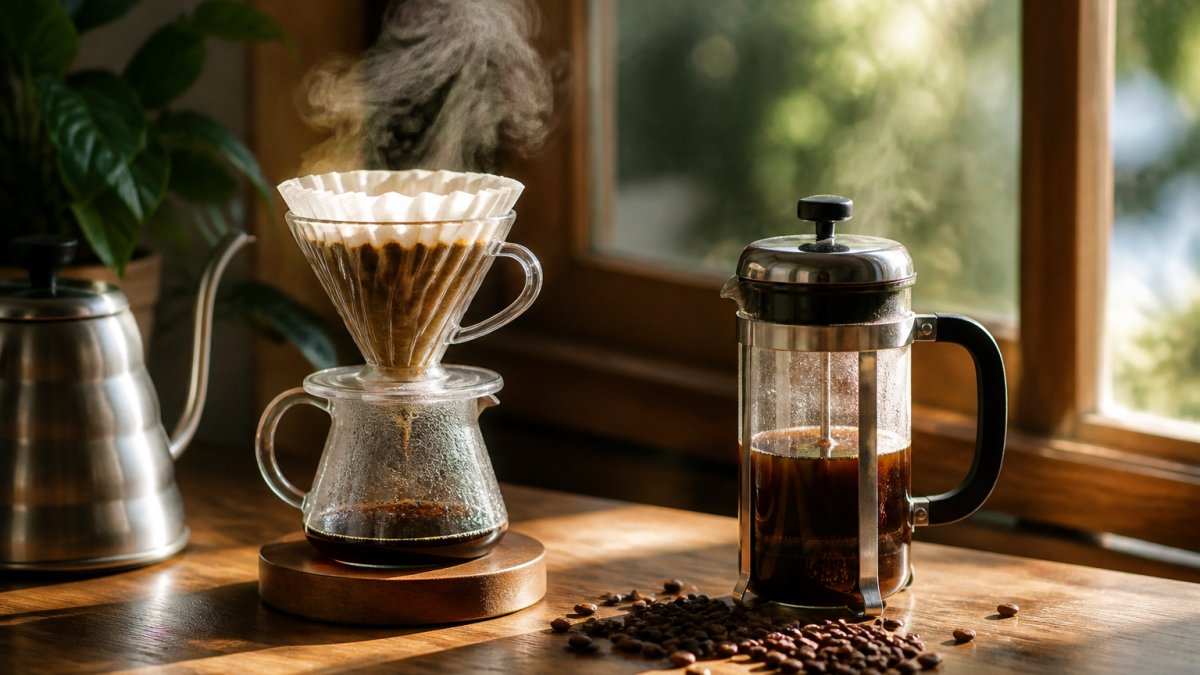
If you're leaning toward immersion, our guide to how long to steep French press coffee covers the timing that gets the best flavor. And if you want to try pour-over before buying gear, here's how to make pour over coffee without special equipment. For the full head-to-head, see our French press vs AeroPress comparison.
Coffee-to-Water Ratio for Brewing: The Golden Range
A coffee-to-water ratio is expressed by weight. That means one gram of coffee for every stated number of grams of water.
Weigh your coffee. Volume scoops vary wildly with grind and bean density, and a scale removes the guesswork that ruins repeatability. Measuring water by eye in the carafe drifts by a third of a cup without anyone noticing.
| Ratio | Coffee (per 12 oz water) | Cup Character | Best For |
|---|---|---|---|
| 1:15 | 24 g | Strong, syrupy | French press, cold brew concentrate |
| 1:16 | 22 g | Balanced, standard | Drip, AeroPress |
| 1:17 | 21 g | Lighter, clear | Pour-over |
| 1:18 | 20 g | Delicate, tea-like | Light roasts, large batches |
Start at 1:16, taste, then adjust one variable at a time. Change the ratio only after grind and temperature are dialed in.
Water Temperature for Coffee Brewing: Why 195-205°F Matters
For a deeper look at how heat changes what lands in the cup, read our breakdown of brewing temperature's impact on coffee and tea flavor.
Espresso and Moka Pot: Pressure Brewing for Bold Flavor
| Parameter | Espresso | Moka Pot |
|---|---|---|
| Dose | 18 g | 15-18 g (basket size) |
| Yield | 36 g | 60-90 g |
| Grind | Fine (powdered sugar) | Medium-fine (fine sand) |
| Water temp | 200°F | Hot water in base |
| Time | 25-30 sec | 4-6 min on stovetop |
| Pressure | High (pump) | Low (steam) |
Espresso demands a fine, consistent grind and a level tamp. Channeling, where water punches through a crack in the puck, is the most common defect and shows up as a sour, uneven shot. Grind consistency matters more here than in any other method. If the shot runs fast and tastes sour, grind finer or increase dose; if it runs slow and bitter, grind coarser or reduce dose. A scale under the cup is the cheapest upgrade you can make.
The Moka pot is more forgiving but less precise. It rewards a medium-fine grind and a filled, unpressured basket. Packing the grounds tight or letting the pot boil dry produces a burnt, metallic taste. Preheating the water shortens time on heat and reduces scorching. Clean the gasket and valve regularly; old oils turn rancid and ruin flavor.
For pressure brewing, we recommend beans built for it. Our 6 Bean Blend dark roast espresso is a six-bean house blend designed for espresso shots and espresso-based drinks. If you prefer a sweeter profile, our Blonde espresso blend combines Central American and African coffees for a sweet cup.


Cold Brew and AeroPress: Immersion Brewing for Smoothness and Control
For cold brew, coarse ground matters, and our Cold Brew Coffee dark French roast is ground very coarse for exactly this method. It's 100% coffee with no additives, built for a smooth, refreshing cup over ice.

Troubleshooting Under-Extraction and Over-Extraction
| Symptom | Likely Cause | Fix | Impact |
|---|---|---|---|
| Sour, thin cup | Grind too coarse | Grind finer | Raises extraction yield |
| Bitter, drying finish | Grind too fine | Grind coarser | Lowers extraction yield |
| Weak but balanced | Too little coffee | Increase dose | Raises strength only |
| Harsh, scorched notes | Water too hot | Drop to 195-198°F | Reduces bitter compounds |
| Uneven, sour shot | Channeling in puck | Level and re-tamp | Evens extraction |
| Muddy cold brew | Fines in the grounds | Use coarser grind | Improves clarity |
Specialty Coffee Association water standards outlines the mineral targets that support good extraction.
Choosing Your Brewing Method: A Flavor-First Decision Framework
Brewing methods can produce different flavor experiences.
- Want clarity and bright acidity? Choose pour-over with a light or medium-light roast.
- Want body and richness? Choose French press or espresso with a medium or dark roast.
- Want smooth, low-acid refreshment? Choose cold brew with a coarse dark roast.
- Want control and speed? Choose AeroPress and adjust contact time.
- Want a strong stovetop cup? Choose the Moka pot with a medium-fine grind.
A practical starting point is a sampler. Our Single Origin Coffee Sampler packs six 2 oz coffees from Brazil, Colombia, Costa Rica, Ethiopia, Honduras, and Tanzania, so you can taste how one method treats different origins before committing to a full bag.
Beverly Blend roasts to order and offers a simple ordering process with fast, automated fulfillment. Start with our single origin sampler to find your flavor, then let us deliver it to your door. Get started with Beverly Blend.
Frequently Asked Questions
Which coffee brewing method extracts the most flavor?
Brewing methods can produce different flavor experiences. The best choice depends on your preferences.
What is the 15-15-15 rule for coffee?
The 15-15-15 rule is a starting point for pour-over brewing. Treat it as a baseline, not a law.
How does grind size affect coffee extraction?
Grind size is one factor to consider when brewing coffee.
What is the difference between immersion and pour-over brewing?
Immersion brewing steeps coffee grounds in water, as with French press and cold brew. Pour-over brewing pours water through a bed of grounds. Neither is better; they suit different preferences.
