

Does Freezing Coffee Beans Keep Them Fresh
Last Updated: October 23, 2026
Quick Summary
Yes, does freezing coffee beans keep them fresh when done correctly, cold slows oxidation and moisture absorption, the main causes of staleness. Properly frozen whole beans maintain peak flavor for three to four months, compared to two to four weeks at room temperature. Success depends on airtight containers, small portions, and careful thawing to prevent condensation.
- Freeze whole beans only; ground coffee degrades in the freezer within two to three weeks
- Portion into one- to two-week supplies using vacuum-sealed bags or airtight glass containers with gaskets
- Thaw sealed packages in the refrigerator first, then at room temperature, to prevent condensation on beans
- Properly frozen beans last three to four months; beyond that they lose vibrancy and brightness
- Never refreeze thawed beans, as each freeze-thaw cycle introduces moisture and structural damage
Table of Contents
- Does Freezing Coffee Beans Actually Preserve Freshness
-
How to Freeze Coffee Beans for Maximum Flavor
- Step 1: Start With Whole Beans and a Roast Date
- Step 2: Decide Whether the Bag Is Still Sealed
- Step 3: Choose a Container That Blocks Air and Moisture
- Step 4: Portion Into Small Batches With Real Numbers
- Step 5: Remove Air and Seal
- Step 6: Freeze Fast and Keep the Temperature Steady
- Why This Protocol Works
- How Long Do Coffee Beans Last in the Freezer
- Can You Freeze Ground Coffee and Still Get Good Flavor
- How to Thaw Frozen Coffee Beans Properly
- Freezing vs. Other Storage Methods
- Common Mistakes to Avoid When Freezing Coffee
- Frequently Asked Questions
Does Freezing Coffee Beans Actually Preserve Freshness
Yes, does freezing coffee beans keep them fresh when done correctly, the answer is yes, it does preserve freshness when executed properly.
At Beverly Blend, we've watched customers assume freezing keeps beans fresh forever. It doesn't; it buys you time.
If you order our premium single-origin coffees and want to stretch that investment across months, freezing is your best move.

But freezing comes with real trade-offs: moisture and condensation, temperature fluctuations, freezer odors, and poor results with ground coffee. These aren't minor details. They're the difference between preserving flavor and destroying it.
How to Freeze Coffee Beans for Maximum Flavor
The process is straightforward, but precision matters. Most flavor loss people blame on freezing happens before the beans hit the cold: too much air, oversized portions, or a container that lets freezer air migrate in.
Step 1: Start With Whole Beans and a Roast Date
Freeze whole beans only. Grinding multiplies the surface area exposed to oxygen and moisture, and ground coffee degrades in the freezer within weeks rather than months. Check the roast date: beans roasted within the past two weeks carry the most aromatic compounds and benefit most from cold storage, while older beans have less to preserve.
Step 2: Decide Whether the Bag Is Still Sealed
Unopened bags are the easiest case. If the original packaging is a one-way valve bag that has never been opened, freeze the whole bag as-is, then place it inside a rigid freezer-safe container or heavy-duty resealable bag as a second barrier against punctures and freezer burn.
Opened bags need repackaging. Once the seal is broken, oxygen has already started working on the beans. Transfer them to an airtight container or vacuum-seal them before freezing.
Step 3: Choose a Container That Blocks Air and Moisture
Rank your options by how completely they exclude air:
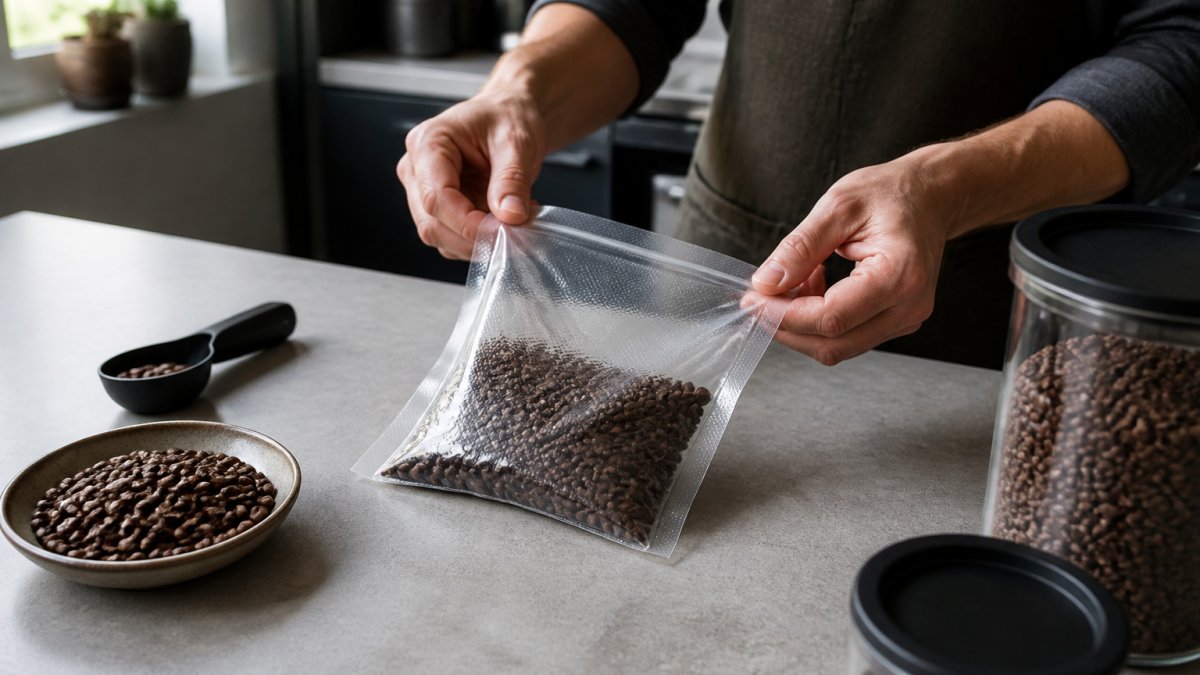
- Vacuum-sealed bags remove nearly all air and are the best choice for long storage. Use bags rated for freezing, not thin storage bags.
- Airtight glass containers with rubber gaskets and clamp lids are the strongest reusable option. Glass does not absorb odors and the gasket blocks moisture.
- Heavy-duty plastic containers with tight-sealing lids work if the seal is genuinely tight. Thin deli containers and standard freezer bags are not adequate for months-long storage.
Avoid ordinary freezer bags and open-top containers. Freezer burn is ice crystal formation on the bean surface, and it happens when air reaches the beans. A proper seal prevents it.
Step 4: Portion Into Small Batches With Real Numbers
Portion size is where most guides stay vague. A practical target is a one- to two-week supply per package. A single daily brewer using about 0.35 ounces per cup needs roughly 5 ounces for two weeks; a household brewing two cups a day needs about 10 ounces.
Weigh portions on a kitchen scale rather than eyeballing them, and label each package with the roast and freeze dates. Small portions mean you thaw only what you'll use, keeping the rest out of repeated temperature swings.
Step 5: Remove Air and Seal
If vacuum sealing, use the moist-food setting if available and stop the seal before the beans are crushed. With rigid containers, fill close to the top to limit headspace, press the lid down firmly, and check the gasket. Squeeze excess air from resealable bags before closing.
Step 6: Freeze Fast and Keep the Temperature Steady
Place portions toward the back or bottom of the freezer, away from the door, where temperature fluctuates least. A steady freezer protects beans far better than one that cycles warm and cold. Keep packages away from strongly scented items, or rely on your airtight layer to block odor transfer.
Why This Protocol Works
The mechanism is simple. Oxidation and moisture absorption are the two forces that stale coffee, and cold slows both. Air in the package is the enemy, so every step above excludes it. Follow the steps and you get the full benefit; skip packaging or portioning and you get the flat, muted result most people associate with frozen coffee.
How Long Do Coffee Beans Last in the Freezer
Properly frozen whole beans maintain good flavor for three to four months. Beyond that, they don't spoil or become unsafe, they simply lose vibrancy: the aroma flattens and the brightness fades.
This timeline assumes airtight containers, minimal air exposure, and a steady freezer temperature. Fluctuating temperatures shorten this window, and beans in regular freezer bags might last only six to eight weeks.
The roast date matters here. Beans roasted within the past two weeks freeze better than older beans: fresh beans have more aromatic compounds to preserve.
Can You Freeze Ground Coffee and Still Get Good Flavor
Freezing ground coffee is possible but not recommended. Grounds have dramatically more surface area exposed to air and moisture, and freezing causes ice crystals to form throughout, damaging the cellular structure.
Most people who freeze ground coffee report noticing flavor loss within two to three weeks. The coffee tastes flat or muted. You lose the brightness and complexity that makes specialty coffee worth buying.
If you must freeze ground coffee, use the smallest possible portions and consume within two weeks. But honestly, the better move is freezing whole beans and grinding just before brewing. A burr grinder takes ninety seconds.
Bourbon Barrel-Aged Guatemala Coffee – Single Origin, Roasted to Order →
How to Thaw Frozen Coffee Beans Properly
Thawing is where careful freezing is most often undone. The goal is to bring beans to room temperature without letting moisture condense on them. When a cold surface meets warm, humid air, water vapor condenses on it, and porous coffee beans absorb that moisture quickly, producing muted flavor and a shorter remaining shelf life.
The Step-by-Step Thaw
- Move only the portion you need. Take one labeled package from the freezer and leave the rest sealed and cold. Do not thaw the whole supply.
- Transfer to the refrigerator first. Place the still-sealed package in the refrigerator for several hours or overnight. This raises the temperature gradually and reduces the temperature gap that drives condensation.
- Bring it to room temperature while still sealed. Leave the sealed package on the counter for one to two hours, or until it reaches room temperature. Keep it closed the entire time.
- Open only when fully warmed. Open the container once the beans are at room temperature. Opening a cold container in a warm kitchen causes condensation to form immediately on the cold beans.
- Use within one to two weeks. Once thawed and opened, the beans are no longer protected by cold storage and degrade at normal room-temperature rates.
Why Sealed Warming Matters
The seal does the work during thawing. As long as the package stays closed, any condensation lands on the inside of the container rather than on the beans. Opening early defeats that protection, so never thaw beans in an open container.
Thawing for Different Brewing Methods
For espresso, you can grind beans straight from the freezer in many setups, but only if you grind the entire portion and use it promptly. For pour-over and drip, let the portion come fully to room temperature while sealed for the most consistent extraction. Never return unused thawed beans to the freezer.
A Quick Check Before You Brew
After opening, smell the beans. Freshly thawed beans should smell sweet and aromatic, not flat or papery. If they smell dull, the package likely had too much air or the thaw was rushed.
Freezing vs. Other Storage Methods
Freezing isn't the only way to extend coffee freshness. Understanding your alternatives helps you choose the right approach for your situation.
Room-temperature storage in an airtight container keeps beans fresh for two to four weeks. It works well if you brew through a bag quickly: no condensation risk, no thawing hassle.
Refrigerator storage sits between room temperature and freezing. It slows oxidation more than room temperature but adds more condensation risk than freezing.
Vacuum sealing at room temperature extends freshness to four to six weeks without any freezing, eliminating air exposure without the condensation complications of cold storage. It's an excellent middle ground.
When asking does freezing coffee beans keep them fresh beyond six weeks, freezing wins for long-term storage in that timeframe. Learn how long coffee stays fresh with different storage methods to choose the best approach for your needs. If you order larger quantities or want to stock up on specialty single-origins like our Ethiopia or Brazil offerings, freezing is your best investment. You preserve peak flavor across months rather than weeks.
The trade-off: freezing requires more attention to technique. Room-temperature storage is simpler but shorter-lived.
Common Mistakes to Avoid When Freezing Coffee
Understanding what goes wrong helps you avoid these pitfalls entirely.
Freezing in the original bag without protection. The original packaging isn't airtight enough for long-term freezer storage.
Thawing at room temperature. This creates condensation that the beans absorb.
Frequent freeze-thaw cycles. Every time you thaw and refreeze, you damage the beans.
Storing ground coffee. The surface area is too large.
Ignoring freezer odors. A freezer full of fish, garlic, and ice cream will perfume your coffee beans.
Freezing old beans. Learn how to revive stale coffee beans if your freezing method doesn't preserve flavor as expected. Beans that have already lost their freshness won't improve in the freezer.
Assuming frozen beans last forever. They don't. Freezing slows degradation but doesn't stop it.
Freezing coffee beans does preserve freshness when you handle the process correctly. Start with our Coffee Sampler Pack to test different origins, then freeze what you don't use immediately to maximize your investment.

| Storage Method | Freshness Window | Condensation Risk | Effort Required |
|---|---|---|---|
| Room temperature (airtight) | 2-4 weeks | Low | Minimal |
| Refrigerator (airtight) | 4-6 weeks | Moderate | Low |
| Vacuum sealed (room temp) | 4-6 weeks | Very low | Moderate |
| Freezer (proper technique) | 3-4 months | Low (if done right) | High |
Frequently Asked Questions
Does freezing whole bean coffee make it last longer?
Yes. Freezing whole coffee beans significantly extends their shelf life by slowing oxidation and moisture absorption. Whole beans stored in an airtight container in the freezer can maintain peak freshness for 3 to 4 months, compared to 2 to 4 weeks at room temperature. The cold slows the chemical processes that degrade flavor and aroma, making freezing one of the most effective long-term storage methods for specialty coffees like those from Beverly Blend.
Can I still use 2-year-old coffee beans?
Coffee beans older than 2 years are typically past their prime. While they may still be safe to brew, the flavor will be significantly diminished due to oxidation and moisture loss. For the best experience, use frozen beans within 3 to 4 months of the roast date printed on your bag.
How should you thaw frozen coffee beans?
Remove only the portion you plan to brew and thaw it in a sealed container before opening. This prevents condensation from forming on cold beans when exposed to warm air, which would introduce moisture and compromise flavor. Keep the remaining frozen beans sealed in the freezer until your next brewing session.
Can I grind coffee beans straight from the freezer?
It's generally recommended to thaw frozen beans before grinding for optimal flavor extraction and equipment performance.
