

How to Revive Stale Coffee Beans for Brewing
Table of Contents
- How to Tell If Coffee Beans Are Stale
- How Long Do Coffee Beans Stay Fresh
- How to Store Coffee Beans to Keep Them Fresh
- Methods to Revive Stale Coffee Beans
- Best Way to Brew Stale Coffee Beans
- What You Cannot Fix: Realistic Limits of Revival
- Are Stale Beans Safe to Use
- Practical Tips to Prevent Staleness
- Frequently Asked Questions
Last Updated: October 8, 2026
How to Tell If Coffee Beans Are Stale
You can revive stale coffee beans to some degree, but first understand how they lose aroma and flavor over time. The first sign is smell: fresh beans release a rich aroma when you open the bag, while stale beans smell flat, like old cardboard.
Look for these visual and sensory clues:
- Faded color. Fresh beans have a deep, glossy brown. Stale beans look dull or grayish.
- No crackle sound. Fresh beans snap slightly when you bite them. Stale beans feel papery and brittle.
- Weak aroma. Squeeze a few beans. Fresh beans release oils and fragrance. Stale beans smell like nothing much.
- Flat taste. If you brew a cup, stale beans produce weak, thin coffee with no depth or sweetness.
- Age. If your beans are older than four weeks from the roast date, they're likely stale.
The roast date matters most. Coffee starts losing peak flavor within days of roasting, and by week three or four the difference is obvious. Beverly Blend roasts to order to ensure maximum flavor and aroma.
How Long Do Coffee Beans Stay Fresh
Coffee beans stay fresh for about two to four weeks after roasting if stored properly. The first week is peak flavor, weeks two and three are still excellent, and by week four brightness declines.
After one month, beans are still safe to use, but flavor fades as the oils break down. Oxygen accelerates this.
Several factors affect freshness:
- Roast date. Lighter roasts stay fresher longer than dark roasts because the oils are less exposed. Dark roasts show flavor loss faster.
- Storage conditions. Cool, dark, airtight containers keep beans fresh longer than open bags on a counter.
- Grind size. Whole beans last longer than ground coffee. Ground coffee goes stale within days because grinding exposes more surface area to oxygen.
- Temperature. Heat speeds up staleness. Room temperature is fine. Heat from sunlight or appliances accelerates flavor loss.
If you buy beans online, ask about the roast date before ordering. Beverly Blend ships within days of roasting, so you receive beans at peak freshness.
How to Store Coffee Beans to Keep Them Fresh
Proper storage is the difference between stale beans and fresh flavor. Minimize oxygen, light, and heat.
Best storage method:
- Use an airtight container. Ceramic, glass, or stainless steel canisters with tight-sealing lids work best. Avoid clear containers that let light in.
- Keep it in a cool, dark place. A kitchen cabinet away from the stove or oven is ideal. Room temperature (around 65-70°F) is perfect. Never refrigerate or freeze beans; moisture damages flavor.
- Store whole beans only. Grind just before brewing. Ground coffee loses flavor within days.
- Keep the original bag if it's resealable. Many specialty roasters use one-way valves that let gases escape but block oxygen. If your bag has one, seal it tightly.
- Avoid the counter. Sunlight degrades beans and appliance heat speeds oxidation.
What NOT to do:
- Don't store beans in clear containers where light reaches them
- Don't leave bags open or loosely sealed
- Don't refrigerate or freeze beans (condensation ruins them)
- Don't buy more beans than you'll use in a month
- Don't grind all your beans at once
Beverly Blend ships beans in sealed bags designed to preserve freshness.
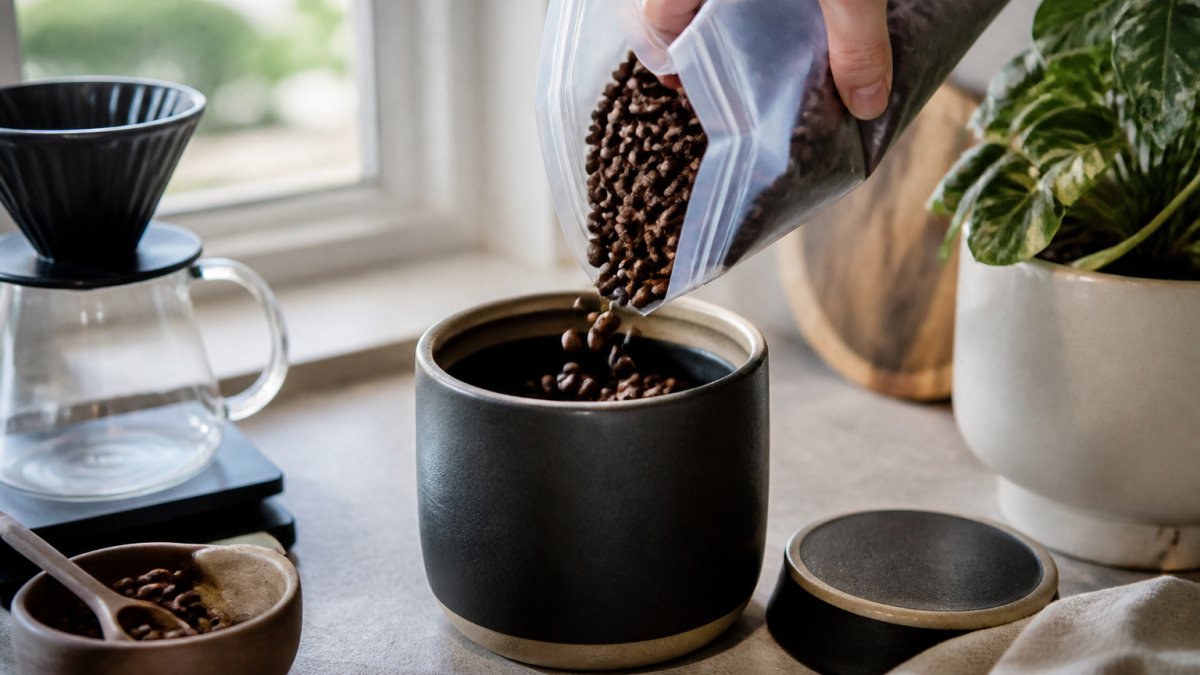
Methods to Revive Stale Coffee Beans
You can't restore lost flavor completely, but you can improve the brew by adjusting your method to extract what remains.
Grinding Stale Beans Fresh
Grind stale beans just before brewing. Grinding hours ahead exposes them to oxygen and accelerates flavor loss.
Use a coarse grind for most methods. Coarse grounds extract slower, masking the flat taste of stale beans, while fine grinds pull out bitterness. Medium-coarse works well for French press or pour-over.
Use a burr grinder if you have one. Consistent particle size matters more with stale beans; blade grinders create uneven pieces that over- and under-extract.
Adjusting Your Brew Method
The brewing method changes how much flavor you extract from stale beans.
Cold brew is your best option for stale beans. The 12-24 hour steep extracts smoothness and masks bitterness without hot brewing's harshness.
French press works well too. Immersion extracts gently, and you control steep time to avoid over-extraction.
Moka pot is trickier, since pressure and heat can amplify bitterness in stale beans.
Avoid espresso machines with stale beans. The pressure forces extraction too fast, pulling out bitterness and thin flavors.
Temperature and Extraction Adjustments
Water temperature affects how much flavor you pull out. Hotter water extracts faster and more aggressively.
For stale beans, use water around 195-200°F instead of the standard 200-205°F. Cooler water extracts more gently, avoiding over-extraction and bitterness.
Adjust your coffee-to-water ratio. Use slightly more beans: if you normally use one ounce per 16 ounces of water, try one ounce per 14 ounces.
Keep brew time shorter. In a pour-over, reduce total brew time by 30 seconds; in a French press, drop from four minutes to three and a half.
Best Way to Brew Stale Coffee Beans
Some brewing methods rescue stale beans better than others.
Cold Brew for Flat Flavor
Cold brew is the best method for stale beans, transforming flat flavor into something smooth and drinkable.
Steps:
- Grind beans coarsely (like breadcrumbs)
- Use a ratio of one ounce of beans per 4 ounces of water
- Pour grounds into a jar or cold brew maker
- Cover with cold or room-temperature water
- Stir once to saturate all grounds
- Seal and let steep for 12-24 hours at room temperature
- Strain through a fine mesh strainer or cheesecloth
- Dilute the concentrate with water or milk before drinking
Cold brew concentrate keeps two weeks in the refrigerator, so you can make a large batch for the week. Stale beans shine here because the long steep pulls out smoothness without bitterness.
The result tastes clean and mild. You lose complexity but gain drinkability, and most people find cold brew from stale beans acceptable, especially with milk or cream.
French Press Method
French press works well for stale beans because you control steep time and can stop extraction before bitterness builds.
Steps:
- Heat water to 195-200°F
- Grind beans medium-coarse (like sea salt)
- Add grounds to the French press (use a 1:16 ratio, one ounce beans to 16 ounces water)
- Pour hot water over grounds and stir
- Place the lid on top but don't press the plunger yet
- Let steep for three and a half minutes
- Press the plunger down slowly over 30 seconds
- Pour immediately into your cup
Stop at three and a half minutes; longer steeps pull out bitterness. Immersion is gentler than pressure-based methods, so you get better flavor than from an espresso machine.
Moka Pot Technique
Moka pots work with stale beans if you adjust the heat and watch carefully.
Steps:
- Fill the bottom chamber with water just below the safety valve
- Add finely ground beans to the filter basket (pack gently, don't tamp)
- Screw the top chamber on tightly
- Place on medium heat (not high)
- Listen for a gentle hissing sound
- Remove from heat immediately when you hear the hiss
- Pour into your cup
The mistake most people make is leaving the moka pot on the heat too long, which pulls out harsh, bitter flavors. Remove it as soon as brewing starts for a milder result.
Moka pots produce strong coffee, so stale beans are less noticeable than in a pour-over or drip machine; the intensity masks some flatness.
What You Cannot Fix: Realistic Limits of Revival
Reviving stale coffee beans has limits. You can improve the brew, but you can't restore what's lost.
What revival can do:
- Make stale beans taste smooth and drinkable
- Reduce harshness and bitterness
- Create acceptable coffee for everyday drinking
- Work well in cold brew or milk-based drinks
What revival cannot do:
- Restore the brightness and complexity of fresh beans
- Bring back lost aroma
- Create the same experience as fresh coffee
- Fix beans that are months old or stored poorly
After four weeks, beans lose most of their character. Beans stored in heat or light degrade faster, and ground beans exposed to air are nearly impossible to salvage because the flavor compounds have oxidized.
Beverly Blend roasts to order, so you always receive beans at peak freshness.
The most realistic approach: use revival methods for beans two to four weeks old, which still have enough flavor to work with.
Are Stale Beans Safe to Use
Yes, stale coffee beans are safe to drink. Staleness is about flavor quality, not food safety.
Coffee beans are low-moisture, shelf-stable foods that don't grow mold or bacteria like fresh produce.
The only real safety concern is mold from moisture. If beans were stored damp, check for visible mold or musty smells.
Stale beans are safe. Moldy beans are not. The difference is storage conditions.
If you're concerned about old beans, brew a small test cup first.
Practical Tips to Prevent Staleness
The best solution is preventing staleness in the first place.
Check the roast date. Always ask when beans were roasted. If a roaster won't tell you, buy elsewhere.
Order from roasters who ship quickly. Beverly Blend roasts to order and ships within days.
Store in airtight containers. Ceramic or glass canisters with tight seals work best.
Grind just before brewing. Whole beans stay fresh longer than ground coffee.
Keep beans cool and dark. Store in a cabinet, not on the counter.
The simplest prevention: order fresh beans regularly.
Stale coffee beans don't have to ruin your morning. Choose a brewing method that works for you, and enjoy the comforting experience of a truly fresh cup. The Specialty Coffee Association provides roasting and freshness guidelines and the National Coffee Association offers brewing recommendations for those who want to dive deeper into coffee science.
Frequently Asked Questions
Can you revive stale coffee beans?
You can improve stale coffee beans through grinding, brewing method adjustments, and extraction changes, but you cannot restore lost aroma or fully recover original flavor. Stale beans lose volatile compounds that give fresh coffee its distinctive taste. Cold brew and French press methods can mask flatness better than drip brewing. However, if beans are months old or improperly stored, revival has limits. The best approach is preventing staleness through proper storage in airtight containers away from heat and light.
How long do whole coffee beans stay fresh after roasting?
Whole coffee beans remain at peak freshness for 2 to 4 weeks after the roast date. Flavor and aroma begin declining after the first week as beans lose volatile compounds through oxidation. After 4 weeks, beans taste noticeably flat and bitter. Ground coffee stales much faster, losing quality within 15 minutes of grinding. Beverly Blend roasts to order, so you receive beans near their peak. Check the roast date on your bag and use beans within this window for the best experience.
How should you store coffee beans to keep them fresh?
Store whole beans in an airtight container away from heat, light, and moisture. Keep them at room temperature, never in the refrigerator or freezer, as temperature fluctuations cause condensation that damages beans. Avoid clear containers; opaque or dark glass works best to block light exposure. Oxygen exposure accelerates staling, so squeeze out air before sealing. Keep beans away from direct sunlight and warm appliances. Properly stored beans maintain quality longer and require less revival effort later.
Does grinding stale coffee beans make them taste fresher?
Grinding stale beans does not restore lost flavor, but it can temporarily improve the brewing experience. Grinding increases surface area, which helps extraction pull more from what remains. However, you lose the benefit immediately after grinding; stale grounds go flat within 15 minutes. The real advantage is using a coarser grind with stale beans to reduce over-extraction, which masks some bitterness. Pair grinding with method adjustments like cold brew or French press for better results than relying on grinding alone.