

Fresh Roasted Coffee vs Store Bought: What's the Difference?
Table of Contents
- Fresh Roasted Coffee vs Store Bought: The Core Difference
- Fresh Roasted Coffee vs Store Bought: At-a-Glance Comparison
- How to Tell if Coffee Beans Are Fresh
- Coffee Bean Shelf Life: The Freshness Window
- The Best Way to Store Coffee Beans
- The Verdict: Which One Should You Buy?
- Frequently Asked Questions
Last Updated: September 5, 2026
Fresh Roasted Coffee vs Store Bought: The Core Difference
The debate over fresh roasted coffee vs store bought comes down to one overlooked factor: time. Once beans leave the roaster, a chemical clock starts ticking that changes everything you taste in the cup (peer-reviewed research). At Beverly Blend, we roast to order specifically because those first days after roasting are when coffee is at its peak, and most grocery store bags have already lost that window before they reach the shelf.
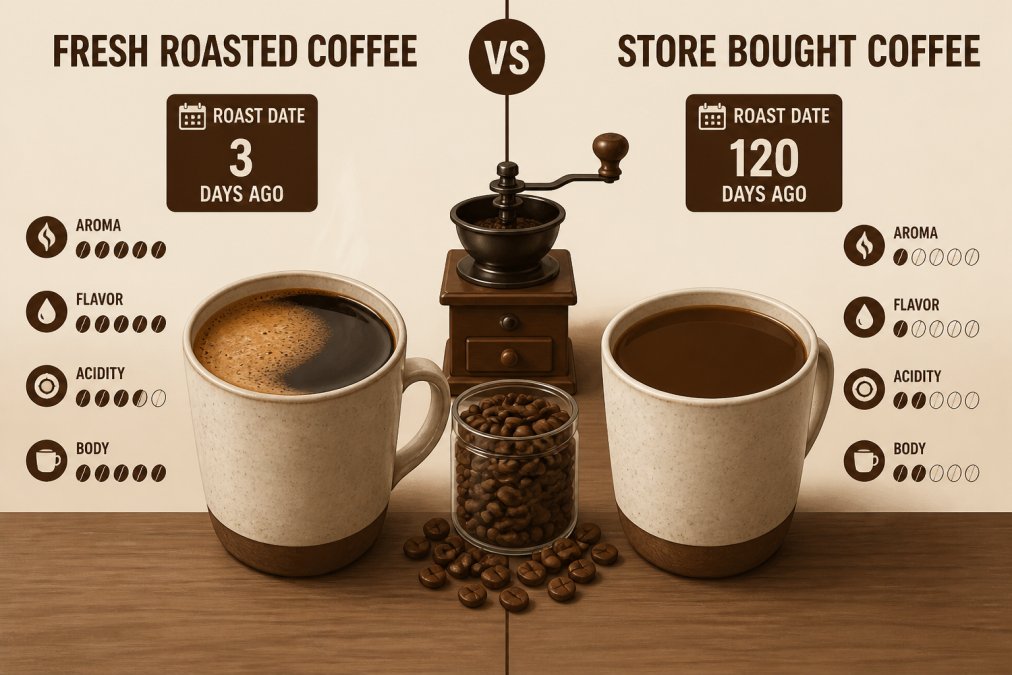
Fresh roasted coffee is roasted within days or weeks of brewing and retains the volatile compounds behind aroma and flavor. Store bought coffee often sits in warehouses and on shelves for months. The difference is not subtle: it is dried orange and chocolate notes versus a flat, papery cup that tastes vaguely of coffee.

Fresh Roasted Coffee vs Store Bought: At-a-Glance Comparison
Before the chemistry, here is the practical breakdown most guides skip.
| Factor | Fresh Roasted | Store Bought |
|---|---|---|
| Roast date | Printed on bag, days ago | Often absent or months old |
| Aroma | Intense, floral, sweet | Muted, flat, sometimes stale |
| CO2 content | High (needs degassing) | Mostly gone |
| Flavor clarity | Bright, distinct origin notes | Blunted, generic |
| Shelf life | 2-4 weeks peak | Months, but flavorless |
| Price per 12 oz | Around $20 | $8-$15 |
Roast Date and the Clock That Starts Ticking
Roast date is the most important piece of information on any bag. If a bag does not list one, the roaster does not want you to know how old it is. Specialty roasters print the date because freshness is their product; commodity brands omit it because their product sits in distribution for months.
Flavor Profile and Aroma: The Sensory Test
Fresh beans release a burst of aroma when you open the bag, a mix of caramel, fruit, and floral notes that fills the room. Stale beans smell flat, sometimes like cardboard or old nuts. During brewing, fresh coffee blooms dramatically as trapped carbon dioxide escapes, while old coffee barely bubbles because its volatile compounds have already oxidized away.
Sourcing and Bean Quality: Single Origin vs Commodity
Coffee quality starts at origin, not at the roaster. Single origin beans from a named farm or cooperative, like the smallholder farmers in Medellin or the Sidama zone in Ethiopia, are grown at altitude in volcanic soil and processed with care. Commodity coffee blends beans from dozens of anonymous sources, prioritizing volume and shelf stability over flavor. You can taste that difference most clearly in acidity and body: fresh single origin coffee has a lively, wine-like brightness, while old commodity blends taste muddy and dull.
How to Tell if Coffee Beans Are Fresh
Most guides stop at "check the roast date," but that only tells you when the bean was roasted, not whether it is at its peak. Freshness is a moving target, and the optimal window depends on the roast profile and processing. Here is how to assess freshness with your own senses.
The Degassing Window: Why Day 3 Beats Day 1
A common misconception is that coffee is best the day after roasting. Beans need time to release trapped CO2, the resting or degassing period. Brewing within the first 48 hours often tastes flat, sour, or overly bright, because escaping CO2 disrupts extraction.
The sweet spot for brewing begins around day 3 and extends through day 14 post-roast, when the bean has degassed enough for even extraction but volatile aromatics are still intact. After day 14, those compounds oxidize and fade, a bag roasted three weeks ago can still taste good, but one roasted three months ago tastes like a memory of coffee.
The Sensory Test: A Simple Home Cupping Protocol
You can run a quick sensory test at home that mirrors professional cupping. It takes about five minutes and requires only a scale, a kettle, and a spoon.
- Grind 10 grams of beans to a medium-coarse consistency, similar to sea salt.
- Smell the dry grounds immediately. Fresh coffee should release a burst of aroma, floral, fruity, nutty, or chocolaty. Stale coffee smells flat, dusty, or vaguely like cardboard.
- Add 150 ml of water just off the boil (around 200°F) and let it sit for four minutes without stirring.
- Break the crust that forms on top with a spoon and smell again. This is the moment when volatile aromatics are most concentrated. A fresh bean will smell sweet and complex; a stale one will smell muted or even sour in an unpleasant way.
- Taste the coffee with a spoon after letting it cool slightly. Focus on acidity and finish. Fresh coffee has a lively, wine-like brightness and a clean finish. Stale coffee tastes flat, papery, or bitter in a hollow way.
This method does not require a professional palate. The difference between a bean roasted 5 days ago and one roasted 6 months ago is dramatic enough that anyone can detect it side by side.
The Squeeze Test and Visual Cues
Beyond cupping, there are physical cues. Fresh whole beans feel dense and firm; stale beans are brittle and break apart easily. Look for a matte surface on light to medium roasts, shiny oil there signals age, as oils migrate out of the cellular structure only over time. Dark roasts are the exception, since oils surface naturally within days, but excessive oil still suggests weeks of sitting.
The One-Way Valve Test
A quality bag of fresh coffee has a one-way valve that lets CO2 escape without letting oxygen in. Squeeze a freshly roasted bag and it should puff back up as CO2 is released. If it stays flat or collapses, the coffee has degassed significantly and is past its peak.
Why Dark Roasts Confuse the Freshness Question
Dark roasts go stale faster than light roasts because the roasting process breaks down the bean's cellular structure, accelerating oxidation (rsc.org). Those shiny oils on dark beans are not a sign of quality, they are a sign that the bean has been roasted long enough to push oils to the surface, which also means oxygen can penetrate more easily. If you prefer dark roasts, buy smaller quantities and drink them faster, ideally within two weeks of the roast date.
Coffee Bean Shelf Life: The Freshness Window
Coffee does not spoil like dairy, but it does stale, and the timeline is shorter than most people assume. Understanding the chemistry behind that timeline is what separates a good cup from a great one.
The Chemistry of Going Stale
Coffee staleness is driven by oxidation and volatile compound loss. Roasting develops hundreds of aromatic compounds, aldehydes, ketones, pyrazines, and sulfur-containing molecules, behind flavors like chocolate, citrus, berry, or caramel. These compounds evaporate at room temperature, and oxygen accelerates their breakdown into flat, papery, or cardboard-like flavors.
Grinding is the fastest way to accelerate staleness (sciencedirect.com). Whole beans have a small exposed surface area; ground coffee increases it by a factor of hundreds, which is why pre-ground coffee loses peak flavor within hours, not days. Whole beans roasted two weeks ago often taste fresher than ground coffee roasted three days ago.
The Resting Period: Why Day 1 Is Not the Peak
Freshly roasted coffee is not immediately at its best. Beans need time to degas, to release CO2 trapped during roasting, a byproduct of the Maillard reaction and caramelization. Brewing the day after roasting lets CO2 interfere with extraction, producing a sour, flat, or overly bright cup.
The optimal degassing window varies by roast level:
- Light roasts: 5 to 14 days post-roast. Light roasts are denser and retain CO2 longer, so they need more rest.
- Medium roasts: 4 to 10 days post-roast. This is the sweet spot for most drinkers.
- Dark roasts: 3 to 7 days post-roast. Dark roasts have a more porous structure, so they degas faster, and also go stale faster.
After the degassing window closes, the bean enters its peak flavor plateau, which lasts roughly until day 21 to day 30 post-roast, depending on storage conditions. After day 30, the decline becomes noticeable even to casual drinkers.
The Role of Packaging in Shelf Life
Packaging is a tool that extends or shortens the freshness window. The one-way valve on specialty bags lets CO2 escape while blocking oxygen, critical because a sealed bag with no valve would balloon and burst as beans degas.
Grocery store coffee is often packaged in foil bags or cans flushed with nitrogen to displace oxygen. This lets it sit on shelves for months without tasting rotten, but it does not preserve volatile aromatics. Nitrogen flushing prevents oxidation but cannot stop volatile evaporation, the result is coffee that is technically not stale but simply neutral.
Storage Conditions That Extend the Window
Storage temperature and light exposure matter more than most realize. Heat accelerates the reactions that degrade flavor compounds; UV light breaks down some of the same compounds; moisture causes beans to lose crisp texture and can promote mold growth.
The ideal storage conditions are:
- Airtight container, preferably the original bag with a one-way valve, or a ceramic or stainless steel canister with a tight seal.
- Room temperature, between 65°F and 75°F. Do not store coffee in the refrigerator, where it absorbs odors and moisture from other foods.
- Dark location, a pantry or cupboard away from direct sunlight.
- Whole beans, grind only what you need immediately before brewing.
The Freezer Question
Freezing works only under specific conditions. Beans must be in an airtight, moisture-proof container, and you should remove them only once, repeated in-and-out causes condensation that degrades them. Freezing is best for beans stored more than a month; for daily drinking, room temperature storage in an airtight container is sufficient.
The Practical Takeaway
The practical rule is simple: buy whole beans with a roast date, use them within 2 to 4 weeks, and store them airtight at room temperature. If you buy from a roaster that ships to order, like Beverly Blend, beans arrive within days of roasting, giving you the full freshness window. If there is no roast date, assume the coffee is past its peak.
The Best Way to Store Coffee Beans
Store whole beans in an airtight, opaque container at room temperature, away from light, heat, and moisture. Avoid the refrigerator, where coffee absorbs odors and moisture, and skip the freezer unless storing for months. Grind only what you need immediately before brewing.
The best container mimics what the roaster used: a bag with a one-way valve that lets CO2 escape while blocking oxygen, the primary driver of staleness. Once opened, press the air out and seal tightly after every use.
The Verdict: Which One Should You Buy?
For daily drinking, fresh roasted coffee wins on every axis that matters: aroma, flavor clarity, and the brewing experience. The price gap is real, roughly $20 for a 12-ounce bag of roasted-to-order single origin versus $10 or less for grocery store bags, but you are paying for beans with volatile compounds intact. The cost per cup difference is small; the flavor difference is enormous.
If you want to experience what fresh roasted coffee actually tastes like, start with a single origin you know. The Colombia medium roast from Beverly Blend, with its dried orange, berry, and chocolate profile, shows how origin character survives when beans are roasted to order. The Ethiopia Natural offers a fruitier, more complex cup from heirloom cultivars grown at 1700-1900 meters. Both are $19.99 per bag, roasted after you order, and shipped fast.
Frequently Asked Questions
Is fresh roasted coffee actually better than store-bought?
Yes, for most people who care about flavor. Fresh roasted coffee, like the single-origin beans from Beverly Blend, is packed with volatile compounds that create its aroma and complex flavor profile. Store-bought coffee often sits on shelves for months, allowing those compounds to fade and the beans to go stale. The difference is clear in the cup: brighter acidity, more pronounced tasting notes, and a richer body.
How long should you wait to drink freshly roasted coffee?
Most roasters recommend waiting 3 to 7 days after the roast date. This is the resting period. During this time, the beans finish degassing, releasing carbon dioxide. Brewing too early can lead to an uneven extraction and flat flavor. For best results, check the roast date on your bag and brew within the first 2 to 4 weeks for the full flavor experience.
How can you tell if coffee beans are truly fresh?
First, look for a roast date, not just a 'best by' date. The roast date should be within the last 2 to 4 weeks. Second, use your senses. Fresh beans have a strong, sweet aroma. They should feel firm and not oily on the outside (unless they are a dark roast). When you pour hot water over them, they should 'bloom' and bubble actively, a sign that they are releasing trapped carbon dioxide.
What is the coffee bean shelf life for roasted coffee?
Roasted coffee beans are best used within 1 to 2 months of their roast date for optimal flavor. While they won't spoil like food, they will go stale as oxygen degrades the oils and compounds inside. After this freshness window, the beans lose their aroma and produce a flat, dull cup. Whole beans stored properly will last longer than pre-ground coffee.
Choosing between fresh roasted coffee and store bought is really a choice about what you value in your morning ritual. If you want maximum flavor and aroma in every cup, roasted-to-order beans from Beverly Blend deliver single origin quality with simple ordering and fast, reliable delivery. Start with a single bag and taste the difference for yourself.
This article was written using GrandRanker