

7 Benefits of Filtered Water for Coffee Brewing
Last Updated: October 29, 2026
Quick Summary
Using filtered water coffee brewing removes chlorine and impurities that flatten aroma while keeping the moderate minerals that extract flavor. Balanced water with roughly 50-100 ppm hardness and near-zero chlorine lets sweetness, acidity and finish come through clearly in the cup.
- Coffee is roughly 98% water, so brewing water shapes flavor before the first sip.
- Aim for roughly 68 ppm total hardness, alkalinity near 40 ppm, and pH around 7.
- Test your water after filtration, since the filter's effect is what actually matters.
- Activated carbon removes chlorine and organics but leaves calcium and magnesium largely intact.
- Straight reverse-osmosis water brews thin coffee, so remineralization is not optional.
Table of Contents
- Why Water Quality Decides How Your Coffee Tastes
- How Water Hardness Affects Coffee Extraction
- Coffee Brewing Water Standards Worth Aiming For
- How Chlorine and Other Impurities Flatten Flavor and Aroma
- Filtered Water vs Tap Water: What Actually Changes in the Cup
- Finding the Best Water Filtration for Coffee
- Protecting Your Machine from Scale Buildup and Costly Repairs
- Brewing with Filtered Water: A Simple Step-by-Step Routine
- Frequently Asked Questions
Why Water Quality Decides How Your Coffee Tastes
Coffee is roughly 98% water, so the benefits of filtered water coffee brewing start long before the first sip. Water is what unlocks the flavor inside coffee beans, brew with the wrong water and you can mute the very qualities you paid for.
Your beans may be excellent and your grinder precise, but if your brewing water carries chlorine, heavy mineral load, or off-notes, the cup will taste flat or harsh. Water is the solvent that pulls soluble compounds from the grounds, change the solvent and you change everything dissolved into your cup.
How Water Hardness Affects Coffee Extraction
Water hardness is the concentration of dissolved calcium and magnesium in your brewing water, and it controls how much flavor material the water can pull from the grounds. Hard water can over-extract and taste chalky; very soft water can under-extract and taste hollow. Balanced water is where coffee tastes like itself.
A common mistake is assuming softer is always better. Distilled or fully stripped water can leave a cup tasting thin and sour because there are too few minerals to bind to the coffee's acids and sugars. Before you change anything, know what you're starting with, a hardware-store hardness test strip tells you more in two minutes than a dozen forum threads.
Calcium, Magnesium, and What They Pull From the Bean
Magnesium binds readily to fruity acids and helps brighter, more complex notes reach the cup, while calcium tends to push toward heavier, chalkier textures when it dominates. The ratio matters as much as the total. Coming from bottled water with a strong mineral profile, expect your first brews with softer filtered water to taste noticeably clearer, sometimes almost delicate.
Coffee Brewing Water Standards Worth Aiming For
Coffee brewing water standards give you a target instead of a guess.
The numbers only help if you can measure them and understand how they interact.
| Parameter | Target range | What it controls | How to test |
|---|---|---|---|
| Total hardness (as CaCO3) | roughly 50-100 ppm | Extraction strength; too low tastes hollow, too high tastes chalky | Hardness test strips or a titration kit |
| Alkalinity (as CaCO3) | roughly 40-70 ppm | Buffering; high alkalinity flattens acidity and mutes brightness | Alkalinity test strips (often sold with hardness strips) |
| pH | roughly 6.5-7.5 | Perceived sourness and stability; extreme pH skews extraction | pH strips or a calibrated meter |
| Chlorine / chloramine | effectively zero | Aroma; chlorine compounds create medicinal off-notes | Chlorine test strips or a total chlorine kit |
| TDS | modest, not near zero | Overall mineral load; near-zero TDS brews thin, lifeless coffee | TDS meter (pen type) |
How the numbers interact. Hardness and alkalinity are not the same measurement, and confusing them is the most common mistake.
A repeatable testing routine. Test your tap water once, then again after filtration, because the filter's effect is what actually matters.
What to do when a reading is off. If hardness is far above target, blend filtered water with distilled or reverse-osmosis water, or choose a filter with a softening stage.
Think of the targets as guardrails: moderate hardness, alkalinity low enough to buffer without flattening acidity, pH near neutral (roughly 6.5 to 7.5), effectively zero chlorine, and modest TDS.
If you want to go deeper on evaluating what lands in your cup, our guide on how to taste coffee like a professional barista walks through the sensory side step by step.
How Chlorine and Other Impurities Flatten Flavor and Aroma
Chlorine is the fastest way to ruin a good bean. Municipal treatment adds it to keep water safe, but chlorine compounds react with coffee's aromatic oils and produce the same medicinal, band-aid notes you'd smell in an over-chlorinated pool. The aroma goes first, then the flavor follows.
Other impurities matter too: sediment and rust add grit, and trace organics contribute musty or earthy off-notes that mask the fruity and floral characteristics you bought the beans for. These faults are invisible in the bag and obvious in the cup.
If flavor clarity is your goal, it helps to start with beans worth protecting. Our guide on how to choose coffee flavor profiles explains how tasting notes and roast levels map to what you actually taste, so you can match your water strategy to the cup you want.
Filtered Water vs Tap Water: What Actually Changes in the Cup
Filtered water vs tap water comes down to what gets removed and what stays. A good carbon filter strips chlorine and many organic compounds while leaving beneficial minerals largely intact. Tap water varies enormously by municipality, so two neighbors on different systems can brew the same beans and get different cups.
What changes in practice:
- Aroma becomes more distinct and identifiable
- Acidity reads as bright rather than sharp or muted
- Sweetness comes forward because it isn't buried under off-notes
- Finish cleans up, with less lingering bitterness
Watch out: not every filter is built for brewing. A basic pitcher filter improves taste, but with very hard source water it may not reduce scale-forming minerals enough to protect an espresso machine. Match the filter to your water report, not the marketing on the box.
Finding the Best Water Filtration for Coffee
The best water filtration for coffee removes chlorine and sediment while preserving a moderate mineral profile. That single sentence rules out a lot of options.
| Method | What It Removes | Mineral Impact | Best For |
|---|---|---|---|
| Activated carbon pitcher | Chlorine, some organics, sediment | Leaves most minerals | Drip, pour-over, low-hardness water |
| Under-sink carbon block | Chlorine, sediment, organics | Leaves most minerals | High-volume home brewing |
| Faucet-mounted carbon filter | Chlorine, sediment, some organics | Leaves most minerals | Renters and small kitchens |
| Reverse osmosis | Nearly everything, including minerals | Strips minerals almost entirely | Very hard or compromised water |
| RO with remineralization | Contaminants, then adds back minerals | Restores calcium and magnesium | Espresso machines, precision brewing |
What each method actually does. Activated carbon works by adsorption: chlorine and many organic compounds bind to the carbon surface as water passes through, making carbon the right tool for the chlorine problem that flattens aroma.
Cartridge life and ongoing cost. Use the manufacturer's rated capacity as a starting point and shorten the interval if your chlorine test shows breakthrough.
When filtered water is not appropriate. Filtration does not always improve water.
For most home brewers, a quality carbon filter is the practical starting point. It's inexpensive, easy to maintain, and solves the chlorine problem that flattens aroma.
The filter cartridge is the part people forget. Replace it on the manufacturer's schedule, and if your water suddenly tastes worse, check the cartridge before you blame the beans.
Reverse Osmosis and Remineralization
Reverse osmosis pushes water through a membrane that rejects most dissolved solids, including the minerals coffee needs. That's why straight RO water brews thin, lifeless coffee. Remineralization fixes it by adding back a controlled amount of calcium and magnesium, either through a cartridge stage or a mineral packet. The result is clean water with a profile you chose rather than one your municipality chose for you.
Protecting Your Machine from Scale Buildup and Costly Repairs
Scale buildup is the quiet killer of coffee equipment. When hard water heats inside a boiler or passes through a shower screen, dissolved calcium and magnesium precipitate out as limescale, insulating heating elements, narrowing flow paths, and eventually causing failures that cost real money to repair.
Espresso machines tend to suffer most because they heat and pressurize water repeatedly; drip brewers and kettles accumulate scale more slowly. Descaling helps, but filtering the water going in is generally the more effective form of prevention.
If you're investing in better brewing, pair clean water with fresh beans. Roast date matters as much as water quality, and the two together do more for your cup than either alone. Fresh roasted coffee subscriptions deliver beans at their peak, complementing your filtered water setup.
Brewing with Filtered Water: A Simple Step-by-Step Routine
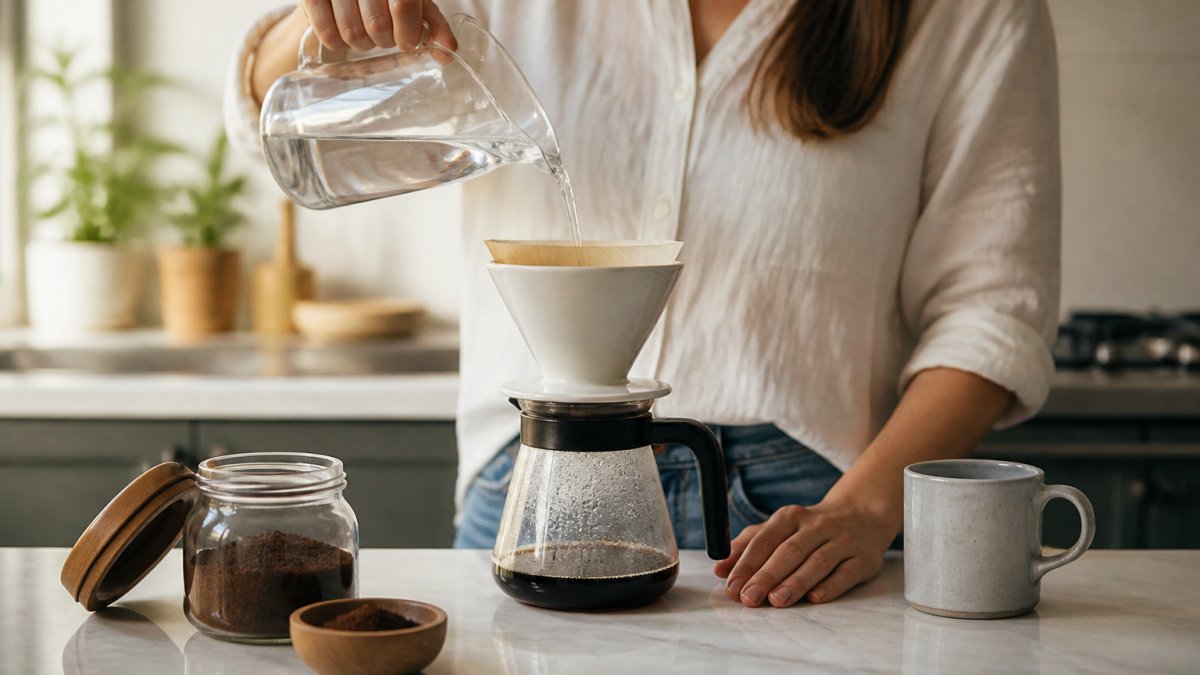
A consistent filtered water coffee routine takes about five minutes to set up and pays off every morning.
- Test your tap water with a hardness strip and check your municipal water quality report.
- Choose your filter based on those results: carbon for chlorine, RO plus remineralization for extreme hardness.
- Fill a dedicated carafe with filtered water and keep it at room temperature for brewing.
- Heat only what you need to your target temperature, generally just off a boil for pour-over.
- Brew with your usual ratio, then taste and adjust.
- Log the result so you can compare against your previous water.
- Replace the cartridge on schedule and note the date.
Expected result: a cleaner aroma, clearer acidity, and a sweeter finish within one or two brews.
Keep your gear clean while you're at it. Our step-by-step guide on how to clean a French Press plunger covers the immersion method, which is the most forgiving way to taste the difference filtered water makes.
Troubleshooting by taste is straightforward. For bean selection, our guide on how to identify quality coffee beans covers roast dates and freshness indicators that matter just as much as water.
Great water removes the obstacles between your beans and your cup, but it can't rescue stale coffee. Beverly Blend roasts to order and offers fast, reliable delivery, so fresh coffee arrives ready to brew.
Frequently Asked Questions
Does using filtered water actually improve the taste of coffee?
Yes, and the reason is simple: coffee is mostly water, so whatever is in the water ends up in the cup. Chlorine and other impurities mask the aromatics that make a freshly roasted bean distinctive, while the wrong mineral levels can push extraction too far or not far enough. Switching to filtered water often makes the biggest difference with light and medium roasts, where delicate fruit and floral notes are easiest to bury. Try brewing the same beans twice, once with tap water and once with filtered, and taste them side by side.
What is the ideal water hardness for brewing coffee?
Most specialty coffee guidance points to water in the range of roughly 50 to 150 ppm total hardness, with alkalinity kept lower than hardness so acids in the coffee are not neutralized. Too soft and the brew tastes flat and thin; too hard and you get chalky, muted flavor plus scale in your machine. A cheap water hardness test strip tells you where your tap water sits, and that number decides whether you need softening, remineralization, or just carbon filtration.
Do I need a specialized water filter for my coffee machine?
Not always, but it depends on your machine and your tap water. A simple activated carbon pitcher filter removes chlorine and improves taste for drip and pour-over setups at low cost. Espresso machines, which heat water under pressure and are prone to scale, usually benefit from a dedicated inline cartridge or a softened, remineralized water supply. Test your water first, then match the filtration to the hardness reading and to how much you have invested in the equipment.
How does water quality impact the longevity of coffee equipment?
Hard water leaves calcium and magnesium deposits, known as scale, on heating elements and inside boilers. Scale insulates the element, so the machine works harder, heats slower, and eventually fails. Descaling helps, but it is a maintenance chore you can largely avoid by brewing with water in the right hardness range. Filter replacement is far cheaper than a repair, so check your cartridge on the schedule the manufacturer gives and do not stretch it past its rated volume.
